CIPD Level 5 Assignment Examples — Associate Diploma in People Management
This page contains fully worked assignment examples for every module in the CIPD Level 5 Associate Diploma in People Management. Examples are organised by pathway — core units, People Management (HR), People Development (L&D), and specialist electives — so you can navigate directly to the module your approved centre has set. Each example is written to the standard required to address all Assessment Criteria at pass or merit grade.
What is the CIPD Level 5 Associate Diploma in People Management?
The CIPD Level 5 Associate Diploma in People Management is an intermediate-level HR qualification designed for practising HR and L&D professionals who need to demonstrate applied theory across employment relations, talent management, reward, and people development. It sits at Level 5 on the Regulated Qualifications Framework (RQF) in England and Wales — equivalent to second-year undergraduate study — and awards Associate CIPD membership (Assoc CIPD) upon successful completion.
The qualification is structured around mandatory core units that all students complete, a pathway choice between People Management (HR-focused) and People Development (L&D-focused), and specialist elective modules that allow further depth in areas such as employment law, wellbeing, or digital learning. A minimum of 120 credits must be achieved. Most students complete between six and eight units in total, depending on their approved centre's programme design.
Assessment at Level 5 is entirely written — there are no examinations. Each unit is assessed through a portfolio of activities structured around scenario-based or case study briefs, with each question mapped to a specific Assessment Criterion (AC). The qualification typically takes 12 to 18 months to complete on a part-time basis. It is recognised by CIPD globally, with particularly strong uptake among HR professionals in the United Kingdom, United Arab Emirates, Saudi Arabia, Ireland, Qatar, and Bahrain.
How CIPD Level 5 Assignments Are Assessed
CIPD Level 5 assignments are assessed against Assessment Criteria (ACs) specified in the unit's assessment brief. Each unit contains between three and five ACs, each subdivided into specific requirements. A pass requires every AC to be addressed with applied examples drawn from a real or scenario-based organisation, with clear connection between HR theory and practice.
A merit grade requires more than description. Markers at Level 5 are specifically looking for critical evaluation: the candidate must compare at least two theoretical perspectives or models, analyse their limitations, and arrive at a reasoned conclusion grounded in evidence. Summarising what a theory says is a pass indicator; evaluating why one approach is more appropriate than another in a specific organisational context is a merit indicator.
Word counts at Level 5 range from 3,000 to 4,500 words per unit, with individual activities within the unit carrying their own sub-limits. Always follow the word count specified in your approved centre's assessment brief — this overrides any general guidance. Referencing is expected but does not need to be academic-journal standard; CIPD reports, HR practitioner publications, and textbooks are all acceptable as evidence sources.
CIPD Level 5 Core Unit Assignment Examples
Three mandatory core units must be completed by all Level 5 students, regardless of pathway. These units establish the strategic and analytical foundations — organisational performance, evidence-based reasoning, and professional behaviour — that underpin every subsequent module.
- 5CO01 — Organisational Performance and Culture in Practice
Covers how internal and external factors shape organisational strategy, the impact of culture on performance, and how changes to structure and employee voice affect organisational outcomes. Commonly assessed through the Chaffinch Group or similar acquisition scenarios. - 5CO02 — Evidence-Based Practice
Covers how to use data, research, and critical thinking to make and communicate people-practice decisions. Requires application of analytical tools and methods to an HR question or challenge. - 5CO03 — Professional Behaviours and Valuing People
Covers the CIPD Profession Map, ethical practice, inclusive approaches to people management, and how to build a culture that values diversity and wellbeing alongside performance.
CIPD Level 5 People Management Pathway Assignment Examples
Students selecting the People Management pathway complete three specialist HR units covering the core operational and strategic functions of an HR generalist or HR Business Partner: employment relations, talent and workforce planning, and reward design.
- 5HR01 — Employment Relationship Management
Covers union and non-union employee voice, psychological contract, conflict resolution, and the legal framework governing employment relations in the UK. - 5HR02 — Talent Management and Workforce Planning
Covers labour market analysis, succession planning, workforce planning models, and strategic positioning in a competitive talent environment. Commonly assessed via the ParcelCare scenario. - 5HR03 — Reward for Performance and Contribution
Covers reward strategy, benchmarking methods, pay structures, and the relationship between reward design and employee motivation and retention.
CIPD Level 5 People Development Pathway Assignment Examples
Students on the People Development pathway study three L&D-specialist units covering learning practice, needs identification, and facilitation — the core functions of an L&D practitioner or training manager operating at associate level.
- 5LD01 — Learning and Development Essentials
Covers the role of L&D in organisational performance, learning theories, design principles, and how to evaluate the effectiveness of learning interventions. - 5LD02 — Identifying Learning and Development Needs
Covers learning needs analysis methods, alignment between L&D strategy and business objectives, and how to prioritise development interventions. - 5LD03 — Learning and Development Facilitation Skills
Covers the skills and techniques required to design and deliver effective learning sessions, manage group dynamics, and evaluate facilitation quality.
CIPD Level 5 Specialist Elective Assignment Examples
In addition to pathway units, Level 5 students select specialist elective modules to deepen expertise in a chosen area. The available electives span employment law, digital learning, wellbeing, diversity, and leadership development. The number of electives required varies by approved centre and programme structure — typically one or two specialist units are included in the qualification design.
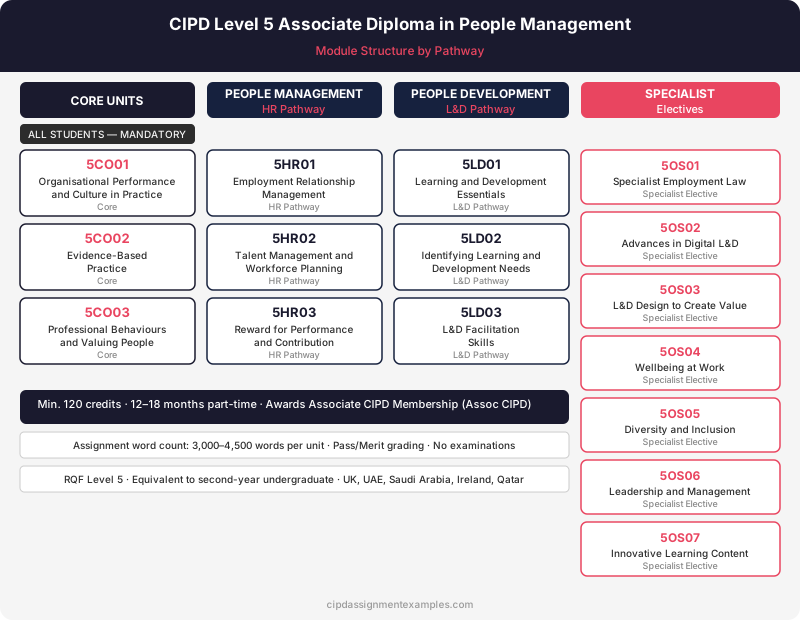
- 5OS01 — Specialist Employment Law
Covers individual and collective employment rights, maternity and parental leave legislation, EU employment law post-Brexit, and the practical application of employment law to HR decision-making. - 5OS02 — Advances in Digital Learning and Development
Covers the application of digital tools, e-learning design, and learning technology in workplace L&D practice. - 5OS03 — Learning and Development Design to Create Value
Covers instructional design principles, blended learning approaches, and how to align L&D design with measurable organisational outcomes. - 5OS04 — Wellbeing at Work
Covers the dimensions of employee wellbeing, the employer's duty of care, wellbeing strategy design, and the link between wellbeing and organisational performance. - 5OS05 — Diversity and Inclusion
Covers the business case for diversity, inclusion frameworks, protected characteristics under the Equality Act 2010, and how to design inclusive people practices. - 5OS06 — Leadership and Management Development
Covers leadership theory, management development interventions, 360-degree feedback, coaching and mentoring as development tools, and succession planning. - 5OS07 — Innovative and Engaging Learning Content
Covers creative content design for learning, gamification, storytelling techniques, and how to produce learning content that sustains engagement beyond initial delivery.
What separates a CIPD Level 5 assignment that passes from one that achieves a merit grade is the quality of evaluation rather than the volume of theory cited. A pass addresses every AC with a relevant example. A merit grade demonstrates that you can weigh competing approaches — two reward frameworks, two employee voice mechanisms, two strategic planning models — and reach a reasoned conclusion based on the specific organisational context. The module-level examples on this site are written to show the analytical depth and AC-mapping precision that merit-standard responses require.
Word Count and Format Guidance for CIPD Level 5 Assignments
CIPD Level 5 assignments are submitted as written portfolios, not essays. Each unit assessment brief specifies individual activities — typically three to five questions per unit — each with its own word limit. Typical ranges by unit type are:
- Core units (5CO01, 5CO02, 5CO03): 3,000–4,500 words across all activities combined. Individual activities within the unit commonly carry limits of 500–1,200 words.
- HR pathway units (5HR01–5HR03): 3,000–4,000 words per unit. Scenario-based activities may require 800–1,500 words to address the AC at merit depth.
- L&D pathway units (5LD01–5LD03): 2,500–4,000 words per unit, depending on the activity design set by your approved centre.
- Specialist electives (5OS01–5OS07): 3,000–4,500 words per unit. The 5OS01 employment law unit typically requires longer responses due to the volume of legislation covered.
Word count limits are set by your approved centre's assessment brief, not by CIPD centrally. If your centre's brief specifies a different range than the above, follow your centre's brief. Exceeding the word count by more than 10% is grounds for a mark penalty at most approved centres.
How CIPD Level 5 Connects to Level 3 and Level 7
The CIPD qualification framework progresses from Foundation through Associate to Advanced. CIPD Level 3 (Foundation Certificate in People Practice) provides the entry point — practical, operationally-focused assignments at A-Level equivalent standard with no requirement for multi-theory analysis or extended word counts. Level 5 builds directly on this by introducing strategic application, scenario-based assessment, and the expectation of theoretical comparison. Every Level 5 core unit has a Level 3 predecessor: 5CO01 builds on 3CO01, 5CO02 builds on 3CO02, and so on.
From Level 5, students may progress to CIPD Level 7 (Advanced Diploma in Strategic People Management) — the post-graduate level qualification that leads to Chartered CIPD membership. Level 7 requires academic referencing standards (Harvard or APA), unit word counts of 5,000–7,500 words, and critical synthesis across multiple theoretical paradigms. Level 5 completion is not a mandatory prerequisite for Level 7, but students who attempt Level 7 without Level 5 foundations typically find the analytical step-change significantly harder to manage.
CIPD Level 5 Assignment Examples — Frequently Asked Questions
What is the difference between CIPD Level 5 and Level 3?
CIPD Level 3 (Foundation Certificate in People Practice) is the entry-level qualification for those new to HR and L&D, equivalent to A-Level standard. CIPD Level 5 (Associate Diploma in People Management) is an intermediate qualification equivalent to second-year undergraduate level, designed for practitioners with HR or L&D experience who need to apply theory to workplace scenarios. Level 5 requires longer assignments (3,000–4,500 words per unit), scenario-based case study responses, and comparison across multiple theoretical frameworks — none of which are required at Level 3.
How many units do you need to complete for CIPD Level 5?
CIPD Level 5 requires a minimum of 120 credits, typically achieved through three mandatory core units (5CO01, 5CO02, 5CO03) plus three pathway units (either HR or L&D) and one or more specialist elective units. The exact combination depends on your approved centre's programme design, but most students complete between 6 and 8 units in total.
What word count is required for CIPD Level 5 assignments?
Word count requirements vary by unit at CIPD Level 5. Core units typically require 3,000–4,500 words per assessment activity. Some activities within a unit carry individual word limits of 500–1,500 words per question. Your approved centre's assessment brief specifies the exact word count for each activity — always follow the brief issued by your centre, not generic guidance.
What is the difference between the People Management and People Development pathways at Level 5?
The People Management pathway (units 5HR01–5HR03) focuses on employment relations, talent management, and reward strategy — the operational and strategic functions of an HR generalist or HR Business Partner. The People Development pathway (units 5LD01–5LD03) focuses on learning and development practice, needs identification, and facilitation — the functions of an L&D practitioner or training manager. Both pathways share the same three mandatory core units (5CO01–5CO03) and draw from the same specialist elective catalogue.
How are CIPD Level 5 assignments marked — what is the difference between pass and merit?
CIPD Level 5 assignments are assessed against Assessment Criteria (ACs) for each unit. A pass requires every AC to be addressed with applied organisational examples and connection to relevant HR theory. A merit grade requires critical evaluation — this means comparing at least two theoretical perspectives, analysing the limitations of each, and drawing evidence-based conclusions rather than describing what the theory says. Markers specifically look for whether you evaluate rather than report.
Can I use these assignment examples as a template for my own submission?
These examples are model answers written to demonstrate structure, depth, and how to address each AC. They show you the standard of analysis required and how to apply theory to a scenario. You must write your own assignment in your own words, applied to your own chosen organisation or the case study specified in your centre's brief. Submitting any example as your own work constitutes academic misconduct under CIPD's Professional Code of Conduct.