7CO03 Personal Effectiveness, Ethics and Business Acumen — CIPD Level 7 Assignment Example
Assignment Example
7CO03 Personal Effectiveness, Ethics and Business Acumen occupies a distinctive position within the CIPD Level 7 Advanced Diploma. Unlike units such as 7CO01 or 7HR01, which focus primarily on external environments and organisational systems, 7CO03 directs analytical attention inward: toward the capabilities, character, and professional conduct of the senior HR practitioner. The unit requires students to apply rigorous theoretical frameworks — from Goleman's emotional intelligence model to French and Raven's power bases to Kantian deontological ethics — to their own professional practice and development, and to engage critically with the ethical dimensions of HR decision-making at senior level. The Level 7 standard requires not merely self-awareness but critical self-evaluation using formal frameworks, the ability to apply competing ethical theories to real HR dilemmas, and the commercial literacy to present people strategy in language that commands board-level credibility. This worked example demonstrates the depth of engagement expected across all five assessment criteria.
AC 1.1 — Personal Effectiveness at Senior HR Level
Daniel Goleman's emotional intelligence (EI) model, first introduced in his 1995 book 'Emotional Intelligence' and subsequently refined in his 1998 Harvard Business Review article 'What Makes a Leader?', identifies five dimensions of emotional intelligence: self-awareness (the ability to recognise one's own emotions and their effects on thinking and behaviour), self-regulation (the ability to manage disruptive emotions and impulses and maintain composure under pressure), motivation (an intrinsic drive to achieve beyond external rewards), empathy (the ability to understand the emotional states of others), and social skill (the ability to manage relationships and build networks effectively). Goleman's research suggested that EI accounted for more variance in leadership effectiveness than technical knowledge or IQ, particularly at senior levels where the cognitive threshold for the role is assumed to have been met and differentiating performance is a function of interpersonal and self-management capability. At Level 7, the critical approach requires not uncritically accepting Goleman's claims: the psychometric validity of EI as a unitary construct has been challenged by researchers including Locke (2005), who argued that the concept is too broad to be meaningfully measured, while others such as Cherniss (2010) have provided meta-analytic support for its predictive validity in leadership contexts.
At senior HR level, self-regulation and empathy are arguably the most critical EI dimensions because of the specific nature of the challenges that HR Directors and CHROs regularly face. Managing large-scale organisational restructuring requires the HR leader to simultaneously hold the strategic rationale for difficult decisions, maintain personal composure in emotionally charged conversations with affected employees, and model the professional conduct that the organisation expects of all its managers. Whistleblowing investigations present a different test: the CHRO may receive disclosures that implicate senior executives or board members, requiring the combination of empathetic listening (ensuring the discloser feels heard and safe) and self-regulation (managing the anxiety and political risk of acting on the disclosure). Board-level conflict — between executive directors, or between the board and management — requires the HR leader to navigate competing interests without being captured by any single faction. In each of these scenarios, the HR professional's personal effectiveness determines whether the organisation's human capital interests are properly served.
The concept of executive presence provides an empirically grounded framework for understanding the visible dimensions of senior professional effectiveness. Amy Cuddy's (2012) research at Harvard Business School identified warmth and competence as the two fundamental dimensions along which people assess and respond to others: leaders who project high warmth and high competence are trusted and respected; those who project only competence are respected but not trusted; those who project neither are dismissed. For HR leaders, warmth — the perception that one cares about others and is fundamentally trustworthy — is particularly important given that employees frequently turn to HR in moments of vulnerability. The CIPD's credibility research (2021) found that HR leaders are most trusted when they combine deep professional expertise with visible business literacy: the combination signals both that they understand people deeply (warmth/care) and that they understand the organisation's commercial context (competence/business acumen). The practical implication is that HR leaders must invest in both dimensions simultaneously — not sacrificing professional values for commercial credibility, nor retreating into HR specialism at the expense of business engagement.
Managing upward — building effective relationships with the CEO, CFO, and board to secure support for people strategy — is one of the most practically important personal effectiveness capabilities for senior HR practitioners, and one of the least well-addressed in traditional HR education. The challenge is fundamentally one of language translation: the data that HR professionals find compelling (engagement survey scores, Kirkpatrick training evaluation levels, 360-degree feedback distributions) are not intrinsically persuasive to finance-trained executives or non-executive directors whose primary frameworks are financial and strategic risk. Effective upward management requires HR leaders to convert their evidence into the language of risk and commercial value: not 'our engagement score fell 6 points' but 'our predicted annual voluntary turnover has increased from 12% to 17%, representing an additional replacement cost of approximately £2.1 million based on average tenure-adjusted replacement cost of £8,000 per role'. Political astuteness — the capacity to understand organisational dynamics, read power relationships, and time interventions effectively — is distinct from but related to personal effectiveness: the HR leader must navigate without becoming politically driven, using political intelligence in service of professional values rather than personal advancement.
AC 1.2 — Political Acumen in Organisations
French and Raven's (1959) taxonomy of social power remains the most widely cited framework in organisational behaviour for analysing the bases from which individuals derive influence over others. The five power bases are: reward power (the ability to provide or withhold valued outcomes such as pay, promotion, or recognition); coercive power (the ability to impose negative consequences such as disciplinary action, demotion, or termination); legitimate power (authority derived from one's formal position in the organisational hierarchy); referent power (influence derived from personal identification — others comply because they admire, respect, or want to be associated with the person); and expert power (influence derived from possessing knowledge or expertise that others lack and need). Raven (1965) subsequently added informational power (influence through the provision of logically compelling information). For HR practitioners, this taxonomy reveals a structural challenge: the CHRO or HR Director typically has limited legitimate power relative to other C-suite members, has coercive power only in the most formal organisational processes, and has reward power that is constrained by governance frameworks. The power bases most available to HR leaders are referent and expert power — and building these is therefore a critical personal effectiveness priority.
Mendelow's stakeholder matrix, which maps stakeholders on axes of interest (in the organisation's actions) and power (to affect outcomes), provides a practical tool for political intelligence in the HR context. High-power, high-interest stakeholders (typically the CEO, board of directors, major investors) require active management: HR strategy must be developed with their priorities explicitly in view, and significant people initiatives must be timed and framed with their perspectives in mind. High-power, low-interest stakeholders (perhaps non-executive directors with specialist portfolio responsibilities) require regular but lower-intensity engagement: sufficient to ensure they remain supportive when issues arise. Low-power, high-interest stakeholders (employees, trade unions, some line managers) require transparency and communication: their views and experiences are important data for HR, but they have limited formal power to block strategic decisions. The analysis changes in specific contexts — a hostile takeover, a significant restructuring, or a union recognition campaign — in which low-power stakeholders may gain substantial leverage. Political acumen means being able to conduct this analysis dynamically and adjust engagement strategies accordingly.
Coalition building — the process of identifying and cultivating allies who will support people initiatives before they reach the point of formal decision — is a fundamental political skill for HR leaders seeking to influence without formal authority. In practice, this means engaging CFOs in workforce analytics projects before presenting them as strategic proposals, briefing sympathetic non-executive directors on people risks before board meetings, and developing relationships with line managers who will champion culture change initiatives in their own teams. The CHRO's unique position — at the intersection of business strategy and employee advocacy — creates both political opportunity and political risk. The opportunity is that HR has access to information across the organisation that other functions do not: employee sentiment, leadership capability assessments, retention risk profiles, and the informal social dynamics of the organisation. The risk is that this access creates expectations of confidentiality that can conflict with political alliance-building. Managing the CEO relationship is particularly complex: the HR Director must be honest about people risks and organisational climate even when those assessments are unwelcome, while maintaining the trust that enables the CEO to share strategic thinking candidly.
AC 2.1 — Ethical Frameworks for HR Decision-Making
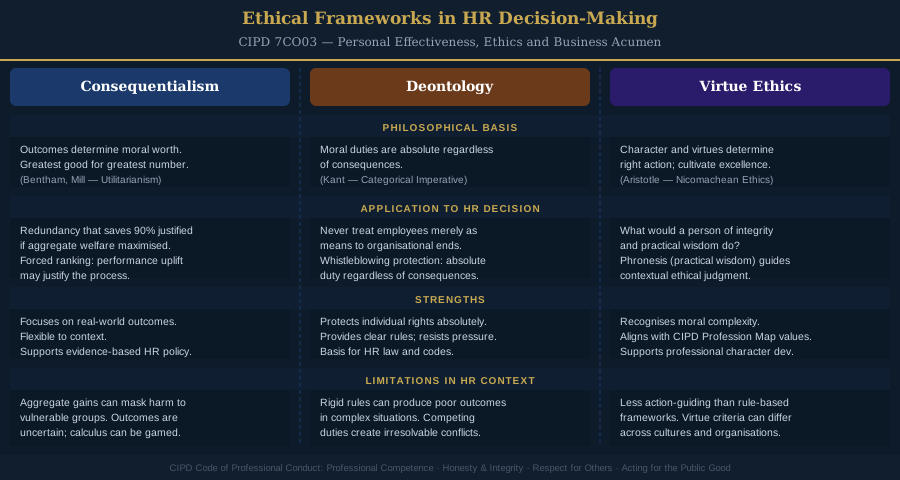
Consequentialism, in its utilitarian form as developed by Jeremy Bentham and John Stuart Mill, evaluates the moral worth of actions by their outcomes: the morally right action is that which produces the greatest good for the greatest number of people affected. Applied to HR decision-making, the utilitarian calculus asks: what are the likely outcomes for all affected parties if this course of action is taken, and does this option produce better aggregate outcomes than the available alternatives? A large-scale organisational restructuring that eliminates 300 roles but secures the employment of the remaining 1,200 workers and the long-term viability of the organisation might be justified on consequentialist grounds: the harm suffered by 300 workers, though real and significant, is outweighed by the benefit secured for 1,200 and by the welfare of the communities and other stakeholders who depend on the organisation's survival. However, the utilitarian calculus at Level 7 must engage with distributional justice questions: aggregate welfare maximisation can mask unacceptable concentrations of harm on vulnerable groups. Rawls's difference principle — that inequalities are just only if they benefit the least advantaged members of society — provides a corrective lens to pure utilitarianism that is increasingly influential in applied HR ethics.
Deontological ethics, associated primarily with Immanuel Kant's moral philosophy, judges actions not by their outcomes but by whether they conform to universal moral duties — categorical imperatives that hold regardless of consequences. Kant's first formulation of the categorical imperative — 'act only according to that maxim whereby you can at the same time will that it should become a universal law' — demands that actions be evaluated by whether they could be consistently universalised: if an action is only justifiable by reference to its particular benefits to a specific actor, it fails the deontological test. Kant's second formulation — 'act so that you treat humanity, whether in your own person or in that of another, always as an end and never as a means only' — is directly relevant to HR practice: it prohibits treating employees merely as instruments of organisational production, a prohibition with implications for performance management, contract design, surveillance practices, and the treatment of workers made redundant through restructuring. Whistleblowing protection illustrates the deontological dimension clearly: a Kantian analysis holds that the organisation has an absolute duty to protect employees who report illegal or unethical behaviour, regardless of the commercial inconvenience or reputational risk that the disclosure creates.
Virtue ethics, rooted in Aristotle's Nicomachean Ethics and experiencing a contemporary revival through the work of Alasdair MacIntyre and Martha Nussbaum, evaluates moral questions by reference to character rather than rules or outcomes. The virtuous person, in the Aristotelian tradition, is one who has cultivated the dispositional excellences — courage, honesty, practical wisdom (phronesis), justice, temperance — that enable them to flourish and to act well in the full range of human situations. For HR ethics, virtue ethics shifts the question from 'what rule applies here?' or 'what outcome does this produce?' to 'what would a person of integrity and practical wisdom do in this situation?'. The CIPD Profession Map's emphasis on values and professional behaviours — particularly 'principle-led' as a core behaviour — aligns more closely with virtue ethics than with either rule-following deontology or outcome-calculating utilitarianism. Importantly, phronesis — practical wisdom — recognises that ethical decision-making in complex organisations requires judgment that cannot be reduced to algorithmic rule-following: the skilled HR professional must be able to read the particular features of a situation and apply general ethical principles with appropriate flexibility.
Applying the three frameworks to specific HR dilemmas reveals their complementarity and their tensions. Consider forced ranking, or 'vitality curve', performance management — the practice, associated with Jack Welch's General Electric, of annually identifying the top 20%, middle 70%, and bottom 10% of performers and consistently managing out the lowest category. The consequentialist case for forced ranking emphasises aggregate performance uplift and the talent management benefit of concentrated investment in high performers. The deontological concern is that the practice treats employees in the bottom category as means to an organisational end — their development and welfare are systematically subordinated to the statistical requirements of the distribution. The virtue ethics critique focuses on the incompatibility of the practice with trustworthiness and fairness as organisational virtues: when employees know that a predetermined proportion of them will be classified as low performers regardless of absolute performance level, the motivational and relational trust on which good work depends is systematically undermined. Meta-analytic evidence (Scullen et al., 2005) suggests that forced ranking systems increase voluntary turnover among valued employees who fear misclassification, creating a perverse outcome even by consequentialist standards.
Data privacy in HR analytics provides a second illuminating case for the application of ethical frameworks. The growing capacity of HR data systems to monitor employee behaviour — keyboard activity, email metadata, location tracking, sentiment analysis — creates powerful consequentialist arguments: early identification of disengagement, burnout risk prediction, and productivity analytics can enable more timely and targeted management interventions. However, GDPR constitutes a deontological constraint on these consequentialist data uses: the Regulation establishes data minimisation (collecting only what is necessary), purpose limitation (using data only for the purpose for which it was collected), and transparency (informing data subjects of how their data will be used) as absolute requirements that cannot be waived on grounds of organisational benefit. The virtue ethics perspective asks a different question: is the kind of organisation we want to be one that monitors employees in this way? — and notes that high levels of surveillance are typically associated with low-trust organisational cultures that are themselves correlated with poor employee wellbeing and performance outcomes. The Level 7 student is expected to work through all three frameworks systematically rather than defaulting to compliance with the legal minimum.
AC 2.2 — CIPD Code of Professional Conduct
The CIPD Code of Professional Conduct articulates four principles that govern the professional obligations of CIPD members: professional competence and honesty (the obligation to maintain the knowledge and skills required for professional practice and to be transparent about the boundaries of that competence); honesty and integrity (the obligation to be straightforward, transparent, and trustworthy in all professional dealings); respect for others (the obligation to treat all people fairly, with dignity, and without discrimination); and acting for the public good (the obligation not to allow organisational or personal interests to override obligations to broader society, including obligations to employees, to labour market participants, and to the profession itself). These principles create specific and sometimes demanding obligations in practice. The Code is not merely aspirational guidance: CIPD membership is conditional on adherence to it, and the CIPD operates a professional conduct process through which complaints of Code violations may be investigated and membership sanctions applied.
The Code's application in specific scenarios reveals the professional courage it requires. Consider a senior HR professional who becomes aware, in the course of their normal role, that a manager is systematically misrepresenting performance appraisal ratings for members of a protected characteristic group — constituting indirect discrimination under the Equality Act 2010. The Code's honesty and integrity principle creates an obligation to investigate and act on this information regardless of the seniority of the manager concerned or the organisational political consequences. The principle of acting for the public good creates an additional obligation: the HR professional cannot allow awareness of unlawful behaviour to remain unaddressed simply because addressing it is commercially inconvenient. The tension between confidentiality obligations (the HR professional may have received this information in a confidential context) and the obligation to prevent ongoing harm requires careful navigation: the CIPD Code acknowledges this tension and does not resolve it with a simple rule, requiring instead the exercise of professional judgment guided by the Code's principles. Speaking up to the board or CEO when organisational decisions are ethically problematic — professional courage — is explicitly positioned in the Code as a professional obligation rather than an optional virtue.
Conflicts of interest — situations in which the HR professional's personal interests or loyalties could compromise their professional judgment or objectivity — represent one of the most common and least discussed Code application scenarios. An HR Director who has a personal financial interest in a supplier under consideration for an outsourcing contract, who is in a personal relationship with a candidate under consideration for a promotion, or who has been offered post-employment consultancy work by a business unit leader whose interests they are currently required to evaluate objectively — in each of these situations, the Code requires disclosure and, in most circumstances, recusal. The difficulty is that organisational culture frequently discourages disclosure of conflicts of interest as personally embarrassing or professionally damaging; the Code's expectation of transparency runs against organisational incentives toward non-disclosure. CIPD professional development in this area must therefore focus not only on what the Code requires but on building the personal confidence and organisational environment in which Code compliance is supported rather than penalised.
AC 3.1 — Commercial Acumen for HR Leaders
Financial literacy is a prerequisite for commercial credibility as a senior HR professional. At minimum, this requires the ability to read and interpret a profit and loss account: understanding how revenue flows to gross profit (after direct costs), operating profit or EBITDA (after indirect costs including people costs), and net profit (after finance costs and taxation). Labour cost as a percentage of revenue — typically ranging from 20-30% in manufacturing to 60-70% in professional and care services — is the key metric that frames all people investment decisions in commercial terms. When an HR Director proposes a new talent acquisition programme, the financially literate CFO will ask what return on investment the programme generates: how does the cost of the programme compare to the value created through improved hiring quality, reduced time-to-productivity, or reduced vacancy costs? Being unable to answer this question in the CFO's language is not merely a communication failure; it signals a fundamental misunderstanding of how commercial organisations make investment decisions, and it positions HR as a cost centre rather than a value creator.
The economics of people decisions are more calculable than is often assumed. Turnover cost modelling illustrates this: the CIPD puts the average cost of replacing an employee at between £3,000 for an entry-level role and £30,000 or more for a senior professional, with replacement cost comprising recruitment fees or advertising, interviewer time, onboarding cost, and the productivity gap during the time-to-competence period for the new hire. If an organisation with 500 professional employees experiences 15% annual voluntary turnover (75 departures), and the average replacement cost is £12,000, the annual turnover cost is £900,000. An HR Director presenting a retention programme costing £80,000 per year — comprising manager coaching, wellbeing investment, and career development conversations — that reduces turnover by 20% (from 75 to 60 departures per year), thereby saving £180,000 in replacement costs, can present an ROI of 2.25:1. This is not sophisticated modelling; it is basic commercial reasoning. The failure to do it is a choice that consistently undermines HR's strategic credibility. At the strategic level, people risk — encompassing skills shortage risk, key person dependency risk, culture risk, and employment law liability risk — belongs on the organisational risk register alongside financial and operational risks, and the HR Director is responsible for quantifying and presenting it in those terms.
Business strategy literacy — understanding the organisation's competitive positioning, business model, revenue drivers, and strategic threats — is the broader commercial competence that enables strategic HR rather than merely reactive HR administration. An HR Director who does not understand why the organisation's margin is under pressure, which product lines or customer segments are growing and which are declining, or what the strategic plan requires in terms of capability for the next three years, cannot design a people strategy that is genuinely aligned with business needs rather than a projection of HR preferences and best practices. Porter's (1980) generic strategy framework — cost leadership, differentiation, focus — has direct HR implications: cost leadership strategies require efficiency-oriented people practices (standardisation, productivity management, careful headcount management), while differentiation strategies require innovation-oriented practices (creative talent, investment in learning, tolerance of experimentation). The CIPD's research consistently shows that strategic alignment between people strategy and business strategy is the highest correlate of HR's perceived contribution by CEOs, yet it is also the capability gap most frequently identified in HR leaders.
AC 3.2 — Building HR Credibility and Evidence-Based Influence
HR's credibility deficit — the perception, frequently expressed in CEO surveys, that HR is too administrative, too compliance-focused, and insufficiently commercially oriented — has been a recurring theme in the profession's self-analysis since the publication of Ulrich's (1997) 'Human Resource Champions'. Dave Ulrich and his colleagues have, through successive editions of the 'HR Competency Study', identified the combination of capabilities that predict HR's perceived contribution to organisational effectiveness: technical HR mastery (deep knowledge of the people practice domain), strategic positioning (understanding business context and priorities), change leadership (the ability to lead organisational transformation), stakeholder credibility (the ability to build trust with diverse organisational stakeholders), and data literacy (the ability to use evidence to support decisions and evaluate interventions). Of these, stakeholder credibility and data literacy are the areas where practitioners most frequently identify development needs, and they are also the areas most directly addressed by 7CO03. Credibility is earned incrementally through a track record of reliable delivery, honest assessment, and consistently commercial communication — and it can be destroyed rapidly through a single instance of professional misconduct, misrepresentation, or failure to deliver on commitments.
Communicating people data to board-level audiences requires a specific translation capability. The board is primarily concerned with strategic risk and the deployment of capital; board members are not typically motivated by HR process metrics or activity counts. The translation principle is straightforward: every people metric must be connected to a business outcome. Employee engagement scores are meaningful to a board only when they are connected to turnover rates, absence rates, or productivity measures that have documented links to financial performance. Skills gap analysis is relevant to board members only when it is framed in terms of the strategic capability the organisation needs to execute its three-year plan and the financial and competitive risk of the gap remaining unfilled. The CIPD Profession Map's 'insights-focused' core behaviour — described as using 'evidence and data to generate actionable insights' — provides the professional framework for this translation work, but translating the capability into practice requires iterative development of the skill and ongoing feedback from board members about what they find persuasive.
Thought leadership and professional network engagement represent credibility-building activities that extend beyond the employing organisation. CIPD Fellow and Chartered Member designations signal commitment to professional standards and ongoing development; participation in CIPD networks, branch events, and policy consultations positions the practitioner as a contributor to the profession's body of knowledge rather than merely a consumer of it. Ulrich et al.'s research suggests that HR leaders who maintain active external networks are perceived as more credible by their boards because they bring external benchmarking data, sectoral intelligence, and emerging practice perspectives that purely internally-focused practitioners cannot offer. Influencing without formal authority — the central political challenge of the HR Director role — is most effectively accomplished by combining demonstrated commercial acumen (earning the right to a seat at the strategic table), a track record of evidence-based recommendations that have proved correct, and a professional reputation for integrity that makes the HR Director's assessments worthy of trust even when they are uncomfortable for the organisation to hear.
Reading This Page in the Context of the Level 7 Programme
7CO03 is the unit that most directly addresses the professional identity and personal development of the senior HR practitioner. Where other Level 7 units develop knowledge about HR domains (employment relations, reward, learning and development), 7CO03 develops knowledge about the self as a professional agent. The ethical frameworks introduced here — consequentialism, deontology, virtue ethics — recur across the programme: the ethics of redundancy selection in 7HR01, the ethics of performance-related pay design in 7HR02, and the ethics of organisational research in 7CO04 all benefit from the analytical vocabulary established in 7CO03. The commercial acumen developed here is the prerequisite for strategic credibility in every other unit. Students should treat 7CO03 not as a peripheral professional development unit but as the foundation for the professional identity they are building throughout the Level 7 programme and the early stages of a senior HR career.
7CO03 vs Level 5 Equivalent — What Changes at Level 7
| Dimension | Level 5 (5CO03) | Level 7 — 7CO03 |
|---|---|---|
| Ethical analysis | Identify ethical considerations in specific HR scenarios; apply CIPD values | Critically apply consequentialist, deontological, and virtue ethics frameworks to complex HR dilemmas; acknowledge framework tensions and justify a reasoned position |
| Self-reflection | Reflect on professional behaviours using the CIPD Profession Map; identify development needs | Critically evaluate own emotional intelligence and political acumen using formal frameworks (Goleman, French and Raven); produce a evidence-based development plan with SMART objectives |
| Commercial literacy | Demonstrate awareness of business context and the importance of commercial considerations | Apply financial literacy to specific people investment decisions; model ROI; present people strategy in board-level commercial language; understand strategic risk frameworks |
| Influence | Build relationships and communicate effectively with stakeholders | Analyse and build power bases (referent/expert power); use stakeholder mapping; deploy political intelligence in service of professional values; build strategic alliances for people initiatives |
| Code application | Understand the CIPD Code of Professional Conduct; identify when it applies | Apply the Code to complex scenarios involving competing obligations; demonstrate professional courage; manage conflicts of interest; articulate obligations to the public good |