7CO01 Work and Working Lives in a Changing Business Environment — CIPD Level 7 Assignment Example
Assignment Example
7CO01 Work and Working Lives in a Changing Business Environment is a core unit of the CIPD Level 7 Advanced Diploma in Strategic People Management. It situates the people profession within the macro-environment of contemporary work: the economic, technological, demographic, and regulatory forces that are fundamentally reshaping employment relationships, labour markets, and the strategic context in which HR operates. Where the Level 5 equivalent (5CO01) introduces students to environmental frameworks such as PESTLE, 7CO01 demands critical engagement with empirical evidence, contested theoretical debates, and the strategic implications of structural change for senior HR practice. This worked example demonstrates the analytical depth, citation standard, and critical evaluation expected at post-graduate level across all six assessment criteria.
AC 1.1 — Globalisation Trends and Implications for People Professionals
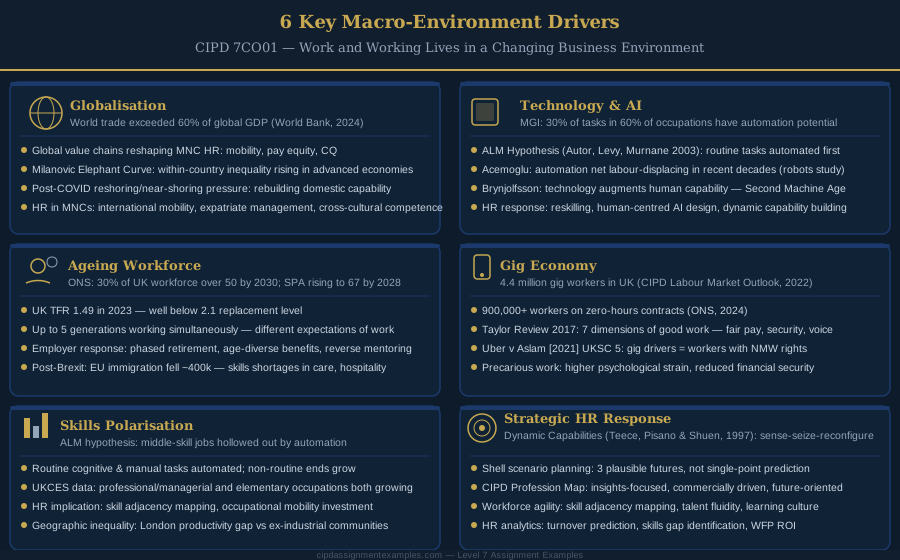
Globalisation — the progressive integration of national economies through trade, investment, capital flows, and the movement of people — has been the dominant structural force shaping work and labour markets since the post-war liberalisation of the 1940s and 1950s. World trade as a percentage of global GDP exceeded 60% by 2023 (World Bank, 2024), a figure that reflects not only growth in merchandise trade but the globalisation of services, financial flows, and the organisation of production through multinational corporations and global value chains. The emergence of GVCs — in which design, component manufacture, assembly, and distribution are distributed across different countries within a single production system — has fundamentally changed the geography of employment and the governance of work. Apple's iPhone is the archetype: designed in California, with components sourced from Japan, Taiwan, South Korea, and Germany, assembled in China, and distributed globally. The HR implications of GVC participation extend from global mobility and international employment frameworks to supply chain labour standards and the governance of employment conditions beyond the immediate employer.
The distributional consequences of globalisation require critical examination at Level 7. Branko Milanovic's Elephant Curve analysis (Milanovic, 2016), derived from global household income data spanning 1988 to 2008, shows that the incomes of the global middle — workers in developing economies, particularly China and South and East Asia — increased substantially, while the incomes of the working and lower-middle classes in advanced economies stagnated or fell. The curve's trunk — a sharp decline in income growth for those around the 80th percentile of the global distribution, who are the lower-middle class in rich countries — has been cited as evidence of globalisation's contribution to growing within-country inequality in high-income states, notwithstanding its reduction of between-country inequality at the global level. For people professionals in UK organisations, this distributional analysis matters because it shapes the political and regulatory environment: rising inequality within advanced economies has fuelled political pressures for trade protection, immigration restriction, and domestic content requirements.
Multinational corporations present specific and complex HR challenges. International mobility — the deployment of employees across national boundaries through expatriate assignments, intracompany transfers, and increasingly virtual international working — requires HR practitioners to navigate competing employment law jurisdictions, social security and pension portability issues, tax treaty frameworks, and the practical challenges of cultural adaptation and family relocation. Global pay equity — the obligation to ensure pay is not discriminatory across national operations — has become a growing governance requirement, with some MNCs extending gender pay gap reporting across all national subsidiaries. Cross-cultural competence, once treated as a soft skill, is increasingly recognised as a strategic capability: research by Earley and Mosakowski (2004) on Cultural Intelligence (CQ) identifies cognitive, motivational, and behavioural dimensions of intercultural effectiveness that can be developed through structured training and experience. The strategic HR function in an MNC must ensure that international assignments are managed as talent development investments rather than operational necessities, with defined repatriation and career pathways to retain knowledge generated through international exposure.
The post-COVID period has introduced significant counter-pressure to globalisation in the form of deglobalisation risk and reshoring. Supply chain disruptions during the pandemic — particularly in semiconductor components, pharmaceutical active ingredients, and personal protective equipment — exposed the fragility of highly optimised global supply chains and prompted governments and corporations to reassess geographic diversification in sourcing and production. Near-shoring (relocating supply chains to geographically proximate countries) and reshoring (bringing production back to domestic locations) have both accelerated. For people professionals, this creates a new strategic challenge: rebuilding domestic manufacturing capability requires skills that have atrophied over decades of deindustrialisation. The strategic HR response involves working with governments and education providers on apprenticeship and vocational training pipelines, engaging with workforce planning to anticipate capability gaps, and designing retention strategies for specialist technical roles in sectors where supply is constrained. The critical evaluation at Level 7 requires noting that reshoring is neither straightforward nor universally desirable: domestic production costs are typically higher, and the environmental footprint of manufacturing changes significantly when production location changes.
AC 1.2 — Technological Disruption and the Future of Work
Automation has transformed work in successive waves throughout industrial history, from the mechanisation of agricultural labour in the eighteenth century, through the application of steam and later electrical power to manufacturing, to the computerisation of routine clerical and manufacturing work in the late twentieth century. The installation of ATMs beginning in the 1970s is a canonical example frequently cited in the literature: despite predictions that they would eliminate bank teller employment, teller numbers initially grew because ATMs reduced the cost of running a bank branch, enabling branch network expansion and growth in demand for human-delivered financial services. This pattern — in which technology augments human labour and creates new categories of employment even while displacing specific tasks — has characterised most technological transitions. The critical question for the current period of AI-driven automation is whether the pattern holds: whether large language models, robotics, and machine vision represent a qualitative break from previous automation waves or an acceleration of the same long-run transition.
The McKinsey Global Institute (2023) estimated that 30% of tasks across 60% of occupations have the technical potential for automation using current or near-current technology, though they distinguish carefully between technical potential and actual adoption, which depends on cost, regulation, social acceptability, and organisational inertia. This distributional analysis is important: the tasks most susceptible to automation are structured, data-rich, and rule-governed, which describes large portions of professional services work — legal document review, radiological image interpretation, financial analysis — as well as the production and logistics tasks that were the target of previous automation waves. The potential disruption to knowledge work is structurally different from previous automation in that it affects workers who previously had reason to believe their educational qualifications provided protection from displacement. For HR practitioners, the policy implication is that reskilling strategies cannot focus solely on lower-skill workers; the transition challenge may be most acute for mid-career professionals in occupations that will be substantially restructured.
The academic debate between Daron Acemoglu (MIT) and Erik Brynjolfsson on automation and labour markets is directly relevant to 7CO01 at Level 7. Acemoglu and Restrepo (2020) argue, using plant-level and local labour market data from the introduction of industrial robots in the United States, that automation has been net labour-displacing in recent decades: the labour-saving effect of automation has outweighed the compensating employment creation effect through productivity growth and new task generation. They estimate that one additional robot per 1,000 workers reduces employment by approximately 0.2 percentage points and wages by 0.42 percentage points in affected commuting zones. Brynjolfsson and McAfee (2014), by contrast, argue in 'The Second Machine Age' that digital technology augments human capability and, over the long run, creates more work than it destroys through productivity-driven wealth creation and the emergence of new industries. The critical insight for Level 7 analysis is that both perspectives can be simultaneously true at different time horizons and for different worker groups: the transition costs fall disproportionately on specific communities, occupational groups, and generations even if aggregate long-run effects are positive.
David Autor, Frank Levy, and Richard Murnane's Routine Task Intensity (ALM) hypothesis, first set out in their 2003 Quarterly Journal of Economics paper, provides the most influential theoretical framework for analysing the distributional effects of automation on occupational structure. The ALM hypothesis distinguishes between routine cognitive tasks (bookkeeping, data entry, formulaic analysis), routine manual tasks (assembly line work, machine operation), non-routine cognitive tasks (strategic planning, creative problem-solving, complex interpersonal work), and non-routine manual tasks (care work, cleaning, driving). Automation disproportionately affects the routine categories, which cluster in the middle of the wage and skill distribution. The consequence is skill polarisation: growth at both the high-skill, high-wage end (non-routine cognitive work) and the low-skill, low-wage end (non-routine manual work), with the middle being hollowed out. UK labour market data from the Office for National Statistics confirms this pattern: professional and managerial occupations and elementary service occupations have both grown as shares of total employment since the 1990s, while skilled trades and clerical occupations have contracted. For HR practitioners, the ALM framework provides a structured basis for workforce planning: mapping existing role portfolios against task routine intensity to identify which occupations are most at risk and designing reskilling pathways toward high-value non-routine cognitive work.
Platform economy employment represents a new organisational form created by digital technology that does not fit comfortably within traditional employment law categories. Companies including Uber, Deliveroo, TaskRabbit, and Upwork use digital matching platforms to connect workers with customers, defining the relationship as one between independent contractors and self-employed service providers rather than as employment. This classification has significant implications for workers: independent contractors are not entitled to the National Living Wage, statutory sick pay, holiday pay, employer pension contributions, or unfair dismissal protection. The platform economy has grown rapidly: the CIPD (2022) estimated that approximately 4.4 million people in the UK undertake gig work as their primary or secondary income source. HR practitioners in client organisations using platform labour must navigate questions of governance, quality assurance, and the management of people who are not legally employees. Those working within platform organisations themselves face the challenge that the prevailing business model depends on the independent contractor classification, creating structural tension between worker welfare and commercial viability.
AC 2.1 — Demographic Trends and Workforce Change
The UK's demographic profile is undergoing structural transformation with profound implications for workforce composition, labour supply, and the design of people management practices. The Office for National Statistics projects that approximately 30% of the UK workforce will be aged over 50 by 2030, reflecting both the ageing of the baby boomer generation and the rise in the State Pension Age — set to reach 67 for both men and women by 2028, with further rises to 68 under current legislation. The UK total fertility rate fell to 1.49 in 2023, well below the replacement level of 2.1, meaning that natural population growth cannot sustain labour supply growth without immigration. These demographic dynamics create a structural labour supply constraint that will intensify over the coming decade and require both policy responses from government and strategic responses from employers in the form of retention of older workers, flexible working arrangements, and productivity investment.
The multigenerational workforce presents both management challenges and opportunities. For the first time in many organisations, up to five generations — Silent Generation (pre-1946), Baby Boomers (1946–1964), Generation X (1965–1980), Millennials (1981–1996), and Generation Z (1997–2012) — may be working simultaneously, though in practice the Silent Generation are largely retired and the multigenerational challenge is most acute in the overlap of Boomers, Generation X, Millennials, and Gen Z. Generational theory is contested: Twenge (2017) argues for significant cohort-based differences in values, expectations, and work orientations, while Costanza et al. (2012) review the empirical evidence and conclude that generational effects are largely methodological artefacts rather than genuine cohort differences when age and life-stage effects are controlled. At Level 7, the critical approach is to engage with this empirical debate rather than uncritically apply generational stereotypes. What is well-evidenced is that workers at different life stages have different priorities: older workers typically value flexibility, phased retirement options, and the opportunity to contribute through mentoring and knowledge transfer; younger workers entering the labour market post-pandemic have recalibrated expectations around remote work availability, career development velocity, and organisational purpose alignment.
International migration has been a critical driver of UK labour market dynamics, particularly in sectors characterised by skills shortages and difficult working conditions. Pre-Brexit, the free movement of EU citizens provided a flexible and substantial labour supply for UK employers in health and social care, agriculture, food processing, construction, and hospitality. Post-Brexit restriction of EU immigration — replaced by the UK points-based immigration system from January 2021 — has contributed to acute labour shortages in these sectors. The number of EU-born workers in the UK fell from a peak of approximately 2.4 million in 2017 to around 2.0 million by 2022 (ONS, 2023). For people professionals in affected sectors, the post-Brexit immigration landscape requires proactive workforce planning: domestic recruitment pipelines, apprenticeship investment, and in some cases salary increases to attract UK-born workers into roles previously filled by EU migrants. The ethical dimension of labour migration — the 'brain drain' effect on sending countries in Eastern Europe, whose health and care systems are weakened by the outmigration of trained professionals — is a systemic concern that people professionals operating at the strategic level should be able to articulate.
AC 2.2 — Precarious Work, the Gig Economy and Worker Wellbeing
The concept of 'good work' provides the normative framework through which people professionals evaluate the quality of employment rather than simply its quantity. The CIPD's definition of good work encompasses five dimensions: work that is meaningful and provides psychological purpose; work that is fairly rewarded in both monetary and non-monetary terms; work that provides employment security and enables financial planning; work that offers development opportunities and a route to progression; and work that includes a mechanism for employee voice. This framework draws on a deep tradition of job quality research, including Warr's (1987) Vitamin Model of wellbeing at work and Hackman and Oldham's (1976) Job Characteristics Model, and provides a diagnostic tool for assessing whether specific employment forms — including platform and gig work — constitute good work by these standards.
The Taylor Review of Modern Working Practices (2017), commissioned by the government of Theresa May and led by Matthew Taylor of the RSA, provided the most comprehensive recent policy analysis of work quality in the UK context. The Review articulated seven dimensions of good work — fair pay and opportunity to progress financially, wellbeing, security, employment quality, voice and autonomy, work-life balance, and fair treatment — and applied these criteria to the growing non-standard employment sector, finding significant deficits in platform and zero-hours contract employment. The Review recommended a new worker category ('dependent contractor') with enhanced rights, stronger enforcement of the National Living Wage for workers misclassified as self-employed, and measures to reduce one-sided flexibility in zero-hours contracts. Its implementation has been partial and contested: the Employment Rights Bill 2024 includes some Taylor recommendations including the right to request predictable working hours, but the broader good work agenda remains largely unimplemented.
Zero-hours contracts — arrangements in which the employer is not obliged to offer minimum hours and the worker is not obliged to accept hours when offered — affect over 900,000 workers in the UK (ONS, 2024), though the true figure including informal casual arrangements is likely higher. The academic and policy debate about ZHCs is polarised: employers and some workers value the flexibility they provide, while trade unions and labour rights advocates emphasise the income insecurity, inability to plan around variable earnings, and ineligibility for employment protections that depend on continuity of employment. The evidence on wellbeing outcomes is mixed but directionally consistent: Datta et al. (2019) found that workers on ZHCs report lower job satisfaction, higher financial strain, and greater work-life interference than permanent employees, even controlling for individual characteristics. For people professionals, the ethical question is not whether ZHCs are technically lawful but whether they constitute good work under the framework set out above — and whether their use in a specific organisational context is consistent with the CIPD's standards for professional practice.
The Uber v Aslam [2021] UKSC 5 Supreme Court ruling is the most significant recent judicial statement on employment status in the platform economy. The Court held unanimously that Uber drivers are 'workers' within the meaning of the Employment Rights Act 1996 and the National Minimum Wage Act 1998, entitling them to the National Living Wage calculated from when they log into the app (not from when they accept a ride), holiday pay accrual, and whistleblowing protection. The Court's reasoning rejected Uber's contractual documentation — which characterised drivers as independent entrepreneurs using the platform as an introduction service — and instead applied a purposive interpretation of employment status legislation focused on the economic reality of the relationship: Uber sets fares, determines routes, controls customer communication, and operates a rating system that effectively disciplines driver behaviour. The ruling has significant implications beyond Uber: it establishes a methodology for courts to look through contractual characterisation to economic reality, with implications for all platform models that maintain operational control while disclaiming employer status.
The wellbeing implications of precarious work are empirically well-documented. High job insecurity — the subjective perception that one's job may be lost — is associated with elevated psychological distress, sleep disturbance, reduced self-rated health, and poorer cardiovascular outcomes in longitudinal studies reviewed by Sverke et al. (2002). Beyond psychological wellbeing, precarious work creates structural exclusions from employment-contingent social protections: workers without continuous employment contracts may be excluded from occupational pension schemes, employer-funded sick pay, and career development investment. The introduction of auto-enrolment pensions in 2012 reduced pension exclusion for qualifying workers, but workers earning below £10,000 per year — a category that includes many zero-hours and part-time workers — remain excluded from auto-enrolment. For CIPD-qualified people professionals, the CIPD's Good Work Agenda provides an explicit professional obligation: the profession has a role not merely in managing employment compliantly but in advocating for employment practices that support worker wellbeing and constitute good work.
AC 3.1 — Structural Change in Labour Markets
Deindustrialisation — the long-run decline in manufacturing's share of output and employment in advanced economies — is perhaps the most consequential structural shift in UK labour markets over the past half-century. Manufacturing as a percentage of UK GDP fell from approximately 30% in 1970 to under 9% by 2023 (ONS, 2023), a decline driven by a combination of import competition from lower-cost producers (particularly in East Asia), productivity growth that reduced manufacturing's labour intensity, and the shift in comparative advantage of the UK economy toward financial and professional services. The employment consequences were severe and geographically concentrated: the communities built around coal, steel, shipbuilding, and textile industries in South Wales, the North East, Yorkshire, the Scottish Central Belt, and parts of the Midlands experienced acute and sustained unemployment in the 1980s and structural labour market disadvantage that persists to the present. Understanding deindustrialisation is not merely historical context for HR practitioners; it shapes the contemporary labour market landscape in which organisations recruit and the policy environment in which people management operates.
The growth of the knowledge economy and professional services has been the demand-side counterpart to deindustrialisation. London and the South East have become the dominant locations for financial services, professional and business services, technology, and creative industries — sectors characterised by high productivity, high wages, and a demand for graduate-level cognitive skills. The geographic labour market inequality that has resulted is substantial: London's GDP per capita was more than double that of the North East of England and Wales in 2022 (ONS Regional Accounts). The Levelling Up agenda, announced by the Johnson government in 2022, explicitly acknowledges this geographic productivity gap and proposes investment in infrastructure, education, and innovation capacity as corrective mechanisms. For people professionals, geographic labour market inequality creates practical challenges in multi-site organisations — differential pay rates across locations, varying labour market tightness, and the challenge of maintaining consistent culture and practice across geographically dispersed workforces — and raises strategic questions about site location, remote working policy, and geographic equity in talent development.
The UK Commission for Employment and Skills (UKCES) produced longitudinal analysis demonstrating the skill polarisation dynamic in UK labour markets empirically. Using the Standard Occupational Classification system, UKCES found consistent growth in managers, directors, senior officials, and professional and associate professional occupations (the high-skill end) alongside growth in elementary occupations (the low-skill end), with decline in the clerical, administrative, skilled trades, and process, plant and machine operative categories that constitute middle-skill employment. This pattern is consistent with the ALM hypothesis and has significant strategic implications for HR. Workforce planning models that assume a stable occupational distribution will systematically underestimate the disruption to middle-skill roles. Talent management frameworks that assume linear career progression through middle management may be miscalibrated for a labour market in which many managerial layers are being eliminated. Learning and development investment must increasingly focus on enabling workers to move between occupational categories — what skills economists call occupational mobility — rather than deepening skills within a single occupational track that may contract.
AC 3.2 — Strategic HR Response to External Change
Scenario planning, as developed by Shell in the 1970s following the first oil crisis, provides a rigorous framework for strategic HR planning in conditions of uncertainty. Unlike forecasting, which attempts to predict a single most-likely future, scenario planning explicitly constructs multiple plausible futures based on differing assumptions about key drivers of uncertainty. Shell's methodology typically identifies two primary axes of uncertainty — for example, the pace of technological change and the strength of regulatory intervention — and constructs four quadrant scenarios representing different combinations of these drivers. For people professionals, scenario planning enables the organisation to develop contingent workforce strategies: capability profiles, resourcing models, and learning frameworks that are robust under multiple futures rather than optimised for a single predicted trajectory. CIPD research has consistently found that fewer than 25% of UK organisations engage in any form of structured workforce planning (CIPD, 2023), representing a significant gap between strategic aspiration and practice.
The dynamic capabilities framework, first articulated by Teece, Pisano, and Shuen (1997), provides a theoretical basis for understanding how organisations sustain competitive advantage in rapidly changing environments. Dynamic capabilities are defined as the organisation's ability to integrate, build, and reconfigure internal and external competences to address rapidly changing environments. Applied to HR, dynamic capabilities translate into three strategic activities: sensing (identifying capability gaps before they become performance constraints, through workforce analytics, skills mapping, and horizon scanning); seizing (acting on capability intelligence through targeted hiring, learning investment, and workforce redeployment); and reconfiguring (restructuring workforce composition as strategic priorities shift, including through the management of strategic transitions such as acquisitions, divestitures, and business model changes). The dynamic capabilities lens positions HR not as an administrative function responding to business decisions but as a strategic partner in building organisational adaptability.
Workforce agility — the ability to rapidly redeploy human capability in response to changing demands — has emerged as a strategic priority in the post-pandemic context. Building workforce agility requires HR practitioners to move beyond static competency frameworks toward skill adjacency mapping: identifying which skills enable rapid transition between roles, and investing in these adjacencies to create a more fluid internal talent market. Microsoft, for example, has invested significantly in skills graph technology that maps employee capabilities at a granular level and identifies learning pathways between roles. The CIPD HR Profession Map identifies 'future-focused' thinking as a core professional behaviour: the expectation that people professionals will anticipate rather than merely react to change. HR analytics provides the data infrastructure that makes strategic workforce planning actionable: turnover prediction models, skills gap identification, workforce composition analysis, and return on investment modelling for people interventions. At Level 7, students are expected to demonstrate not merely awareness of these tools but a critical understanding of their limitations — the data quality constraints, the ethical dimensions of algorithmic people management, and the risk of false precision in workforce modelling.
Reading This Page in the Context of the Level 7 Programme
7CO01 functions as the contextual foundation for the entire Level 7 Advanced Diploma. Understanding the macro-environmental forces shaping work is prerequisite to making sense of the strategic choices examined in 7CO02 (People Management and Development Strategies), the employment relations dynamics in 7HR01 (Strategic Employment Relations), and the reward governance questions in 7HR02 (Reward for Performance and Contribution). The analytical standard established in 7CO01 — critical evaluation of competing theoretical perspectives, use of primary empirical data, and strategic recommendations grounded in evidence — is the standard expected throughout the programme. Students who engage seriously with the Milanovic Elephant Curve, the Acemoglu-Brynjolfsson debate, and the Teece dynamic capabilities framework in 7CO01 will find these theoretical tools applicable across all subsequent units. The unit is also the most explicitly connected to the CIPD Profession Map's 'insights-focused' core behaviour: the expectation that people professionals derive their strategic contribution from a well-grounded, critically evaluated understanding of the world of work rather than from operational experience alone.
7CO01 vs Level 5 Equivalent — What Changes at Level 7
| Dimension | Level 5 (5CO01) | Level 7 — 7CO01 |
|---|---|---|
| Analytical approach | Apply frameworks (PESTLE, Porter) to describe the external environment of a case organisation | Critically evaluate competing theoretical accounts of macro-environmental change; engage with empirical evidence and contested academic debates |
| Theory use | Name and apply established frameworks; describe their components | Evaluate theoretical claims against empirical evidence; note limitations and competing perspectives (e.g., Acemoglu vs Brynjolfsson on automation) |
| Evidence standard | Reference CIPD factsheets and module readings; some statistics from reputable sources | Cite primary data sources (ONS, World Bank, UKCES, academic journals); use specific statistics with source and date |
| Strategic recommendations | Suggest HR practices in response to identified external factors | Develop evidence-based strategic workforce plans using frameworks such as dynamic capabilities and scenario planning; acknowledge complexity and uncertainty |
| Ethical dimension | Identify ethical considerations in people practices | Critically evaluate distributional consequences of macro-change (who wins and who loses from globalisation, automation, gig economy) and articulate professional obligations |
Related CIPD Level 7 Resources
- CIPD Level 7 Assignment Examples — Complete Module Guide
- 7CO02 People Management and Development Strategies — Assignment Example
- 7HR01 Strategic Employment Relations — Assignment Example
- 7HR02 Reward for Performance and Contribution — Assignment Example
- Labour Market Trends — CIPD Analysis and HR Implications
- Workforce Planning — Definition, Methods and Strategic Frameworks