CIPD Level 7 Assignment Examples — Advanced Diploma in Strategic People Management
This page contains worked assignment examples for every module in the CIPD Level 7 Advanced Diploma in Strategic People Management. Examples are organised by pathway — four mandatory core units, HR pathway units, and specialist electives — and written to the post-graduate analytical standard required to address each Assessment Criterion. Level 7 assignments require academic referencing, strategic framing, and critical synthesis that goes significantly beyond Level 5 expectations.
What is the CIPD Level 7 Advanced Diploma in Strategic People Management?
The CIPD Level 7 Advanced Diploma in Strategic People Management is the highest-level taught CIPD qualification, sitting at Level 7 on the Regulated Qualifications Framework (RQF) in England and Wales — the same level as a post-graduate or Master's degree. It is designed for senior HR and L&D professionals operating at director, head of function, or senior business partner level, and leads to Chartered CIPD membership (MCIPD) upon completion of the qualification and CIPD's professional reflection and experience assessment pathway.
The qualification is structured around four mandatory core units that all students complete, a pathway choice between Strategic People Management (HR-focused) and Strategic Learning and Development (L&D-focused), and specialist elective modules that allow depth in areas such as advanced employment law, strategic reward, technology-enhanced learning, or coaching and mentoring. A minimum of 120 credits at Level 7 must be achieved. Most students complete seven to nine units across 18 to 24 months of part-time study.
Assessment is entirely written and entirely analytical. There are no examinations. Each unit is assessed through extended written assignments structured around Assessment Criteria, with academic referencing mandatory throughout. The qualification is recognised across the United Kingdom and internationally — it is particularly valued as a senior HR credential in the UAE and Saudi Arabia, where CIPD Level 7 is increasingly aligned with professional licensing requirements for senior people management roles.
How CIPD Level 7 Assignments Are Assessed — Post-Graduate Standard
CIPD Level 7 assignments are assessed at post-graduate standard. This means the expectation is not applied description of theory — it is critical synthesis. Assessors at Level 7 expect candidates to demonstrate that they can evaluate competing theoretical perspectives, identify the limitations and assumptions embedded in HR models, and apply that critical lens to real strategic HR challenges. Describing what Ulrich's HR model says is not a Level 7 response. Evaluating why the three-box model is contextually limited in a given organisational setting, with reference to peer-reviewed critique, is a Level 7 response.
Academic referencing is mandatory at Level 7. Most approved centres require Harvard (author-date) referencing. The minimum expectation per unit is 8 to 15 academic sources — peer-reviewed journal articles, academic texts, and CIPD research reports form the core evidence base. CIPD factsheets are acceptable supplementary sources, but a submission built primarily on factsheets will not reach pass standard at Level 7.
Word counts at Level 7 range from 5,000 to 7,500 words per unit. The research unit 7CO04 (Business Research in People Practice) typically requires an extended research report of 8,000 to 10,000 words. These are minimum-quality thresholds — the expectation is that every word carries analytical weight. Padding word count with definitions or theory summaries that do not serve the argument is a Level 7 marker's clearest signal that the candidate has not yet reached post-graduate depth.
CIPD Level 7 Core Unit Assignment Examples
All four core units are mandatory for every Level 7 student. These units establish the strategic, research, and ethical foundations of the Advanced Diploma — connecting changes in the external business environment to people strategy, covering how to design and deliver strategic HR and L&D, and equipping candidates to conduct original people practice research.
- 7CO01 — Work and Working Lives in a Changing Business Environment
Covers megatrends reshaping work — technology, globalisation, demographic change, the gig economy — and how organisations and HR strategy must adapt. Requires macro-level strategic analysis, not operational HR description. - 7CO02 — People Management and Development Strategies for Performance
Covers the design and evaluation of strategic HR and L&D frameworks, the relationship between people strategy and organisational performance, and how to align HR architecture to business strategy. Commonly involves critique of strategic HR models (Ulrich, Becker & Gerhart, AMO theory). - 7CO03 — Personal Effectiveness, Ethics and Business Acumen
Covers the professional and ethical responsibilities of senior HR practitioners, political and commercial acumen, stakeholder management at board level, and how to navigate complex ethical dilemmas in strategic people practice. - 7CO04 — Business Research in People Practice
Requires candidates to design, conduct, and report on an original research project in a people practice context. Covers research methodology (quantitative, qualitative, mixed methods), epistemological positioning, ethics of organisational research, and the communication of findings to senior stakeholders.
CIPD Level 7 HR Pathway Assignment Examples
Students following the HR pathway at Level 7 complete three specialist units that address the strategic dimensions of employment relations, talent and resourcing strategy, and reward design — the core domains of a senior HR professional operating at business partner or director level.
- 7HR01 — Strategic Employment Relations
Covers the strategic management of employment relationships, collective bargaining, the changing role of trade unions, international employment relations frameworks, and how employment relations strategy aligns with business strategy in different organisational contexts. - 7HR02 — Resourcing and Talent Management to Sustain Success
Covers strategic workforce planning, talent pipeline development, global resourcing, succession management at director and executive level, and the strategic use of employer brand in competitive labour markets. - 7HR03 — Strategic Reward Management
Covers the design of total reward strategy, executive pay, pay equity and gender pay gap reporting, the link between reward philosophy and organisational culture, and international reward considerations for multinational organisations.
CIPD Level 7 Specialist Elective Assignment Examples
Level 7 specialist electives provide post-graduate depth in a chosen HR or L&D specialism. Students typically complete one or two specialist units depending on their approved centre's programme structure. The elective catalogue at Level 7 directly mirrors the Level 5 specialist elective range, but at post-graduate analytical depth — the same subject areas are revisited through a strategic, critical, and academically referenced lens.
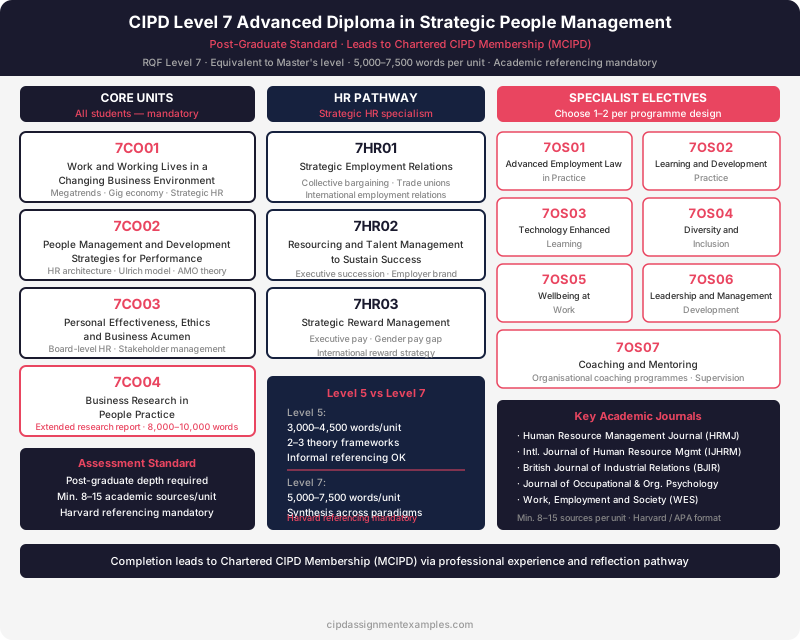
- 7OS01 — Advanced Employment Law in Practice
Covers complex employment law cases, discrimination law, collective employment rights, employment tribunal practice, and the strategic management of employment law risk at organisational level. Mirrors 5OS01 but at post-graduate depth with case law analysis required. - 7OS02 — Learning and Development Practice
Covers the strategic positioning of L&D in organisations, evaluation of complex L&D interventions, and the evidence base for L&D investment decisions at senior level. - 7OS03 — Technology Enhanced Learning
Covers the strategic application of learning technology, AI in L&D, the digital transformation of learning design, and how technology reshapes the role of L&D practitioners at strategic level. - 7OS04 — Diversity and Inclusion
Covers systemic approaches to diversity and inclusion strategy, intersectionality, the business and ethical case for inclusion, and the design of organisation-wide D&I initiatives grounded in evidence. - 7OS05 — Wellbeing at Work
Covers the strategic management of employee wellbeing, the integration of wellbeing into people strategy, mental health at work, and the evaluation of wellbeing programmes at organisational scale. - 7OS06 — Leadership and Management Development
Covers the design of leadership development strategy, talent pipeline and succession planning for senior roles, executive coaching, and the evaluation of leadership capability frameworks. - 7OS07 — Coaching and Mentoring
Covers the theoretical underpinnings of coaching and mentoring, the design of coaching programmes at organisational level, professional supervision, and the evidence base for coaching outcomes in leadership development.
The single most common reason CIPD Level 7 assignments are referred is the gap between description and critical analysis. Candidates who reach Level 7 with strong Level 5 habits — applying theory accurately, connecting it to organisational examples — often find that Level 7 assessors are specifically looking for what those frameworks fail to explain. The worked examples on this site demonstrate how to build the critical stance and synthesise across multiple theoretical positions at the analytical depth that post-graduate markers require. What does the evidence base actually support? Where does the model break down? What would you recommend and why, grounded in both theory and empirical research?
Academic Referencing Standards for CIPD Level 7 Assignments
Academic referencing at Level 7 is not optional — it is an assessment requirement. Most approved centres specify Harvard (author-date) referencing. The expectation per unit is a minimum of 8–15 academic sources, with peer-reviewed journal articles forming the core of your evidence base alongside academic texts and CIPD research reports.
The most credible academic journals for CIPD Level 7 evidence include:
- Human Resource Management Journal (HRMJ) — CIPD's own research journal; directly aligned with the qualification's subject matter
- International Journal of Human Resource Management (IJHRM) — covers strategic and international HR across comparative contexts
- Journal of Occupational and Organizational Psychology (JOOP) — relevant for wellbeing, motivation, and performance topics
- British Journal of Industrial Relations (BJIR) — essential for 7HR01 employment relations and collective bargaining content
- Work, Employment and Society (WES) — covers labour market, gig economy, and changing work topics relevant to 7CO01
CIPD research reports (CIPD.org/knowledge) are acceptable as supplementary evidence and often provide current UK and international HR benchmarking data that strengthens applied arguments. Avoid citing news articles, HR practitioner blogs, or unreviewed web sources as primary evidence — these are appropriate at Level 3 and Level 5 but undermine the post-graduate standard at Level 7.
How CIPD Level 7 Relates to a Master's Degree
The CIPD Level 7 Advanced Diploma sits at Level 7 on the Regulated Qualifications Framework — the same level as a Master's degree — but it is a professional qualification, not a university academic award. Completion of the Advanced Diploma does not confer a Master's degree. It leads to Chartered CIPD membership (MCIPD) via the experience and reflection pathway.
Some universities offer dual-award programmes that combine the CIPD Level 7 with an MSc in Human Resource Management or an MA in Organisational Development. In these programmes, the academic and CIPD requirements are integrated, and students graduate with both credentials. Outside of dual-award programmes, candidates holding the CIPD Level 7 Advanced Diploma may be able to claim Accredited Prior Learning (APL) credit toward a Master's programme at a participating university — but this is subject to individual university policies.
Students who have completed CIPD Level 5 will find that Level 7 builds on the same qualification architecture but raises every analytical expectation: longer word counts, academic referencing, strategic framing, and post-graduate critical depth. Students progressing from CIPD Level 3 to Level 7 without completing Level 5 should note that the analytical step-change is substantial — Level 7 assumes familiarity with HR theory, scenario-based analysis, and theoretical comparison as baseline competencies.
CIPD Level 7 Assignment Examples — Frequently Asked Questions
What is the CIPD Level 7 Advanced Diploma in Strategic People Management?
The CIPD Level 7 Advanced Diploma in Strategic People Management is the highest-level taught CIPD qualification, equivalent to post-graduate or Master's level study on the Regulated Qualifications Framework (RQF). It is designed for senior HR and L&D professionals — typically those operating at HR Director, Head of HR, or Senior HR Business Partner level — and leads to Chartered CIPD membership (MCIPD or FCIPD) upon completion and reflection. Assignments require post-graduate analytical depth, academic referencing (Harvard or APA), and word counts of 5,000–7,500 words per unit.
How many units are in the CIPD Level 7 qualification?
The CIPD Level 7 Advanced Diploma requires a minimum of 120 credits at Level 7, typically achieved through four mandatory core units (7CO01–7CO04), three HR pathway units (7HR01–7HR03) or equivalent L&D pathway units, and one or more specialist elective units (7OS01–7OS07). Most students complete seven to nine units in total over 18–24 months.
What word count is required for CIPD Level 7 assignments?
CIPD Level 7 assignments require significantly longer responses than Level 5. Individual unit submissions typically range from 5,000 to 7,500 words in total. Some units — particularly 7CO04 (Business Research in People Practice) — require a research report that may extend to 8,000–10,000 words. Your approved centre's assessment brief specifies the exact word count and format for each unit.
Do CIPD Level 7 assignments require academic referencing?
Yes. Academic referencing is mandatory at CIPD Level 7. Most approved centres specify Harvard (author-date) referencing. Each unit assignment is expected to include a minimum of 8–15 academic sources — peer-reviewed journal articles, academic texts, and CIPD research reports. CIPD factsheets and practitioner publications are acceptable as supplementary sources but should not form the majority of your evidence base at Level 7.
Is CIPD Level 7 equivalent to a Master's degree?
CIPD Level 7 is not a Master's degree — it is a Level 7 qualification on the RQF, which is the same level as a Master's degree, but it is a professional qualification rather than an academic one. It does not carry the same academic credit as an MA or MSc. Some universities offer dual-award programmes that combine the CIPD Level 7 with a Master's degree, but the CIPD Advanced Diploma alone leads to Chartered CIPD membership, not a university degree.
What is the difference between CIPD Level 5 and Level 7 assignments?
CIPD Level 5 assignments are assessed at undergraduate equivalent standard: applied theory, scenario-based analysis, comparison of 2–3 frameworks, 3,000–4,500 words per unit, informal referencing acceptable. CIPD Level 7 assignments are assessed at post-graduate standard: strategic rather than operational framing, synthesis across multiple theoretical paradigms, critical stance on HR practice and research methodology, 5,000–7,500 words per unit, academic referencing mandatory, and a minimum of 8–15 sources per unit. The analytical jump between Level 5 and Level 7 is the most significant step in the CIPD qualification framework.