70:20:10 Learning Model — Explained, Critiqued and Applied to CIPD Assignments
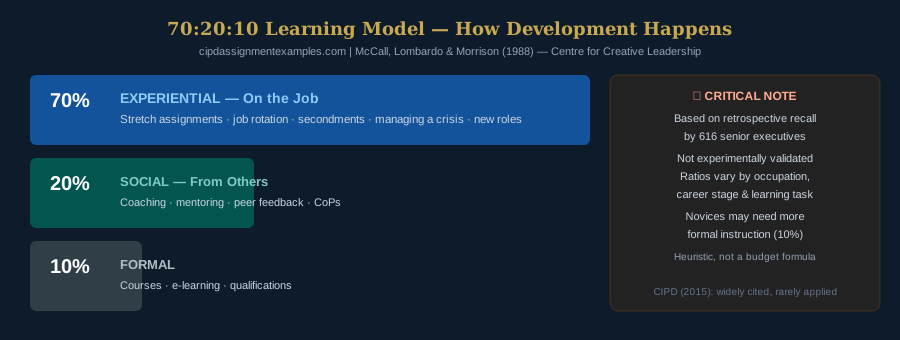
The 70:20:10 learning model is one of the most widely cited frameworks in L&D strategy — and one of the most frequently misapplied. It proposes that effective capability development draws approximately 70% from on-the-job experience, 20% from learning through relationships with others, and 10% from formal instruction. Understanding where the model came from, what the research actually shows, how L&D professionals use and misuse it in practice, and how to critically evaluate it for Level 5 and Level 7 CIPD assignments is essential for students studying people development and L&D strategy.
Learning Model
Origins and Development of the 70:20:10 Model
The 70:20:10 model was developed by Morgan McCall, Robert Eichinger, and Michael Lombardo at the Center for Creative Leadership (CCL) in Greensboro, North Carolina, in the late 1980s. The CCL is one of the most respected applied research institutions in leadership development globally, and the research that produced 70:20:10 was part of a broader programme investigating how leaders develop the capabilities they use at senior organisational levels. The methodology was interview-based: the research team conducted in-depth interviews with 616 senior executives, asking them to reflect on their careers and describe how they had learned what they knew about leading and managing people and organisations.
McCall, Lombardo, and Morrison published their findings in The Lessons of Experience: How Successful Executives Develop on the Job (1988). The book identified challenging assignments — taking on new and difficult roles, managing through a crisis, launching something new, dealing with failure — as the primary source of executive learning. Relationships with bosses, mentors, and peers were the second most significant source. Formal courses and training programmes were acknowledged as a development input but described as a relatively minor contributor compared to the other two categories. The 70:20:10 figures that became the model's shorthand were not the result of precise statistical measurement — they were descriptive approximations of the general pattern that emerged from the executives' retrospective accounts. The figures were later embedded in the Career Architect Development Planner by Lombardo and Eichinger, which became a standard tool in large-organisation HR functions through the 1990s and 2000s.
Charles Jennings, who served as Chief Learning Officer at Reuters and Oxford University Press before becoming an independent L&D consultant, was the figure most responsible for bringing 70:20:10 to global practitioner attention in the 2000s. Jennings positioned the framework not as a descriptive summary of how executives reported learning but as a prescriptive principle for designing L&D strategy — the argument being that if most learning happens through experience and relationships, L&D functions should be investing primarily in creating conditions for those learning modalities rather than in formal training programmes. This transformation from descriptive research finding to strategic design principle is critical context for understanding both the model's influence and its limitations.
The Three Components Explained
The three components of the 70:20:10 model describe distinct but overlapping categories of learning and development, each with specific HR and L&D design implications. It is important to understand that in the original CCL research these were not carefully bounded categories — they were retrospective attributions by experienced executives summarising their entire career development. In practice, the boundaries between them are permeable: a coaching conversation that helps an executive reflect on a challenging project experience simultaneously instantiates both the 70% and the 20%; a formal leadership programme that incorporates action learning from real work challenges integrates all three. The categories are analytical distinctions, not separate channels.
The 70% — Experiential Learning component encompasses all forms of development that occur through direct engagement with challenging work. The key word is challenging: routine, well-understood work produces competent execution of existing skills but not new capability development. The types of experience that drive development most powerfully include: stretch assignments (roles or projects that demand capabilities beyond the individual's current repertoire); job rotation into unfamiliar functions or business units; cross-organisational or international secondments; leading change initiatives; managing through organisational crisis; launching new products, markets, or ventures; and recovering from high-profile failure. The HR and L&D implication of the 70% is that organisations serious about capability development must actively design development assignments — not merely wait for people to develop incidentally through ordinary job performance. Talent management systems that identify high-potential individuals but then leave their development to chance are not acting on 70:20:10's implications.
The 20% — Social Learning component encompasses all forms of development that occur through relationship with others. Coaching relationships — either with trained external coaches or with line managers who have developed coaching skills — help individuals extract insight from their experience that they would not derive through unguided reflection alone. Mentoring provides access to the accumulated wisdom of more experienced practitioners. Peer learning groups and action learning sets create structured social contexts for reflective learning from live work challenges. Communities of practice — Wenger's (1998) foundational concept of groups of practitioners who share a domain, share a practice, and share a community — enable informal knowledge transfer at scale. The 360-degree feedback process is a social learning mechanism: the act of systematically gathering others' perspectives on one's own behaviour and receiving them in a structured development conversation can catalyse significant self-insight and behaviour change. The HR implication of the 20% is that a coaching culture — where coaching conversations are a normal feature of management practice, not a remedial intervention — is a core infrastructure requirement for effective L&D strategy.
The 10% — Formal Learning component encompasses structured, designed learning events: courses, workshops, e-learning programmes, webinars, qualifications, conferences, and any other formally delivered learning. This has historically been the dominant channel of L&D investment in most organisations — and the model's argument is that this dominance is misaligned with where learning actually occurs. However, the implication is not that formal learning is unimportant. Formal learning performs specific and irreplaceable functions: it provides the conceptual frameworks that enable individuals to derive more insight from experience (someone who understands Kotter's change model can derive more structured learning from managing a change programme than someone without that framework); it ensures reliable transmission of knowledge that is critical for compliance and safety; it provides a common language and shared conceptual toolkit across an organisation; and it is the most efficient modality for foundational knowledge acquisition for novice learners. The HR implication of the 10% is not to eliminate formal learning but to use it as an enabler of experiential and social learning rather than as the primary development vehicle.
Practical Applications of the 70:20:10 Model
For HR and L&D professionals, applying 70:20:10 requires designing specific infrastructure for each component. The 70% demands a deliberate stretch assignment programme: rotational programmes that move high-potential employees through different functions over a defined period; cross-functional project teams that deliberately include employees from outside their usual domain; acting-up arrangements that give future leaders genuine management authority in temporary senior roles; international assignments for global organisations; and transformation project leadership for employees being developed for senior roles. These experiences must be designed with intentionality — what capability is this assignment intended to develop, and who will support the individual in extracting the learning?
The 20% demands coaching and mentoring infrastructure. At the senior level, executive coaching from trained external coaches is the established standard. At the middle management level, line manager coaching capability — developed through manager-as-coach programmes and sustained through a culture that normalises coaching conversations — is the most scalable approach. Mentoring programmes pair less experienced employees with more senior practitioners, creating structured relationships where tacit knowledge and career wisdom are transferred. Reverse mentoring — where junior employees share expertise in technology, emerging trends, or the experience of being a new cohort member with senior leaders who lack that perspective — is an increasingly important variant. Revans's (1983) action learning methodology brings small groups of managers together to work on real, live organisational problems through questioning insight and structured reflection: it simultaneously instantiates social learning, experiential learning, and — where reading or formal input is incorporated — formal learning, making it one of the most complete developmental methodologies available.
The integration of learning with workflow — bringing development resources to the point of need rather than requiring employees to step away from work to attend training — is the practical realisation of 70:20:10 in the digital age. Microlearning (short, focused learning resources of 3-10 minutes addressing a specific task or concept); performance support tools (job aids, checklists, and reference guides accessible in the workflow); and embedded learning in digital platforms (contextual guidance appearing in software systems at the moment a user encounters an unfamiliar task) all bring the 10% closer to the 70%, reducing the transfer gap that undermines the impact of traditional course-based learning. The most effective L&D strategies integrate all three components into a coherent ecosystem rather than managing them as three separate channels with separate budgets and separate governance.
The Research Reality — What the Evidence Actually Shows
The foundation of the 70:20:10 model is retrospective self-report from 616 senior executives in US corporations in the late 1980s. This is a crucial methodological fact that Level 7 students must engage with directly. The research design has three significant limitations. First, it relied on memory: participants were asked to recall their entire career development and attribute it to categories of experience. Human memory is systematically reconstructive, not archival — people re-narrate their past in ways that fit current understanding, and the act of categorising learning sources may itself have shaped the recall in ways that produced neat approximations rather than accurate proportions. Second, the sample was highly specific: senior executives in large US corporations — a demographic with specific access to stretch assignments, executive coaching, and leadership development investments that are not available to the majority of the global workforce. Extrapolating from this sample to all learning in all contexts is a significant inferential leap. Third, the figures were descriptive summaries of approximate patterns, not precise measurements — the 70:20:10 label gives a false precision to what were rough proportions from qualitative interview data.
Multiple researchers have sought to validate or replicate the 70:20:10 ratios across different populations and found considerable variation. Laker and Powell (2011) in their review of the hard skills/soft skills learning literature found that the relative contribution of different learning modalities varies substantially by the type of skill being developed. Technical and procedural skills are often most efficiently acquired through formal instruction; complex interpersonal and leadership capabilities may indeed be most powerfully developed through experience and relationship. Career stage matters significantly: novice learners in an unfamiliar domain benefit more from structured formal instruction that provides the foundational knowledge they need to learn from experience — unguided experience for someone who lacks the conceptual framework to interpret what they are encountering is not 70% of their development, it is confusion. The ratios that described senior executive career development cannot be mechanically applied to a graduate recruit's first year.
The categories in 70:20:10 are not independent — this is perhaps the model's most significant theoretical limitation. High-quality formal learning enhances the quality of experiential learning by providing frameworks for interpreting experience. A manager who has learned the principles of psychological safety through a formal programme will extract different and richer developmental insight from their experience of managing a team meeting than an equally experienced manager without that framework. Conversely, experience without reflection produces habit rather than learning — which is why Kolb's (1984) experiential learning cycle (concrete experience → reflective observation → abstract conceptualisation → active experimentation) requires the reflective and conceptualisation stages to convert experience into transferable capability. The 70:20:10 model does not explain how experience becomes learning; it only asserts that most development is experiential. Kolb provides the mechanism that 70:20:10 assumes but never specifies.
Novice versus expert learning is a further variable the model does not address. Cognitive load theory (Sweller, 1988) and research in expertise development (Ericsson, 2008) converge on the finding that novice learners benefit most from structured, guided instruction that manages cognitive load and provides a scaffolded path through foundational knowledge. Experts benefit most from deliberate practice and reflection on increasingly challenging experience. The 70:20:10 model describes how experienced executives developed their leadership capability — a population already well beyond the novice stage for many of the capabilities being developed. Applying the model to organisational contexts where the primary development challenge is foundational skill acquisition misapplies a framework derived from expert development to novice development contexts.
How L&D Professionals Misuse the Model
The most common and damaging misapplication of 70:20:10 is using it to justify cutting formal training budgets. The argument runs: "research shows employees learn 90% of what they know from experience and relationships, so we can significantly reduce our investment in formal training." This treats a descriptive heuristic about how development appears to have occurred retrospectively as a prescriptive budget formula — a category error that ignores both the methodological limitations of the original research and the specific functions that formal learning performs that experience and relationship alone cannot reliably deliver. Compliance training, onboarding, foundational technical skills, and knowledge that must be standardised across a large population are all better delivered through formal instruction than through unguided experience. Cutting formal training as a 70:20:10 implementation strategy reliably produces compliance failures and performance problems among new hires who lack the foundational knowledge they need to learn effectively from experience.
Treating the percentages as precise allocation targets is a related misapplication. L&D functions that set budgets at 70/20/10 of total spend, or that design programmes targeting exactly 70% of time on experience and 10% on formal content, have transformed a rough descriptive heuristic into a pseudoscientific formula. The figures in the original research were approximations acknowledged as such by McCall, Lombardo, and Morrison — they were never intended as precise measurement targets. L&D strategy that is grounded in actual learning needs analysis data — what specific capabilities does this population need to develop, for what strategic purpose, and what modalities are most appropriate for these specific learning objectives? — will produce better outcomes than L&D strategy that mechanically allocates resources to hit a ratio that was never empirically established.
Ignoring the infrastructure requirements of experiential and social learning is the third common misapplication. The 70% of learning that occurs through experience does not happen automatically or equitably. Stretch assignments are allocated by managers, and research consistently shows that the managers who allocate them have systematic biases: affinity bias means that stretch opportunities flow disproportionately to individuals who remind the manager of themselves; gender bias means women are less likely to be given stretch assignments in domains culturally coded as masculine; proximity bias in hybrid organisations means employees who are physically present in the office receive more informal mentoring and stretch opportunity than those working remotely. If 70:20:10 is to deliver equitable development outcomes, the organisation must explicitly manage the distribution of stretch experiences and social learning access — which requires active HR and L&D governance, not simply a philosophical orientation toward experiential learning.
Critical Evaluation for Level 7 Assignments
At Level 7, students must go beyond acceptance of the 70:20:10 model and engage with it as a theoretical claim subject to evaluation. The core critique is epistemological: the figures are heuristics derived from a specific sample through a specific methodology, not empirical laws derived from controlled experimental study. This does not mean the model is useless — strategic heuristics can be valuable even when they lack the precision of empirically validated measurement — but it means that L&D professionals who cite the model as scientific justification for design decisions are overstating the evidence. The appropriate framing is: "70:20:10 provides a useful strategic orientation suggesting that experiential and social learning should be prioritised alongside formal instruction, but the specific ratios are not validated across different populations, tasks, or learning contexts."
Alternative frameworks offer genuine theoretical depth that 70:20:10 lacks. Kolb's (1984) experiential learning cycle — concrete experience, reflective observation, abstract conceptualisation, active experimentation — provides the mechanistic explanation of how experience becomes learning that 70:20:10 asserts without explaining. Kolb's model predicts that experience without reflection and conceptualisation will not produce transferable learning — an insight with significant practical implications for the design of development assignments. A stretch assignment unaccompanied by a coaching relationship that facilitates structured reflection is less likely to generate the deep learning that 70:20:10 attributes to the 70%. Constructivist learning theory (Vygotsky, 1978; Bruner, 1966) suggests that all learning is inherently social and experiential — the division into three separate channels is an analytical convenience that obscures the integrated nature of the learning process.
Situated learning theory (Lave and Wenger, 1991) provides perhaps the most coherent alternative to 70:20:10 for L&D strategy. Lave and Wenger argue that learning is not primarily a cognitive process of information transfer but a process of becoming a legitimate practitioner in a community of practice — a process that is inherently social, contextual, and embedded in participation in real work. From this perspective, the question of how much learning occurs through formal instruction versus experience versus social relationship is the wrong question — the right question is what forms of participation in authentic communities of practice enable newcomers to develop into competent practitioners. This reframing shifts L&D strategy from allocating learning modalities to designing communities and participation structures — a more radical and more evidence-grounded orientation than 70:20:10 provides.
The real evidence-based question for L&D strategy is: what specific learning method produces the best capability outcome for this specific learning need, for this specific learner population, in this specific organisational context? This requires a systematic learning needs analysis (see Learning Needs Analysis), learning design based on evidence about method effectiveness for the specific objective, and Kirkpatrick Level 3 evaluation to assess whether behaviour change occurred. A generic model telling L&D professionals that 70% of development happens through experience will not answer this question — only evidence from needs analysis and outcome evaluation will. Students who make this argument in 7CO02 assignments, while using 70:20:10 as a useful strategic orientation rather than a prescription, demonstrate the critical thinking that examiners are looking for.
Using the 70:20:10 Model in Your CIPD Assignment
5HR03 (Supporting Individual Development) at Level 5 is the primary unit where the 70:20:10 model is directly applicable. Assessment criteria asking students to evaluate different methods for delivering learning and development are best answered using the 70:20:10 framework as an organisational structure — describing each component (experiential, social, formal), providing specific method examples for each, and evaluating the relative strengths and limitations of formal versus informal approaches. At Level 5, a clear, well-structured description with accurate attribution and practical examples of each component will meet the marking criteria; critical evaluation of the model's evidence base is not required but will earn merit.
7CO02 (People Management and Development Strategies for Performance) at Level 7 requires genuine critical evaluation. Examiners at this level will specifically reward students who do not simply describe 70:20:10 as established fact but who engage with its origins, acknowledge its methodological limitations, compare it with alternative frameworks (Kolb's experiential learning cycle, Wenger's communities of practice, constructivist theory), and develop a learning strategy recommendation that is grounded in a learning needs analysis rather than a generic model. The strongest answers at Level 7 will use 70:20:10 as a starting point — acknowledging its strategic usefulness as an orientation — and then argue that specific L&D design decisions should be derived from evidence-based needs analysis and outcome evaluation rather than from a ratio that was never designed to be prescriptive.