What is CIPD? — The Professional Body for HR and People Management Explained
The CIPD — the Chartered Institute of Personnel and Development — is the world's largest professional body for HR, Learning and Development, and Organisational Development professionals. If you are considering a career in HR, currently studying a CIPD qualification, or trying to understand the significance of CIPD membership and designatory letters, this guide provides a comprehensive, accurate account of what the CIPD is, what it does, how its qualifications and membership grades work, and what the research evidence says about its professional and financial value.
Professional Body Explained
What CIPD Stands For and Its History
CIPD stands for the Chartered Institute of Personnel and Development. It is the world's largest professional body for HR, L&D, and OD professionals, with over 160,000 members in more than 120 countries. Its headquarters are in Wimbledon, London, where it has been based since the 1970s. The organisation's history stretches back over a century and reflects the evolution of HR as a profession from its welfare-oriented origins to its current strategic positioning.
The CIPD was founded in 1913 as the Welfare Workers' Association. The founding context is significant: the early welfare workers were employed predominantly in munitions factories during the First World War to manage the health, morale, and welfare of the largely female workforce that had entered factory employment for the first time. These welfare officers were the predecessors of the modern HR function, and the pastoral and ethical concerns they addressed — fair treatment, safe working conditions, employee wellbeing — remain embedded in the CIPD's professional values more than a century later.
The organisation became the Institute of Labour Management in 1931, then the Institute of Personnel Management (IPM) in 1946, reflecting the professionalisation of what was by then a recognised management discipline. A significant milestone came in 1994, when the IPM merged with the Institute of Training and Development (ITD) to form the Institute of Personnel and Development (IPD), reflecting the growing integration of HR and L&D in organisational practice. The organisation received its Royal Charter in 2000 and became the Chartered Institute of Personnel and Development — the CIPD — marking its recognition as a full chartered professional body with the status equivalent to the Chartered Institute of Accountants or the Law Society.
Today the CIPD serves members across all sectors and all sizes of organisation, from sole traders employing their first member of staff to FTSE 100 corporations and major public sector employers. Its research programme, professional qualifications, and policy advocacy make it the authoritative voice on people management practice in the United Kingdom and an influential voice internationally. For CIPD students at all levels, understanding the organisation's history and purpose provides context for why the professional values and ethical standards that underpin its qualifications — and that are assessed in every assignment — matter beyond the examination hall.
What the CIPD Does
The CIPD's activities cluster around four core functions, each of which directly affects the experience of students, members, and HR practitioners more broadly.
Setting Professional Standards
The CIPD defines professional standards for HR, L&D, and OD through the CIPD Profession Map, first published in 2019. The Profession Map provides a comprehensive framework of the knowledge, behaviours, and values that people professionals should demonstrate at all career stages and across all specialisms. It is the most significant statement of what the HR profession is and what it should aspire to be — ethically, professionally, and strategically. All three CIPD qualification levels are aligned to the Profession Map, and assessors use it as a reference point for evaluating the quality and appropriateness of students' work.
Research and Evidence
The CIPD is a substantial research organisation as well as a professional body. Its research programme covers the full range of people management topics: the Labour Market Outlook (published quarterly) tracks employment intentions, pay expectations, and redundancy plans across sectors; the annual Reward Management Survey tracks pay levels, structures, and benefits; the People Profession Survey tracks the demographics, career patterns, and satisfaction levels of HR practitioners; the Good Work research programme (launched following the Taylor Review in 2017) examines job quality across sectors and employment types. This research output is freely available to all members and provides the evidence base that students are expected to cite in CIPD assignments. Assignments that draw on CIPD research — rather than generic management textbooks — consistently perform better in marking.
Professional Qualifications
The CIPD offers professional qualifications at three levels, detailed in the next section. These qualifications are available through a network of approved learning providers (ALPs) — colleges, universities, and private training organisations — who deliver the content and assess the work. The CIPD accredits these providers and moderates assessment standards to ensure consistency. Students enrol with a learning provider rather than directly with the CIPD; upon successful completion of a CIPD-accredited qualification, students upgrade their CIPD membership to the appropriate grade.
Policy Advocacy
The CIPD contributes to government policy on work and employment through consultation responses, commissioned research, and direct lobbying. Notable contributions include response to the Taylor Review of Modern Working Practices (2017), which examined the rights and employment status of workers in the gig economy; consultation responses to the Employment Rights Bill (2024), which introduced significant changes to collective consultation, zero-hours contracts, and fire-and-rehire practices; and sustained advocacy on flexible working, pay transparency, menopause in the workplace, and mental health. The CIPD publishes People Management magazine, the leading UK publication for HR practitioners, which serves as a forum for evidence-based practice discussion alongside its news reporting function.
CIPD Qualification Levels
The CIPD offers three qualification levels aligned to England's Regulated Qualifications Framework (RQF). Each level builds on the previous, with increasing analytical complexity, strategic orientation, and research sophistication required. Choosing the right entry level is important: starting too low wastes time and money; starting too high risks underperformance in assessments that require capabilities not yet developed.
Level 3: Foundation Certificate in People Practice
The Level 3 Foundation Certificate is the entry point to CIPD qualification for those new to HR or with limited prior HR experience. It is equivalent in complexity to A-level study. The qualification covers the fundamentals of people practice: core employment law, recruitment and selection, reward and recognition, performance management, and people data and analytics at a foundational level. Content is largely descriptive and applied — students are expected to demonstrate understanding of concepts and apply them to straightforward workplace scenarios.
The typical duration is 9 to 12 months studying part-time alongside employment, although accelerated routes exist. Assessment is entirely through written assignments — there are no written examinations — typically submitted in the form of essays, reports, or professional practice assessments structured around specific assessment criteria. Upon successful completion, students qualify for Associate (Assoc CIPD) membership. The Level 3 is most appropriate for HR coordinators, administrators, and assistants who want to formalise their understanding of HR practice and gain professional recognition.
Level 5: Associate Diploma in People Management
The Level 5 Associate Diploma is a mid-career qualification that requires students to demonstrate analytical and critical thinking as well as knowledge application. It is equivalent in complexity to undergraduate degree-level study. The qualification is more demanding than Level 3 in both content and assessment approach: students are expected to evaluate evidence, compare alternative theoretical frameworks, critically assess their own organisational practice, and make evidence-based recommendations.
The Level 5 programme comprises core units and specialist pathway units. The core units — which all Level 5 students study regardless of pathway — include Organisational Performance and Culture in Practice (5CO01), Evidence-Based Practice (5CO02), Professional Behaviours and Valuing People (5CO03), and Employment Relationship Management (5HR01) along with Talent Management and Workforce Planning (5HR02) and Reward for Performance and Contribution (5HR03). Pathway units allow specialisation in People Management, Organisational Learning and Development, or People Analytics. Completion typically takes 12 to 18 months part-time and leads to Associate (Assoc CIPD) membership.
Level 7: Advanced Diploma in Strategic People Management
The Level 7 Advanced Diploma is the strategic leadership qualification, equivalent in complexity and demand to postgraduate study at masters level. Students at Level 7 are expected to operate with genuine intellectual independence: synthesising complex and conflicting evidence, developing original analytical frameworks, critically evaluating theoretical assumptions, and making strategic recommendations grounded in rigorous evidence. The Level 7 is the benchmark qualification for senior HR practitioners — HR Directors, HR Business Partners operating at board level, and heads of specialist functions including reward, talent, and L&D.
The core units include work on strategic employment relations (7HR01), strategic people management (7HR02), strategic reward management (7HR03), and the CIPD's distinctive capability strand covering leadership and management development, organisation design, and people analytics at Level 7. The research project (7CO04) — equivalent to a masters dissertation — requires students to undertake an independent, systematic inquiry into a people management question and produce a research report of approximately 12,000 to 15,000 words. Completion typically takes two to three years part-time. Successful completion leads to Chartered Member (MCIPD) status, with the pathway to Chartered Fellow (FCIPD) available through subsequent CPD and experience evidence.
Membership Grades
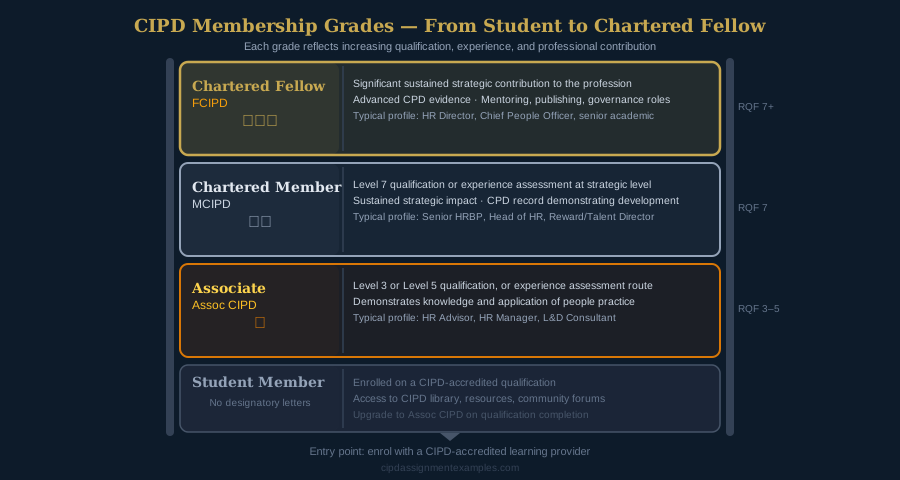
CIPD membership is structured around four grades that reflect increasing levels of professional qualification, experience, and contribution to the profession. Each grade carries designated letters used after the member's name in professional contexts.
Student Membership
Student membership is open to anyone enrolled on a CIPD-accredited qualification with an approved learning provider. Student members have access to the CIPD's online knowledge resources including the CIPD Library (which provides access to academic journals and research reports), the CIPD community forums, and the full range of CIPD podcasts, webinars, and factsheets. Student membership is automatically held during study and does not require a separate application — enrollment with a CIPD-accredited learning provider confers student membership status. Student members do not carry designatory letters.
Associate (Assoc CIPD)
Associate membership is the first professional grade, awarded on successful completion of a Level 3 or Level 5 CIPD qualification. Associates may also apply through the Experience Assessment route if they can demonstrate equivalent knowledge and competence to Level 5 standard through documented professional experience and a structured application process reviewed by CIPD assessors. Associates carry the designatory letters Assoc CIPD and have full access to CIPD member resources, employment advice services, and professional community networks. Associate membership is appropriate for HR practitioners at coordinator, advisor, and manager level, and for L&D practitioners in similar roles.
Chartered Member (MCIPD)
Chartered Member is generally regarded as the benchmark professional designation for qualified HR practitioners. It is awarded on successful completion of a Level 7 qualification, or through the Experience Assessment route for practitioners who can demonstrate sustained strategic-level impact equivalent to Level 7 standard through their professional experience and CPD record. Chartered Members carry the designatory letters MCIPD. The Chartered Member grade signals that the practitioner operates at a strategic level, can demonstrate evidence-based practice, and engages with the profession's development through CPD. Senior HR roles including HR Business Partner (strategic level), Head of HR, and many Director-level roles list MCIPD as a requirement or strong preference in job specifications.
Chartered Fellow (FCIPD)
Chartered Fellow is the highest CIPD membership grade, awarded to members who have made a significant and sustained contribution to the HR or L&D profession at the most senior level. Chartered Fellows carry the designatory letters FCIPD. The criteria for Fellowship go beyond qualification level alone — they require evidence of sustained strategic impact, advanced CPD engagement, and contribution to the development of the profession itself (through mentoring, research, publishing, speaking, or governance activities). HR Directors, Chief People Officers, and academic leaders in HR are the typical profile of FCIPD holders. Fellowship can be achieved either by progression from MCIPD with an evidence-based application, or in exceptional cases through direct election by the CIPD Board for outstanding contribution.
The CIPD Profession Map
The CIPD Profession Map, published in 2019, is the most significant statement of professional standards for people professionals in the UK. It replaced the previous HR Profession Map (2009) and represents a fundamental rethinking of how the HR profession defines itself — moving from a functional, task-oriented definition toward a values-led, purpose-driven professional identity. The Profession Map is the conceptual foundation for all three CIPD qualification levels and the framework against which CPD evidence is assessed for membership upgrades.
The Map's core purpose is "championing better work and working lives" — a formulation that deliberately positions people professionals as advocates for employees and society as well as for employers. This dual accountability — to the organisation and to the people within it — is reflected in the professional values that underpin the Map: ethical practice, inclusivity, commercial awareness, and evidence-based decision-making. These values are not merely aspirational statements; they are assessed through the CIPD's commitment to professional ethics, with members bound by the CIPD Code of Professional Conduct.
The specialist knowledge areas in the Profession Map cover the full breadth of people practice: People Practice (the operational and advisory HR function), Culture and Behaviour (leadership, organisational culture, change), Business Acumen (commercial and financial literacy), Analytics and Creating Value (people data, workforce analytics), Digital Working, Resourcing and Talent Management, Reward Management, Employment Relations, L&D, and Organisation Development and Design. Each knowledge area has defined content at Foundation, Associate, and Chartered levels, providing a progression framework for career development.
The core behavioural competencies in the Profession Map are: ethical practice, valuing people, professional courage and influence, working inclusively, commercial drive, insights-focused, situationally decisive, and skilled influencer. These behaviours are assessed in CIPD assignments through the professional practice dimensions of each unit — students are expected not only to demonstrate knowledge but to show how a skilled, ethical professional would apply that knowledge in context. At Level 7, assignments consistently require students to demonstrate professional courage: the ability to provide honest, evidence-based assessments even when they challenge prevailing assumptions or managerial preferences.
Continuing Professional Development (CPD)
CPD is a mandatory requirement for all grades of CIPD membership — all members are required to undertake, record, and reflect on their continuing professional development as a condition of maintaining their membership. The CIPD CPD framework follows a four-stage cycle: Plan (identify development needs and priorities), Do (undertake the development activity), Reflect (consider what was learned and how it changed your practice), Apply (demonstrate how the learning has been applied in your professional role). This reflective model is consistent with Kolb's experiential learning cycle and Gibbs' reflective model — frameworks that CIPD students are expected to recognise and apply in professional practice assignments.
What counts as CPD is deliberately broad: formal study, reading practitioner and academic publications, attending webinars and conferences, participating in professional network discussions, coaching and being coached, on-the-job learning from stretching assignments, and peer mentoring all qualify. The breadth of what counts reflects the CIPD's commitment to lifelong learning as a professional value, not merely a membership compliance requirement. Members maintain their CPD record on the CIPD's online platform, where the four-stage cycle structure is built into the interface.
For Associate members seeking to upgrade to Chartered Member, the CPD record is the primary evidence vehicle. The upgrade assessment requires Associates to demonstrate, through a structured CPD portfolio, that they are operating consistently at a strategic rather than operational level — advising senior leaders, influencing business direction, and making evidence-based people management decisions with organisation-wide impact. This evidence standard means that Associates typically need two to three years of sustained strategic-level experience before a successful upgrade application is viable, regardless of their initial qualification level.
Is CIPD Worth It? A Balanced Assessment
The question of whether CIPD qualification and membership delivers sufficient return on the investment of time and money is legitimate and deserves an honest evidence-based answer rather than a promotional one. The evidence on value is, on balance, positive — but context-dependent.
The financial case is supported by CIPD's own Reward Management Survey data, which consistently finds that CIPD members earn 12 to 15 percent more on average than HR practitioners without CIPD qualifications in equivalent roles. MCIPD holders earn a larger premium than Assoc CIPD holders. The premium is larger in financial services, professional services, and large corporate employers than in SMEs and the voluntary sector. At senior levels — HR Director and Chief People Officer — CIPD membership (typically MCIPD or FCIPD) is effectively a prerequisite for the most competitive roles, making the premium calculation somewhat academic: the cost of not having the qualification is exclusion from the most remunerative career pathways.
The professional credibility case is strong. In employment tribunal proceedings, CIPD membership is recognised by Employment Tribunal judges as an indicator of professional competence — an HR practitioner with MCIPD defending an employer's processes is perceived as more credible than a non-CIPD practitioner. In organisational contexts, CIPD membership provides a shared professional language and framework that facilitates peer relationships, professional community, and access to up-to-date research and practice guidance that is genuinely valuable for day-to-day practice decisions.
The limitations are also real. In very small organisations — owner-managed SMEs, micro-businesses, and many voluntary sector organisations — CIPD membership is less valued by employers who do not have the HR sophistication to understand the grade distinctions, and where the practical value of the qualification is less directly observable. The financial and time commitment of Level 7 — typically two to three years part-time alongside employment, with fees that can reach £10,000–£15,000 depending on the provider — is substantial, and the return on investment is most secure for practitioners in organisations and sectors where the qualification is most valued. International portability is strong in Commonwealth countries (particularly Australia, New Zealand, and Canada) but less established in continental Europe and the United States, where different professional body ecosystems operate.
Using This in Your CIPD Assignment
Understanding what CIPD is and what it stands for provides essential context for assignment writing at all levels. At Level 3 and Level 5, assignments frequently ask students to demonstrate awareness of professional ethics and the CIPD Profession Map — framing your answer in terms of the Map's core purpose ("championing better work and working lives") and its professional values shows assessors that you understand the professional context in which your analysis sits. At Level 7, the research project (7CO04) requires students to engage directly with CIPD research output — the Labour Market Outlook, Reward surveys, and Good Work research are primary evidence sources for claims about labour market conditions, pay practices, and employment quality.
Assignments that reference the CIPD Profession Map accurately and cite CIPD research publications alongside academic sources consistently outperform assignments that rely solely on academic frameworks. The CIPD expects its students to bridge academic theory and professional practice — demonstrating familiarity with the organisation's own research output is evidence of that bridging. When citing CIPD research: CIPD (2024) Labour Market Outlook: Autumn 2024. London: CIPD. When citing the Profession Map: CIPD (2019) CIPD Profession Map. London: CIPD [online] Available at: cipd.org [Accessed: date].
Related CIPD Resources
- CIPD Qualification Levels Explained — Level 3, 5 and 7 Compared
- CIPD Level 7 Assignment Examples — All Units
- CIPD Level 5 Assignment Examples — All Units
- CIPD Assessment Criteria Explained — How Assignments Are Marked
- CIPD Code of Conduct and Professional Ethics
- How to Write a CIPD Assignment — Structure, Evidence and Referencing