UK Employment Law Overview — CIPD Fundamentals Guide
UK employment law provides the legal framework within which every employer-employee relationship operates. For CIPD students, legal literacy is not optional — the ability to identify the relevant statutory provision, cite it accurately, and apply it to an organisational scenario is a core competency assessed across Level 5 (5OS01 Specialist Employment Law, 5HR01 Employment Relationship Management) and Level 7 (7HR01 Strategic Employment Relations). This overview covers the essential employment law principles: contracts, dismissal, discrimination, working time, family rights, redundancy, collective law, and the post-Brexit regulatory landscape.
CIPD Overview
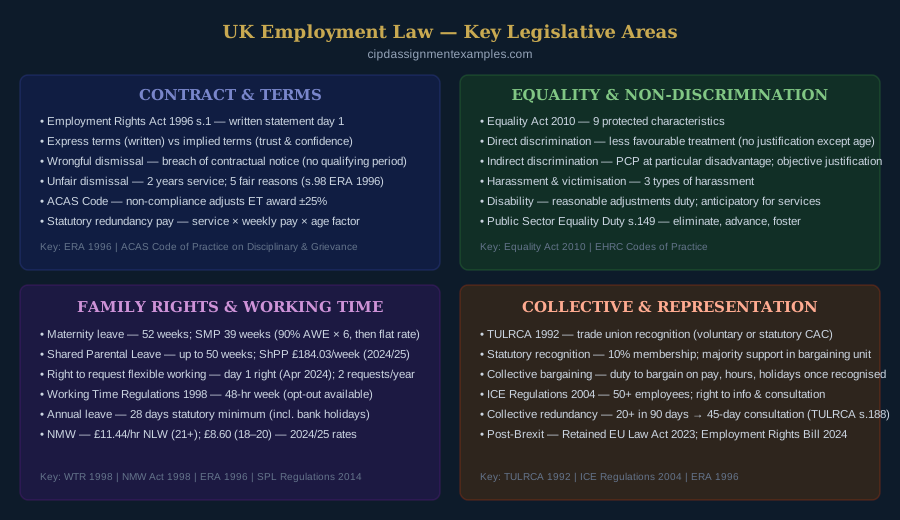
The Employment Contract
The employment contract is the foundation of the individual employment relationship. Section 1 of the Employment Rights Act 1996 requires employers to provide a written statement of employment particulars to every employee. Since the Good Work Plan reforms that took effect in April 2020 (implementing the Taylor Review recommendations), this written statement must be provided on the first day of employment — previously, employers had two months to provide it. The written statement must include: the names of the parties, the date employment began, rate and method of payment, hours of work, holiday entitlement, job title or description, notice period requirements, place of work, any collective agreements affecting the employment, and whether the employment is permanent or fixed-term.
The employment contract comprises both express terms (those explicitly stated in the written agreement) and implied terms (those read into the contract by law or custom without being explicitly stated). Implied terms include: the duty of mutual trust and confidence; the employee's duty to obey lawful and reasonable instructions; the duty of care (employer's obligation to provide safe working conditions and equipment); the employee's duty of confidentiality; the duty of fidelity and good faith; and terms implied by custom and practice (conduct that has become so established it is reasonable to infer both parties intended it to form part of the contract).
The implied term of mutual trust and confidence, first articulated in Courtaulds Northern Textiles v Andrew [1979] IRLR 84, is the most practically significant implied term in employment law. It operates as a two-way obligation: the employer must not, without reasonable and proper cause, conduct itself in a manner calculated or likely to destroy or seriously damage the relationship of confidence and trust between employer and employee. The practical importance is that a serious breach of this implied term by the employer — through bullying, demotion, failure to address grievances, or arbitrary changes to terms — entitles the employee to resign and claim constructive dismissal. The mutual trust and confidence term has been described by academic commentators as the foundation of modern employment relationship law.
The distinction between employees, workers, and the self-employed is of increasing importance following the gig economy litigation of the 2010s and 2020s. Employees have the full suite of employment rights including unfair dismissal protection, statutory redundancy pay, and the right to a written statement. Workers — a middle category recognised by the Employment Rights Act 1996 and the Working Time Regulations 1998 — are entitled to national minimum wage, working time protections, and statutory holiday pay, but not to unfair dismissal protection. Self-employed contractors have the most limited statutory protection. The Supreme Court's decision in Uber BV v Aslam [2021] UKSC 5 confirmed that Uber drivers were workers, not independent contractors, dramatically expanding the gig economy workforce's access to worker rights.
Unfair Dismissal and Wrongful Dismissal
Unfair dismissal is governed by Part X of the Employment Rights Act 1996. To bring an unfair dismissal claim, an employee must ordinarily have at least two years' continuous employment with the employer. There are important exceptions to the qualifying period: dismissals that are automatically unfair (because of pregnancy, trade union activity, whistleblowing, exercising a statutory right, or health and safety activities) attract protection from the first day of employment. The qualifying period does not apply to these automatically unfair dismissal categories.
Section 98(2) of the Employment Rights Act 1996 specifies five potentially fair reasons for dismissal: capability (including performance and ill-health); conduct (including misconduct and gross misconduct); redundancy; statutory illegality (the employee cannot legally continue in the role, for example because they have lost the right to work in the UK or lost a required licence); and some other substantial reason (SOSR — a catch-all for situations that do not fit the other four categories, such as a business reorganisation or the breakdown of trust). The employer must both establish a potentially fair reason and demonstrate that they acted reasonably in treating that reason as sufficient to dismiss (the s.98(4) band of reasonable responses test).
Procedural fairness is assessed against the ACAS Code of Practice on Disciplinary and Grievance Procedures. The Code does not have direct legal force, but employment tribunals are required to take it into account, and non-compliance — by either employer or employee — allows tribunals to adjust any compensation award by up to 25% upward (for unreasonable employer non-compliance) or downward (for unreasonable employee non-compliance). The Code requires: a written letter setting out the basis for the proposed disciplinary action; a formal disciplinary meeting at which the employee can be accompanied by a trade union representative or work colleague; the right of appeal against any disciplinary sanction. For gross misconduct — sufficiently serious misconduct that justifies immediate dismissal without notice — employers should still investigate and follow the Code's procedure before dismissing, unless the evidence is overwhelming and the facts are not seriously in dispute.
Wrongful dismissal is the contractual claim that arises when an employer terminates employment in breach of the contractual notice period. Unlike unfair dismissal, wrongful dismissal requires no minimum continuous employment — it is available from the first day of employment. The claim can be brought either in the employment tribunal (up to £25,000 compensation) or in the civil courts (no financial limit). The measure of compensation is the wages that would have been earned during the notice period, not a loss of future earnings. An employee who is summarily dismissed for gross misconduct but disputes that the misconduct occurred can bring a wrongful dismissal claim — if the tribunal finds that the misconduct did not justify summary dismissal, the employer was in breach of the notice term. The maximum compensation for unfair dismissal (the uncapped basic award plus the capped compensatory award of £115,115 in 2024/25 or 52 weeks' pay whichever is lower) is typically much higher than wrongful dismissal compensation for most employees.
Discrimination Law — The Equality Act 2010
The Equality Act 2010 consolidated and replaced nine separate pieces of anti-discrimination legislation, including the Sex Discrimination Act 1975, the Race Relations Act 1976, the Disability Discrimination Act 1995, and the Employment Equality (Religion or Belief, Sexual Orientation, Age) Regulations 2003. It provides a single, coherent framework covering nine protected characteristics and four prohibited conduct types.
The nine protected characteristics under section 4 of the Equality Act 2010 are: age; disability; gender reassignment; marriage and civil partnership; pregnancy and maternity; race; religion or belief; sex; and sexual orientation. Each characteristic has specific legal definitions and rules — disability, for example, is defined in section 6 as a physical or mental impairment that has a substantial and long-term adverse effect on the ability to carry out normal day-to-day activities. Marriage and civil partnership protection applies only in employment, not in the provision of goods and services. Pregnancy and maternity is a separate characteristic from sex, with distinct legal rules including the prohibition on any less favourable treatment at any point during pregnancy or maternity leave without the need for a comparator.
The four prohibited conduct types are: direct discrimination (treating someone less favourably because of a protected characteristic — requires a real or hypothetical comparator, and generally cannot be objectively justified except in age discrimination cases where age can be justified as a proportionate means to a legitimate aim); indirect discrimination (applying a provision, criterion or practice — PCP — that is facially neutral but puts persons sharing a protected characteristic at a particular disadvantage, which can be justified as a proportionate means to a legitimate aim); harassment (unwanted conduct related to a protected characteristic that has the purpose or effect of violating the person's dignity or creating an intimidating, hostile, degrading, humiliating or offensive environment — three variants: conduct related to a protected characteristic, sexual harassment, and less favourable treatment for rejecting or submitting to sexual harassment); and victimisation (less favourable treatment because the person has done or is suspected of having done a protected act, such as bringing a discrimination claim, giving evidence in support of a claim, or raising a grievance about discrimination).
The disability duty of reasonable adjustments is a distinctive feature of disability discrimination law with no parallel in other protected characteristic protection. Section 20 of the Equality Act 2010 imposes a duty on employers to take reasonable steps to avoid a substantial disadvantage to a disabled person arising from: a provision, criterion or practice; a physical feature of premises; or the absence of an auxiliary aid or service. What is reasonable is a fact-sensitive assessment depending on: the effectiveness of the adjustment in preventing the disadvantage; the cost and practicality of the adjustment; the employer's financial resources; and the nature of the employer's activities. The duty is anticipatory in some contexts and reactive in employment — an employer need not make an adjustment they did not know about, but once on notice of a disabled employee's disadvantage they must act.
Working Time and National Minimum Wage
The Working Time Regulations 1998 implemented the EU Working Time Directive into UK domestic law and remain in force as retained EU law following Brexit. The core provisions are: the 48-hour average weekly working time limit (averaged over a reference period of 17 weeks — or up to 52 weeks in certain sectors under collective or workforce agreements); the opt-out right (individual employees may agree in writing to work more than 48 hours per week, but the agreement must be voluntary, not a condition of employment, and can be revoked by the employee on 7 days' notice or such longer period as specified in the agreement, up to a maximum of 3 months); rest breaks (20 minutes if the daily working time is more than 6 hours); daily rest (11 consecutive hours in each 24-hour period); and weekly rest (24 consecutive hours in each 7-day period, or 48 hours in each 14-day period).
Annual leave entitlement under the Working Time Regulations is 28 days (5.6 weeks) per year including bank holidays, or 28 days on top of bank holidays if the employer chooses to be more generous. Workers cannot be required to take all their annual leave in the same leave year in circumstances where they were unable to take it due to sickness — following the Court of Justice of the European Union's decisions in Stringer v HMRC and KHS AG v Schulte, workers on long-term sickness can carry over holiday accrued during sick leave. The 2023 amendments to the Working Time Regulations (effective January 2024) further reformed the carry-over rules for COVID-19 legacy holiday and irregular-hours workers.
The National Living Wage and National Minimum Wage are set annually by the government following recommendations from the Low Pay Commission. The 2024/25 rates are: National Living Wage (for workers aged 21 and over) £11.44 per hour; aged 18–20, £8.60 per hour; under 18 and apprentices, £6.40 per hour. Employers who pay below the applicable minimum wage rate are liable to HMRC enforcement action including naming on the government's NMW non-compliance register, civil penalties of up to 200% of underpayments, and employment tribunal claims. The calculation of NMW compliance is complex — it depends on the worker's pay reference period, deductions from pay, employer benefits in kind, and the correct hourly rate for the work category (time work, output work, unmeasured work, or salaried-hours work).
Family Rights in Employment
The UK statutory family rights framework is one of the most extensive in the world, though take-up data suggests persistent gaps between formal entitlement and actual use. Statutory maternity leave is 52 weeks (26 weeks Ordinary Maternity Leave plus 26 weeks Additional Maternity Leave) and is available from day one of employment. Statutory Maternity Pay is payable for 39 weeks to qualifying employees (those with 26 weeks' continuous employment by the 15th week before the expected week of childbirth and earnings at or above the Lower Earnings Limit): 90% of average weekly earnings for weeks 1–6, then the flat rate (£184.03 in 2024/25) or 90% of average weekly earnings if lower for weeks 7–39. Employees who do not qualify for SMP may qualify for Maternity Allowance from HMRC on similar terms.
Paternity leave entitlement was reformed by the Paternity Leave (Amendment) Regulations 2024, effective for babies born on or after 6 April 2024. The key change is flexibility: fathers (or the mother's partner) can now take their 1 or 2 weeks of paternity leave in non-consecutive separate weeks and have up to 52 weeks (previously 56 days) after the birth to take it. Statutory Paternity Pay is £184.03 per week (2024/25) or 90% of average weekly earnings if lower. Shared Parental Leave — covered in detail at Shared Parental Leave UK Employer Guide — allows parents to share up to 50 weeks of leave and 37 weeks of pay, but take-up remains below 5%.
Parental leave — separate from both maternity leave and Shared Parental Leave — entitles employees with at least one year's continuous employment to 18 weeks of unpaid leave per child (up to the child's 18th birthday), with a maximum of 4 weeks per year. Right to request flexible working was reformed by the Employment Relations (Flexible Working) Act 2023: from 6 April 2024 it is a day-one right (previously 26 weeks' service was required), employees can make 2 requests per year (previously 1), and employers must deal with requests within 2 months (previously 3 months). Employers may still refuse flexible working requests on any of the 8 statutory grounds, but must now consult the employee before refusing. The statutory grounds for refusal include: burden of additional costs, detrimental effect on ability to meet customer demand, inability to reorganise work among existing staff, and planned structural changes.
Collective Employment Law
Collective employment law governs the rights of employees acting collectively through trade unions and other representative bodies. The Trade Union and Labour Relations (Consolidation) Act 1992 (TULRCA 1992) is the primary statute. Trade union recognition — the formal process by which an employer agrees to recognise a trade union for collective bargaining purposes — can be voluntary (agreed directly between employer and union) or statutory (imposed by the Central Arbitration Committee following the Schedule A1 procedure). The statutory recognition procedure requires the union to demonstrate that it has at least 10% membership in the proposed bargaining unit and that a majority of workers in that unit are likely to support recognition. Once recognition is achieved, the employer has a duty to bargain collectively with the recognised union over pay, hours and holidays.
The Information and Consultation of Employees (ICE) Regulations 2004 (amended 2019) provide a statutory right for employees in organisations with 50 or more employees to request information and consultation arrangements. The right is triggered when 10% of employees (or 15 employees, whichever is greater) make a formal request to the employer. Once arrangements are established, the employer must inform and consult employee representatives on matters relating to the organisation's economic situation, employment prospects, and substantial changes to work organisation or contractual relations.
Collective redundancy consultation is governed by TULRCA 1992 sections 188–192. Where an employer proposes to make 20 or more employees redundant at one establishment within a period of 90 days or less, it must: notify the Secretary of State using form HR1 (at least 30 days before the first dismissal where 20–99 redundancies are proposed, 45 days where 100 or more are proposed); and consult with appropriate representatives (recognised trade union representatives or, where there is no recognised union, elected employee representatives) for the same minimum periods. The purpose of consultation is to consider ways of avoiding the dismissals, reducing the numbers affected, and mitigating the consequences. Failure to comply with the collective redundancy consultation obligation can result in a protective award of up to 90 days' pay per affected employee.
Redundancy — Individual Rights
Statutory redundancy pay is the compensatory payment owed to employees who have at least two years' continuous employment and are dismissed by reason of redundancy. The calculation uses the formula: service × weekly pay × age-related multiplier. The age multiplier is: half a week's pay for each year of service under age 22; one week's pay for each year of service between ages 22 and 40; one and a half weeks' pay for each year of service over age 41. Weekly pay is capped at £643 per week in 2024/25, and maximum service counted is 20 years. The maximum statutory redundancy payment is £19,290 in 2024/25. Many employers pay enhanced redundancy terms above the statutory minimum — these are contractual benefits and must be applied consistently to avoid indirect discrimination claims.
Redundancy selection criteria must be objectively fair and consistently applied. Historical use of Last In, First Out (LIFO) as a selection criterion has become problematic following the Equality Act 2010: LIFO may disproportionately select younger workers, potentially giving rise to age discrimination liability. Objective selection criteria — skills, performance ratings, attendance records, disciplinary records — are defensible provided they are applied to all employees in the selection pool consistently and documented. The duty to consider suitable alternative employment requires employers to offer any suitable vacancy in the organisation to employees at risk of redundancy before dismissing — failure to do so can make an otherwise fair redundancy unfair.
Individual consultation obligations exist even where collective consultation is not triggered. The ACAS Code of Practice on Disciplinary and Grievance Procedures does not directly apply to redundancy, but the duty to act reasonably under s.98(4) ERA 1996 requires individual consultation as part of a fair procedure. An employee selected for redundancy without any individual consultation — notified in a group meeting and then processed for dismissal — will typically succeed in an unfair dismissal claim even where the redundancy selection itself was fair, because the procedure was not fair.
Post-Brexit Employment Law
The UK's departure from the European Union on 31 January 2020, and the end of the transition period on 31 December 2020, raised significant questions about the future of EU-derived employment law in the UK. The European Union (Withdrawal) Act 2018 retained all EU-derived domestic legislation as "retained EU law" — operative in domestic law and enforceable in UK courts as if originally enacted by the UK Parliament. The subsequent Retained EU Law (Revocation and Reform) Act 2023 clarified that most retained EU employment law is preserved unless specifically revoked by Parliament.
The main bodies of EU-derived employment law that remain in force as UK domestic law include: the Working Time Regulations 1998 (EU Working Time Directive); the Agency Workers Regulations 2010 (EU Temporary Agency Workers Directive); the Part-time Workers (Prevention of Less Favourable Treatment) Regulations 2000 (EU Part-time Work Directive); the Fixed-term Employees (Prevention of Less Favourable Treatment) Regulations 2002 (EU Fixed-term Work Directive); and the Transfer of Undertakings (Protection of Employment) Regulations 2006 (EU Acquired Rights Directive / Business Transfers Directive). TUPE — which protects employees' terms and conditions on the transfer of a business or service — was amended in 2014 but remains substantively aligned with EU law.
New domestic UK employment legislation since Brexit includes: the Employment (Allocation of Tips) Act 2023 (requiring employers to pass all tips, gratuities, and service charges to workers without deduction); the Workers (Predictable Terms and Conditions) Act 2023 (creating a right for workers and agency workers with irregular working patterns to request more predictable terms); and the Carer's Leave Act 2023 (providing up to one week's unpaid leave per year for employees with caring responsibilities from April 2024). The Employment Rights Bill introduced in October 2024 proposes the most significant package of employment law reform in a generation: day-one unfair dismissal rights (replacing the 2-year qualifying period, subject to a statutory probationary period), restrictions on fire and rehire practices, strengthened collective bargaining rights, and enhanced trade union recognition procedures. At the time of writing, the Bill is proceeding through Parliament and will transform the UK employment law landscape significantly when enacted.
Using Employment Law in Your CIPD Assignment
Employment law content is most directly assessed in 5OS01 (Specialist Employment Law) at Level 5, which covers the individual employment relationship, discrimination law, dismissal, family rights, working time, and collective law in depth. At Level 7, 7HR01 (Strategic Employment Relations) requires not just accurate legal knowledge but critical evaluation of the legal framework's effectiveness, its interaction with HR policy, and the strategic implications of legal change for people management. The Employment Rights Bill 2024 is highly likely to appear as assessment content at Level 7 from 2025 onwards. For all employment law AC responses: cite the statute accurately with section number (e.g. Employment Rights Act 1996, s.98(2)); distinguish between the legal standard and the HR best practice standard; and evaluate the implications of legal compliance for people management effectiveness, not just compliance risk.
Related CIPD Resources
- Shared Parental Leave UK — Complete Employer Guide
- Maternity Leave UK — Complete Employer Guide
- Equality Act 2010 — CIPD Guide to Protected Characteristics
- EU Employment Law Post-Brexit — What Changed and What Stayed
- Employee Relations — Definition, Models and Importance
- 7HR01 Strategic Employment Relations Assignment Example