Shared Parental Leave UK — Complete Employer Guide 2024/25
Shared Parental Leave (ShPL) was introduced by the Shared Parental Leave Regulations 2014 (pursuant to the Work and Families Act 2006) and has been available for babies born or adopted on or after 5 April 2015. Despite being available for over a decade, take-up remains stubbornly below 5%, largely because of the significant pay gap between Statutory Shared Parental Pay and the enhanced first-six-weeks rate under Statutory Maternity Pay. This guide covers everything employers and HR practitioners need to know: eligibility, the curtailment mechanism, block notice requirements, ShPP rates, SPLIT days, enhanced pay obligations, and the administrative process.
UK Employer Guide
What is Shared Parental Leave?
Shared Parental Leave is a statutory right that allows eligible parents to share up to 50 weeks of leave and up to 37 weeks of pay following the birth or adoption of a child. It is fundamentally distinct from maternity leave: it is not an extension of maternity leave but a separate entitlement that is activated only when the mother or primary adopter curtails their maternity or adoption leave. The moment the mother submits a valid curtailment notice to her employer, the remaining weeks of leave convert into a shared pot that both parents can draw from.
The legislative architecture is provided by the Work and Families Act 2006 (which created the enabling power), the Children and Families Act 2014 (which introduced the detailed framework), and the Shared Parental Leave Regulations 2014 (which set out the operational rules). The Statutory Shared Parental Pay (General) Regulations 2014 govern the pay entitlement. The scheme applies to parents of children born or adopted on or after 5 April 2015 — children born before that date are covered by the previous Additional Paternity Leave regime, which is now effectively obsolete.
ShPL covers births, adoptions (including overseas adoptions where the child enters Great Britain), and surrogacy arrangements where the intended parents are seeking or have obtained a parental order. For overseas adoptions, the relevant trigger date is when the child enters Great Britain rather than the placement date. The scheme applies to both heterosexual and same-sex couples. From a policy perspective, ShPL represents a major philosophical shift: the UK moved from a model where leave was allocated to the mother and a small secondary entitlement given to the father, to a model where leave is a family resource to be shared according to the couple's preference.
Eligibility — The Dual Test
ShPL eligibility operates as a dual test: both the mother (or primary adopter) and the partner must independently satisfy their respective eligibility conditions. Failure of either test means neither parent can use the ShPL scheme.
Mother's Eligibility Test
The mother must: (a) be entitled to statutory maternity leave (SML) or to Statutory Maternity Pay (SMP) or Maternity Allowance (MA); (b) have curtailed or given notice to curtail their SML or SMP/MA; and (c) share the main responsibility for caring for the child with the partner. The curtailment notice is the activation mechanism — without it, the ShPL pot does not exist. The notice must state the date on which the maternity leave or SMP/MA ends, and once submitted it is generally irrevocable (with limited exceptions: if the partner does not in fact intend to take ShPL, the curtailment can be revoked provided it is revoked before the stated end date).
Partner's Eligibility Test
The partner must: (a) have been employed by the same employer (or a different employer) for a continuous period of at least 26 weeks ending with the 15th week before the expected week of childbirth (EWC); (b) earn at least the Lower Earnings Limit (£123 per week in 2024/25) in the 8 weeks before the end of that 26-week period; and (c) be living with the child or be the child's father, the mother's husband, civil partner, or partner. The partner's employment test is assessed at the 15th week before EWC — this is the same qualifying week as for SMP. Note that the partner's employer need not be the same as the mother's employer; ShPL is designed to operate across different employers and different sectors.
A common point of confusion is that the 26-week continuous employment test for the partner is assessed at a fixed point in time (the 15th week before EWC), not at the time the leave is actually taken. A partner who satisfies the test at that qualifying week but subsequently changes employer remains eligible — the test is a snapshot, not a continuous requirement.
How Many Weeks Are Available?
The starting point is the 52 weeks of statutory maternity leave. Two weeks of compulsory maternity leave must always be taken by the mother immediately after birth (four weeks for factory workers under health and safety legislation), so the maximum that can be converted into ShPL is 50 weeks of leave and 37 weeks of Statutory Shared Parental Pay. If the mother has already taken some maternity leave before curtailing, the ShPL pot is reduced accordingly: if the mother takes 16 weeks of maternity leave before curtailing, the ShPL pot is 36 weeks (52 minus 16) of leave and 23 weeks of ShPP (37 minus 14, since SMP was payable for those first 6+8 = 14 weeks at varying rates).
Parents can take their ShPL weeks sequentially or concurrently. Sequential use means one parent finishes their leave before the other begins — the total leave available is spread across the full period. Concurrent use means both parents take leave simultaneously — a couple taking 8 weeks concurrently uses 16 weeks from the shared pot, not 8. Most couples use a combination: the mother takes early weeks under maternity leave, the father takes some weeks concurrently during the early period when both want to be present, then the mother returns to work while the father continues on ShPL. This pattern optimises both the financial position (the mother takes the enhanced SMP first-6-weeks period) and the care arrangements.
Statutory Shared Parental Pay — Rates and the Pay Gap Problem
Statutory Shared Parental Pay is payable at the lower of: the standard weekly rate (£184.03 in 2024/25) or 90% of the employee's average weekly earnings. ShPP is payable from the first week of ShPL — there is no enhanced initial period of the kind that applies under SMP (which pays 90% of average weekly earnings for the first six weeks). This structural difference creates a significant financial disincentive for higher earners — typically but not always fathers — to use ShPL.
To illustrate the scale of the disincentive: for an employee earning £35,000 per year (average weekly earnings approximately £673), SMP in weeks 1–6 would be £605.77 per week (90% of £673). By contrast, ShPP from week 1 is £184.03 per week. The financial loss from choosing ShPL over allowing the mother to remain on SMP for the first six weeks is £421.74 per week — over £2,500 over the six-week period. For higher earners the gap is even more substantial. This is not a marginal difference; it is a structural disincentive embedded in the design of the scheme that the government has not addressed despite recognising the low take-up problem.
The CIPD's 2022 research found ShPL take-up below 5% and identified the pay gap as the primary barrier, alongside low employer awareness and complex administration. For comparison, in countries with non-transferable paternity quotas (Sweden, Norway, Iceland), where fathers lose entitlement if they do not personally take a defined block of leave, take-up rates are dramatically higher. The absence of a non-transferable paternity element in the UK scheme — a political choice made to preserve parental flexibility — is consistently identified by academic commentators as the central design flaw explaining low take-up.
How to Take Shared Parental Leave — The Notice Mechanism
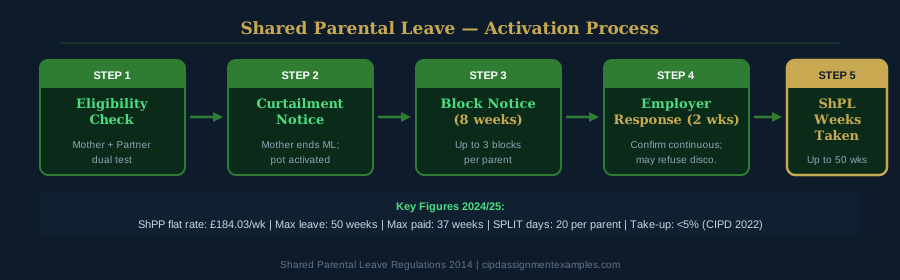
ShPL operates through a formal notice mechanism with strict procedural requirements. There are three types of notice: the curtailment notice (submitted by the mother to activate the pot), the notice of entitlement and intention (submitted by both parents to their respective employers, establishing that ShPL is being planned), and the period of leave notice (the 8-week advance notice that triggers a specific block of leave).
Curtailment Notice
The curtailment notice is the foundational document that activates ShPL. The mother submits it to her employer stating the date on which maternity leave or SMP/MA will end. The date must be at least the day after the compulsory 2-week maternity period ends. Once submitted and the stated date has passed, the curtailment notice is irrevocable — the mother cannot un-curtail her maternity leave. The only exception is where the partner has not in fact taken any ShPL and the curtailment has not yet taken effect — in that narrow window, revocation is permitted. This irrevocability is a significant trap for the unwary: a mother who curtails maternity leave and then has the partner's employment fall through (so the partner cannot take ShPL) cannot reclaim the curtailed weeks.
Block Notice — 8 Weeks Advance Notice
Each parent gives their employer at least 8 weeks' advance notice of each period of ShPL they want to take, using a period of leave notice. Each parent is entitled to submit up to 3 separate period of leave notices during the currency of the ShPL pot — this means each parent can take up to 3 separate blocks of leave (subject to the available weeks). The 8-week notice period is measured from the date the notice is received by the employer to the date the leave begins; the notice must specify the start and end dates of the proposed leave period.
Employer Response Window — 2 Weeks
Once a period of leave notice is received, the employer has 2 weeks to respond. For a continuous block (the entire entitlement taken in one unbroken period), the employer cannot refuse — the employee is entitled to take it, and the employer can only respond by confirming the dates. For a discontinuous pattern notice (for example, 3 weeks on, 2 weeks off, 3 weeks on), the employer can refuse and must offer a continuous alternative within the 2-week response window. If the employer refuses a discontinuous pattern and the employee does not accept the offered alternative, the employee may withdraw the notice and it does not count against their allowance of 3 notices.
This distinction between continuous and discontinuous patterns is practically important. Employees who want complex, fragmented patterns of ShPL should be aware that employers are legally entitled to refuse discontinuous patterns. HR practitioners should have a clear policy on how discontinuous requests will be handled — whether the default is to agree (where operationally feasible) or to refuse and offer continuous alternatives — to ensure consistency and manage employee expectations.
Shared Parental Leave in Touch (SPLIT) Days
SPLIT days are Shared Parental Leave in Touch days — the ShPL equivalent of KIT (Keeping in Touch) days under maternity leave. Each parent on ShPL may work up to 20 SPLIT days for their employer without that work bringing the ShPL to an end or reducing the number of ShPL weeks. Unlike KIT days, SPLIT days must be agreed between the employer and employee — neither party can require the other to use them. The employee is paid their normal rate for SPLIT days worked, and the ShPP for that week is not affected. SPLIT days are useful for: attending team meetings, keeping the employee connected to the team during a fragmented ShPL pattern, brief project contributions, and training events.
The Administrative Process — Step by Step
Managing ShPL involves a seven-step administrative process that spans both employers and requires cross-employer documentation exchange. The complexity is one reason HR departments cite for low take-up — the scheme requires more administrative effort than straightforward maternity leave.
Step 1 — Employee Notification: The mother informs her employer of the intention to curtail maternity leave and the planned curtailment date. The partner informs their employer of the intention to take ShPL.
Step 2 — Notice of Entitlement: Both parents submit a notice of entitlement and intention to their respective employers. This notice states: the child's expected week of birth (or actual birth date), the total ShPL and ShPP available, and how the parents intend to divide it. The notice of entitlement is not a leave request — it is a preliminary notification that ShPL is planned.
Step 3 — Employer Verification: Each employer can request a copy of the child's birth certificate (within 14 days of receiving the entitlement notice), evidence of the other parent's employer or declaration of self-employment, and contact details for the other parent's employer. Employers have 14 days from receiving the entitlement notice to request this information.
Step 4 — Curtailment Notice Submission: The mother submits a formal curtailment notice specifying the date on which maternity leave ends. This document should be retained permanently as it determines the ShPL pot available.
Step 5 — Period of Leave Notice: At least 8 weeks before the first period of ShPL is to begin, each parent submits a period of leave notice specifying the start and end dates. The employer has 2 weeks to respond.
Step 6 — Payroll Processing: ShPP is administered by the mother's employer (or the partner's employer, depending on who is taking the leave). Employers reclaim 92% of ShPP from HMRC (or 103% for small employers qualifying for Small Employer Relief). ShPP is treated as earnings for income tax and National Insurance purposes.
Step 7 — Return to Work: Employees returning from ShPL of 26 weeks or less have the right to return to the same job. Employees returning from combined ShPL and maternity leave of more than 26 weeks have the right to return to the same job or, if that is not reasonably practicable, a suitable alternative job on no less favourable terms. This mirrors the maternity leave return rights.
Enhanced Shared Parental Pay — Obligations and Risk
Many organisations enhance maternity pay — paying above the statutory SMP rate, for example full pay for 16 weeks. Whether an organisation that enhances maternity pay must also enhance ShPP is a question that has generated significant employment law litigation and ACAS guidance. The core issue is indirect sex discrimination: if an employer pays enhanced maternity pay to women but only statutory ShPP to the father taking equivalent leave, does that constitute less favourable treatment?
The Employment Appeal Tribunal considered this issue in Capita Hartshead Ltd v Duckworth [EAT 2016]. The EAT held that comparing a man on ShPL to a woman on maternity leave may not be a valid comparison for direct sex discrimination purposes, because maternity leave protects a woman's health and safety in connection with pregnancy and childbirth — it has a different purpose. However, the EAT left open significant questions about indirect sex discrimination, and subsequent ACAS guidance has recommended that employers review whether their enhanced maternity pay policies create a disproportionate deterrent to fathers taking ShPL.
The practical recommendation for HR practitioners is: if your organisation pays enhanced maternity pay, take legal advice on whether the current policy creates indirect sex discrimination risk in respect of ShPP. A neutral, non-discriminatory approach is to pay the same enhancement for ShPP as for SMP — either full pay for the same number of weeks, or a defined rate above the statutory minimum for both. Many progressive employers have adopted this approach. The business case is straightforward: if enhanced pay is justified for talent attraction and retention in respect of mothers, the same reasoning applies to parents who use ShPL.
Using Shared Parental Leave in Your CIPD Assignment
Shared Parental Leave is directly assessed in 5HR01 (Employment Relationship Management) — particularly in questions about family-friendly policy design, the employment relationship, and work-life balance — and in 5OS01 (Specialist Employment Law), where accurate knowledge of the statutory framework is required. At Level 7, ShPL appears in 7HR01 (Strategic Employment Relations) in the context of gender pay gap analysis, family-friendly policy as an inclusion driver, and the strategic implications of enhanced family leave for talent attraction and retention. Key points for assignment accuracy: always cite the correct statutory rate (£184.03/week in 2024/25); explain the curtailment mechanism as the activation trigger; and critically evaluate the pay gap problem and its impact on take-up.
Related CIPD Resources
- Maternity Leave UK — Complete Employer Guide
- 5HR01 Employment Relationship Management Assignment Example
- 5OS01 Specialist Employment Law Assignment Example
- 7HR01 Strategic Employment Relations Assignment Example
- UK Employment Law Overview — CIPD Fundamentals
- Employee Relations — Definition, Models and Importance