Total Reward Approach — CIPD Framework, Components and Assignment Application
The total reward approach recognises that employees are motivated by far more than their monthly salary — and that organisations which treat every element of the employment relationship as part of a coherent reward strategy secure decisive advantages in attraction, retention, and engagement. This guide covers the theoretical foundations, the financial and non-financial components, the motivational theory underpinning total reward, and how to apply the model convincingly in your CIPD 5HR03 or 7HR03 assignment.
CIPD Framework
Definition and Evolution of Total Reward
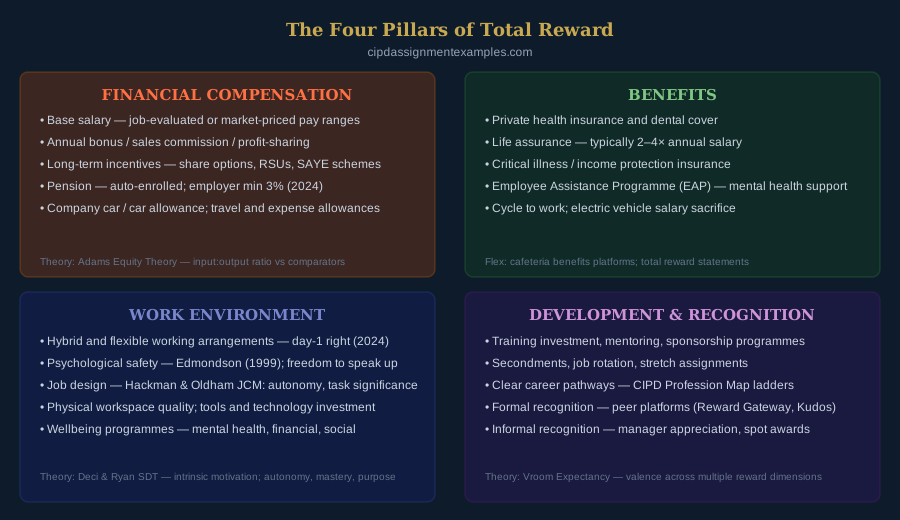
Total reward encompasses every element of the employment deal that an employee values in exchange for their contribution — salary, benefits, flexibility, recognition, development, and the quality of the work environment itself. The concept emerged during the 1990s as a response to the recognised limitations of purely financial reward strategies, which had begun to show diminishing returns in attracting and retaining talent in increasingly competitive labour markets.
Armstrong and Brown's (2006) widely cited definition frames total reward as "the combination of financial and non-financial rewards available to employees". The WorldatWork Total Rewards model (2006) identified five component domains: Compensation, Benefits, Work-Life Balance, Performance and Recognition, and Development and Career Opportunity. This model established a taxonomy that L&D and reward professionals could use to audit their employment offer systematically.
The CIPD's position is that total reward should function as a strategic tool for attraction, retention, and engagement — not merely an administrative catalogue of pay and perks. This strategic framing matters in assignments: the examiner is looking for evidence that you understand total reward as an integrated system aligned to business objectives, not as a checklist of employee benefits.
It is worth distinguishing total reward from adjacent concepts. Compensation and benefits (C&B) refers specifically to the financial elements of remuneration. Employee value proposition (EVP) is the broader narrative of why someone should choose to work for an organisation — total reward is the substantive content that underpins the EVP story. A compelling EVP without a genuinely competitive total reward offer is marketing without substance.
Financial Components of Total Reward
The financial pillar of total reward remains the foundation of any reward strategy. Base salary is the fixed element and the primary comparator employees use when assessing their market position. Base pay is typically set through one of three approaches: job evaluation (systematic internal assessment of job size — methods include Hay grading, Korn Ferry Levels, and Towers Watson's Global Grading System), market pricing (setting pay directly against external benchmarks for equivalent roles — see pay benchmarking), or a hybrid of both. Pay structures may be built around pay grades with ranges (minimum, midpoint, maximum), spot rates (single fixed salary per role), or broadbands (wider ranges that accommodate greater pay variation).
Variable pay adds performance-contingent compensation on top of base salary. Annual bonus schemes (typically 10–30% of base salary at target for management roles, higher for commercial functions) pay out based on individual, team, or organisational performance metrics. Sales commission is a particularly high-leverage variable pay design in commercial functions. Profit-sharing schemes (such as the Scanlon plan, which shares productivity gains with employees) link individual reward directly to collective financial performance. Performance-related pay (PRP) has been extensively studied: Lazear's (2000) natural experiment at Safelite Glass showed a 44% productivity increase when individual PRP was introduced, though the evidence in knowledge-work settings is more mixed.
Long-term incentives (LTIs) are most common in listed companies and larger private firms, primarily for senior leadership. Share option schemes (SAYE — Save As You Earn, CSOP — Company Share Option Plan, and EMI — Enterprise Management Incentives for SMEs) give employees the right to purchase shares at a discounted or locked-in price, creating alignment between employee wealth and shareholder value. Restricted Stock Units (RSUs) vest over time, rewarding loyalty as well as performance. Deferred bonus arrangements require executives to hold a proportion of their bonus in shares for several years, reducing short-termism.
Benefits form a significant component of the total compensation cost — typically 20–30% of the base salary equivalent for a UK employee when employer National Insurance contributions and pension costs are included. Since 2012, auto-enrolment into workplace pensions has been mandatory; as of 2024, minimum contributions are 3% employer and 5% employee of qualifying earnings. Other common benefits include: private medical insurance (PMI), group life assurance (death in service — typically 2–4× salary), critical illness cover, Employee Assistance Programmes (EAPs) providing confidential counselling and legal advice, and lifestyle benefits such as cycle-to-work schemes, gym membership, and retailer discounts.
Allowances and expenses — including company car allowances (a taxable cash sum replacing a company car, typically £5,000–£15,000 per annum for manager and above), home working allowances, and phone allowances — complete the financial picture. These elements are often underrepresented in total reward communications despite their real monetary value to the employee.
Non-Financial Components of Total Reward
The non-financial pillar of total reward is where significant differentiation between employers is possible — and where many organisations underinvest relative to their financial spend. The work environment encompasses both the physical workspace (quality of facilities, technology, tools) and the psychological environment. Edmondson's (1999) concept of psychological safety — the shared belief that the team is safe for interpersonal risk-taking, honest feedback, and speaking up without fear of punishment — is increasingly recognised as a fundamental component of a rewarding work experience. Hybrid and flexible working arrangements became a central employee expectation following the 2020–2022 shift in working patterns; CIPD (2023) research shows that flexibility is now cited by a majority of employees as a key factor in job choice decisions.
Job design represents one of the highest-leverage levers in the non-financial reward toolkit. Hackman and Oldham's (1976) Job Characteristics Model identifies five core job dimensions that drive intrinsic motivation: skill variety (the range of skills used in the role), task identity (completing a whole, identifiable piece of work), task significance (the impact of the work on others), autonomy (freedom over how and when work is done), and feedback (direct information about the results of the work). The Motivating Potential Score (MPS = [(Skill Variety + Task Identity + Task Significance)/3] × Autonomy × Feedback) provides a quantitative tool for assessing and redesigning jobs to increase their intrinsic motivating potential — directly relevant to 5HR03 and 7HR03 assignments.
Recognition is the most underutilised and cost-effective element of total reward. Formal recognition includes employee-of-the-month programmes, long service awards, and peer recognition platforms such as Kudos or Reward Gateway. Gallup (2022) research found that employees who receive recognition are twenty times more likely to be engaged than those who do not — yet a majority of employees report that they have not received meaningful recognition from their manager in the past week. Informal recognition — a specific, timely, and genuine acknowledgement from a line manager of a well-executed piece of work — costs nothing and is consistently among the strongest drivers of discretionary effort in engagement survey data.
Development and career opportunity is the fourth non-financial pillar. Perceived Investment in Employee Development (PIED) — the employee's belief that their organisation is genuinely investing in their growth — is a well-evidenced predictor of commitment and retention, particularly among younger employees entering the workforce with strong learning and career development expectations. Development elements include: training investment (formal programmes, professional qualifications, funded CIPD membership), mentoring (guidance from experienced colleagues), sponsorship (active advocacy for advancement from senior leaders), secondments (temporary assignments to different functions or geographies), and clear and credible career pathways.
Why Total Reward Works: Motivational Theory
The theoretical strength of the total reward approach lies in its integration with multiple streams of motivation research. Understanding these connections is essential for Level 5 and Level 7 assignments, where theory-to-practice application is the primary marking criterion.
Vroom's Expectancy Theory (1964) provides perhaps the most direct theoretical justification for total reward. In Vroom's model, motivation equals the product of three variables: expectancy (the belief that effort will lead to performance), instrumentality (the belief that performance will lead to reward), and valence (the value the individual places on that reward). Total reward strengthens motivational force by increasing valence across multiple dimensions simultaneously. If an employee highly values development opportunities, including them in the reward deal increases motivational force without increasing pay cost. Conversely, organisations that offer only financial reward are leaving motivational potential unrealised for employees who value autonomy, flexibility, or development more than incremental pay.
Deci and Ryan's Self-Determination Theory (SDT) identifies three basic psychological needs — autonomy, competence, and relatedness — whose satisfaction drives intrinsic motivation. Intrinsic motivation (engaging in an activity for its inherent satisfaction) is more durable, more creative, and more resilient under pressure than extrinsic motivation from pay. SDT provides the theoretical underpinning for emphasising job design, psychological safety, and development in the total reward mix. The crowding-out hypothesis — supported by Deci's (1971) original experiment and the meta-analysis by Frey and Jegen (2001) — warns that introducing or increasing large extrinsic financial rewards for activities that were previously intrinsically motivated can actually reduce performance and engagement. This is a significant caution for PRP design in knowledge-work contexts.
Adams' Equity Theory (1963) adds a crucial social comparison dimension. Employees assess the fairness of their reward by comparing their input:output ratio (effort and contribution relative to pay and benefits) to the perceived ratio of comparators — both internal colleagues and external market peers. If the ratio feels unfair, the employee reduces input (effort, engagement) until equilibrium is restored. Total reward must be perceived as equitable relative to these comparators — which creates a communication challenge: a benefit that is not visible in the equity comparison calculation (because the employee is unaware of it) has no motivational effect in Equity Theory terms. This is a core justification for total reward statements and transparent reward communication.
Total Reward Strategy Design
Designing a total reward strategy requires alignment between the reward mix, the organisation's business strategy, and the specific talent segments the organisation is trying to attract and retain. Miles and Snow's (1978) strategic typology provides a useful framework. Prospector organisations (competing through innovation and market leadership) need flexible, market-leading reward packages — particularly in non-financial elements such as autonomy, interesting work, and development — to attract the creative risk-takers they need. Defender organisations (competing through operational efficiency and cost leadership) can use more internally consistent, efficiency-focused reward structures with lower pay positioning offset by strong employment security. Analyser organisations (combining efficiency and innovation) need a hybrid reward strategy that segments the workforce accordingly.
Employee segmentation is essential for effective total reward design. Different employee groups value different reward elements systematically. Early-career employees typically prioritise development, interesting work, flexibility, and the quality of learning experiences. Employees with caring responsibilities (parents, carers) typically prioritise flexibility, remote working, and wellbeing support. Senior employees typically value autonomy, decision-making authority, long-term incentive opportunities, and organisational purpose. Segmentation through reward preference surveys — asking employees directly what they value — enables the design of a reward mix that delivers more motivational impact per pound of cost.
Market benchmarking establishes the competitive position of the financial reward components. Setting pay at the right percentile of the market for each role — typically P25 (cost leadership), P50 (market median), or P75 (market leader) — determines how many candidates the organisation can attract and retain against competitors for talent. See pay benchmarking methodology for a full treatment of benchmarking techniques. The reward positioning decision must be explicit, evidence-based, and coherent with the broader talent strategy.
Flex benefits platforms enable individualised reward within a defined total cost envelope. Cafeteria benefits designs allow employees to select from a menu of options — trading, for example, additional pension contributions for additional annual leave, or private health cover for a cash allowance. Salary sacrifice arrangements (employer and employee both save National Insurance contributions) are common mechanisms for pension, cycle-to-work, and electric vehicle benefits. The governance challenge is ensuring that flex designs remain cost-neutral for the employer while genuinely expanding employee choice.
Communicating Total Reward
Even the most thoughtfully designed total reward strategy delivers negligible motivational value if employees are unaware of what they receive. Research consistently shows that employees underestimate the value of their total employment package by 30–40%. This communication gap means that substantial reward spend is effectively wasted from a motivational standpoint — the investment is being made but the behavioural change it is intended to drive is not occurring.
Total reward statements (TRS) address this gap by presenting the full personalised monetary value of the employment deal in a single annual document — base salary, employer pension contributions, benefit values, bonus entitlements, and estimated value of non-financial elements. The psychological impact of seeing the full package value (often significantly higher than employees expect) can shift retention decisions that base salary comparisons alone would resolve in favour of leaving.
Digital personalised benefits portals — provided by platforms such as Benefex, Thomsons Online Benefits, and Reward Gateway — take the TRS concept further by enabling real-time access to reward information, benefit selection, and recognition programmes in a single interface. The data generated by portal usage also provides HR teams with evidence about which benefits are genuinely valued (high uptake) versus which are selected by few employees and should be reconsidered.
Line managers are the most proximate communicators of total reward for most employees. HR's role includes equipping managers with the understanding, language, and confidence to discuss the full employment offer with their teams — particularly in retention conversations, pay review discussions, and onboarding. A reward strategy that exists only in HR documents is not a strategy; it is a policy.
Critical Evaluation of Total Reward
A Level 7 assignment requires critical evaluation, not just description of the total reward approach. Several robust critiques deserve engagement. First, total reward can function as a mechanism for masking an uncompetitive base salary behind an impressive total package. If the core pay is below market, no amount of wellbeing programmes, bean bags, or flexible working arrangements will compensate in the long run — particularly for employees who need to service housing costs, debt, or family financial obligations. The equity comparison most employees make is primarily on base pay, not total package value.
Second, non-financial rewards can be experienced as paternalistic. Mandating employee wellbeing programmes, imposing mindfulness sessions, or designing offices on the assumption that everyone values open collaborative spaces assumes the employer knows better than the employee what they value. Self-Determination Theory itself warns that interventions which undermine autonomy — even well-intentioned ones — can reduce intrinsic motivation. True total reward design invites employees to co-create the reward mix rather than presenting them with a curated selection.
Third, equity theory suggests that most employees compare pay, not total reward packages, in their social comparison calculations. Base pay remains the dominant currency of comparison in conversations with peers, at networking events, and on salary transparency platforms such as Glassdoor. The total reward framing may be more influential with HR professionals designing reward systems than with employees experiencing them.
Fourth, the 2024 trend toward linking executive pay to ESG metrics — diversity targets, carbon reduction commitments, employee wellbeing scores — creates a governance debate about whether this represents genuine strategic alignment or represents window-dressing designed to satisfy investor pressure without driving meaningful change. The design of ESG-linked incentives requires the same rigour as any other PRP scheme: clear targets, meaningful metrics, and genuine consequences for non-delivery.
Using This in Your CIPD Assignment
In 5HR03 (Reward for Performance and Contribution), the total reward approach is a core topic. Examiners expect you to explain the WorldatWork or CIPD model, distinguish financial from non-financial components, and evaluate the advantages of a total reward approach over purely transactional reward. Strong answers reference Armstrong and Brown (2006), the WorldatWork model (2006), and at least two motivational theories (Expectancy Theory, SDT, Equity Theory) to explain why total reward should, in theory, outperform a pay-only strategy.
In 7HR03 (Strategic Reward Management), the bar rises further. You are expected to critically evaluate the total reward concept — acknowledging where the theory is stronger than the evidence, where implementation challenges arise, and where specific organisational contexts might call for different approaches. The Miles and Snow strategic typology provides a useful framework for contextualising your recommendation. A well-structured 7HR03 answer would: (1) define total reward and its components; (2) explain the theoretical foundations; (3) evaluate the evidence for and against; (4) apply to the specific case context; and (5) make a strategic recommendation with clear rationale.
Related CIPD Resources
- Benchmarking Pay Data — Methods for Gathering and Measuring Reward Data
- 7HR03 Assignment Example — Strategic Reward Management
- 5HR03 Assignment Example — Reward for Performance and Contribution
- Workforce Planning — Definition, Process and CIPD Assignment Application
- Organisational Culture — CIPD Framework and Assignment Application