Workforce Planning — Definition, Process and CIPD Assignment Application
Workforce planning is the discipline that connects people strategy to business strategy — ensuring that an organisation can execute its objectives with the talent it has, is building, or is acquiring. This guide explains the CIPD definition, the five-step planning process, supply and demand analysis techniques, succession planning, and how to apply the framework in your 5HR02 and 7HR02 CIPD assignments.
Definition & Process
Definition and Scope of Workforce Planning
Workforce planning is the process of identifying the number and types of employees an organisation needs to achieve its strategic objectives, and taking systematic action to ensure supply meets demand over time. The CIPD's authoritative definition describes it as "a process that ensures the right number of people with the right skills are in the right place at the right time to deliver an organisation's short and long-term objectives".
The scope of workforce planning is often confused with adjacent but distinct concepts. Human resource planning (HRP) is a broader term encompassing all HR activities aligned to business strategy — workforce planning is one component of it. Manpower planning is an older term largely replaced by workforce planning, though it appears in older academic texts you may encounter. Succession planning is a focused component of workforce planning concerned with senior and critical role coverage — not a synonym for workforce planning as a whole.
Workforce planning operates across two distinct time horizons. Short-term operational workforce planning (typically 6–12 months) addresses scheduling, resourcing open vacancies, managing seasonal or project-driven headcount fluctuations, and ensuring adequate capacity to deliver current operations. Long-term strategic workforce planning (typically 3–10 years) addresses capability development, workforce transformation in response to technology or structural change, significant hiring programmes, and large-scale restructuring. Most organisations that conduct any workforce planning at all operate primarily in the short-term horizon — CIPD research (2023) found that fewer than 50% of UK organisations conduct formal workforce planning beyond a 12-month window.
The distinction matters in your assignment: when asked about workforce planning in a strategic context (as 7HR02 typically is), your answer should explicitly address the longer-horizon strategic dimension, not merely describe a reactive headcount plan for the next quarter.
Why Workforce Planning Matters
The strategic case for workforce planning rests on three fundamental problems it prevents: talent shortages, talent surpluses, and capability misalignment. Organisations that do not plan ahead routinely find themselves unable to fill critical roles at the pace their strategy requires — leading to productivity loss, customer service failure, missed market opportunities, and competitive advantage for rivals who invested in earlier talent pipeline development. The NHS workforce crisis of the early 2020s, which saw thousands of unfilled clinical vacancies despite sustained recruitment efforts, is a large-scale illustration of what strategic workforce planning failure looks like at the national level.
Talent surplus is an equally consequential failure, though less immediately visible. Unplanned workforce growth — common in organisations experiencing rapid expansion followed by contraction — leads to expensive restructuring programmes, redundancy costs, reputational damage in the labour market, and the loss of valuable institutional knowledge when long-serving employees exit in poorly managed reductions.
The deeper value of workforce planning lies in enabling proactive rather than reactive resourcing. For roles requiring specialised capabilities — clinical professionals, data scientists, specialised engineers — recruitment timelines of 12–24 months are not uncommon. An organisation that begins recruiting when the vacancy already exists is perpetually behind. Strategic workforce planning begins building the pipeline 12–24 months before the need becomes acute, giving the organisation the lead time to hire, develop, or reskill the talent it will require.
CIPD research (2023) provides useful contemporary evidence for assignments: organisations that conduct formal workforce planning beyond 12 months report significantly higher confidence in their ability to meet strategic objectives. This is an important finding to cite — it grounds the theoretical case for workforce planning in empirical evidence from UK practice.
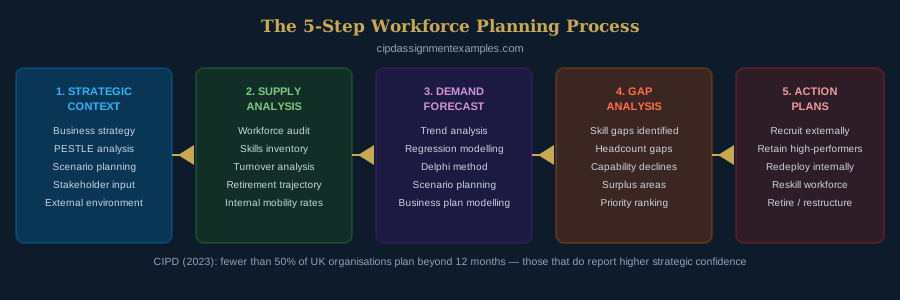
The Five-Step Workforce Planning Process
Step 1 — Understand the Strategic Context. Workforce planning begins with a clear understanding of what the organisation is trying to achieve and in what environment it is operating. This requires analysis of the business strategy (growth, contraction, transformation, acquisition, geographic expansion), the external labour market environment (skills availability, competitive pressures for talent, demographic changes), and the technological context (automation and AI adoption changing role requirements). Scenario planning tools — developing two to four plausible alternative futures rather than a single-point plan — help workforce planners avoid over-committing to one projection of what the future will look like. Shell's scenario planning methodology, developed in the 1970s and now widely applied in strategic workforce planning, models three to four distinct futures and derives workforce implications from each.
Step 2 — Analyse Current Workforce Supply. The supply analysis establishes a clear picture of what the organisation currently has: headcount by role, grade, location, skills, age, and length of service; voluntary turnover rates by department, grade, and tenure; retirement trajectory (average age distribution by function — how many will retire in each of the next five years); skills inventory (a systematic mapping of the capabilities currently held across the workforce); and internal mobility data (promotion rates, lateral move patterns, and the depth of succession pipelines for critical roles). This analysis is grounded in HR information system data, supplemented by workforce surveys, competency assessments, and performance management data.
Step 3 — Forecast Future Demand. The demand forecast projects what workforce the organisation will need to execute its strategy over the planning horizon. Multiple methods exist (discussed in detail below), each with different data requirements, time horizons, and accuracy characteristics. The output is not a single precise prediction but a range of workforce scenarios — headcount by role family, critical capability requirements, geographic distribution, and key skill clusters — mapped to the business planning horizon.
Step 4 — Gap Analysis. Comparing the projected supply position (Step 2 output adjusted for expected attrition, retirements, and internal mobility) against the forecast demand (Step 3 output) reveals the gaps: skills gaps (capabilities required but absent); headcount gaps (roles needed but unfilled); capability gaps (knowledge and skills that are declining as the workforce ages or as roles evolve); and surplus areas (functions where the future organisation needs fewer people than the current workforce plan delivers). The gap analysis provides a prioritised diagnostic that drives action planning.
Step 5 — Action Plans. The gap analysis generates a set of workforce challenges that require active intervention. The action planning framework — often described using the six Rs — provides a structured toolkit: Recruit (external hiring for roles that cannot be filled internally); Retain (reducing voluntary turnover through targeted engagement and reward interventions); Redeploy (internal mobility, matching employees in surplus roles to emerging vacancies); Reskill (training and development to build capabilities that are absent or insufficient); Retire (phased exits or managed transition programmes for roles in permanent decline); and Outsource or Automate (transferring non-core or repetitive work to external providers or technology solutions). Each action has an owner, timeline, cost estimate, and risk assessment.
Supply Analysis Techniques
A rigorous supply analysis draws on multiple data sources to build an accurate picture of the existing and projected workforce. The workforce audit is the foundational tool: a comprehensive snapshot of the current state by role, grade, skills, age profile, service length, location, and, where legally permissible, protected characteristics — enabling diversity pipeline analysis alongside pure headcount planning.
Retention analysis examines voluntary turnover rates by department, grade, and tenure to identify where the organisation is losing people disproportionately. New joiners in their first 12 months are the highest-risk attrition segment in most organisations; if turnover is concentrated in this period, the problem is likely induction, management quality, or a mismatch between expectation and reality rather than a compensation issue. Exit interview analysis and leaver surveys provide qualitative evidence about the drivers of departure that quantitative turnover data alone cannot reveal.
Retirement trajectory analysis examines the age distribution of the workforce by function and grade, modelling how many employees are likely to reach retirement age within each year of the planning horizon. In organisations with long-tenured workforces — many public sector bodies, long-established manufacturers, and professional partnerships — the retirement wave can represent a significant knowledge and capability risk if not planned for systematically.
Internal mobility analysis tracks promotion rates (how quickly employees progress through grades), lateral move patterns (cross-functional and cross-site mobility), and succession pipeline depth for each critical role (the ratio of ready-now or near-ready internal successors to role vacancies). A ratio below 1:1 for critical roles signals succession risk that requires immediate developmental intervention.
Demand Forecasting Methods
Trend analysis is the most straightforward demand forecasting method: if headcount has grown at an average of 8% per year for the past five years and the business plan projects continued similar growth, the headcount in Year 5 can be extrapolated forward. Using revenue per FTE (or a similar business volume metric) as the normalising factor — rather than raw headcount growth — accounts for productivity improvements and structural changes to the workforce model. Trend analysis works best in stable, mature organisations with predictable business trajectories; it is less reliable in fast-growth, highly variable, or transforming businesses.
Regression modelling provides a more sophisticated approach, statistically modelling the historical relationship between business volume metrics (revenue, transactions, patients treated, products shipped) and workforce requirements at the role family level. The resulting statistical model is then used to project workforce requirements from the business plan's forward projections. The quality of the model depends on the stability of the historical relationship — which may break down during significant structural change.
The Delphi method is a structured expert elicitation process in which HR facilitates independent forecasting by business leaders — asking each leader separately to estimate their workforce needs over the planning horizon, collating the results, and sharing anonymised aggregate findings to facilitate convergence in subsequent rounds. The Delphi approach is particularly valuable when quantitative data is insufficient or unreliable, and when the forecasting challenge requires judgment about emerging capability requirements that historical data cannot capture. It mitigates anchoring bias (the tendency for groups to converge prematurely on the first estimate raised) by maintaining anonymity through rounds.
Scenario planning is the most intellectually rigorous and uncertainty-tolerant approach. Rather than seeking a single accurate forecast, scenario planning develops three to four plausible alternative futures — typically an optimistic scenario, a base scenario, a pessimistic scenario, and a disruptive scenario (such as a major technology shift or regulatory change) — and derives the workforce implications of each. The strategic value lies not in predicting which scenario will occur but in identifying which workforce investments are robust across multiple scenarios (and should therefore be prioritised) versus which are scenario-specific bets (and should be contingent on scenario signals).
Succession Planning
Succession planning identifies and develops internal talent to fill critical senior roles when vacancies arise through departure, retirement, or expansion. The CIPD succession planning framework involves four stages: (a) identifying critical roles — those whose loss would significantly damage the organisation's ability to execute its strategy, typically representing 5–10% of all roles; (b) identifying potential successors for each critical role, categorised by readiness: ready now, 1–2 years, 3+ years — providing a depth-of-pipeline assessment; (c) developing the pipeline — through stretch assignments, sponsorship from senior leaders, mentoring, targeted training, and international or cross-functional exposure; and (d) monitoring and reviewing — regularly updating readiness assessments and adjusting development plans as circumstances change.
The 9-box grid (plotting employees on a 3×3 matrix of current performance versus future potential) is the most widely used succession planning tool in UK organisations. However, the academic evidence on its validity is mixed. King (2018) provides a detailed critique of the 9-box approach, noting that assessments of "potential" are highly subjective, prone to affinity bias, and rarely validated against subsequent career outcomes. The research on potential assessment reliability suggests that managers' judgements about high-potential employees reflect the assessors' stereotypes and network connections as much as genuine capability signals.
Bower's (2007) longitudinal study of CEO succession outcomes found that internal successors consistently outperform external hires over the long term — a finding that strengthens the case for investing in internal pipeline development. However, the diversity challenge in traditional succession planning is substantial: research consistently shows that succession processes that rely on manager nomination and informal sponsorship perpetuate demographic homogeneity in senior pipelines. Structured succession planning with explicit diversity goals and objective potential assessment criteria is required to address this.
Critical Evaluation
Cappelli's (2008) influential critique of workforce planning argues that the assumptions of stable planning environments on which traditional workforce planning rests have been fundamentally undermined by increasing organisational and market volatility. In environments where business strategy changes every 18 months, a five-year workforce plan may be creating costly false precision rather than genuine strategic alignment. Cappelli advocates for more agile resourcing models — talent marketplaces, flexible sourcing, modular capability development — that can respond to changing needs without the lead-time costs of long-range planning.
The uncertainty problem is genuine and deserves engagement in assignments. The longer the planning horizon, the less reliable any individual forecast — whether quantitative (regression-based) or qualitative (Delphi). The appropriate response is not to abandon long-range planning but to adopt scenario-based frameworks that plan for multiple futures simultaneously, rather than optimising a single-point plan that will prove incorrect. The Shell scenario planning model explicitly addresses this: the value is in the planning process and the organisational capabilities it builds, not in the accuracy of any one scenario.
Power dynamics in succession decisions represent a significant equity concern. The identification of high-potential employees is systematically influenced by manager biases, sponsor networks, and informal visibility — factors that disadvantage employees without senior advocates, those who do not fit dominant cultural norms, and those from underrepresented groups. An HR function committed to the CIPD's professional values of inclusion must design succession processes that counteract these dynamics through structured assessment, diverse decision-making panels, and transparent criteria for high-potential designation.
Using This in Your CIPD Assignment
In 5HR02 (Talent Management and Workforce Planning), examiners expect you to explain the workforce planning process, compare different demand forecasting methods, and evaluate how gap analysis links to resourcing action plans. Strong answers use the five-step framework as a structural scaffold, apply it to the case study or your own organisation, and reference the CIPD definition alongside at least one theoretical framework (such as scenario planning or the Delphi method) to demonstrate analytical depth.
In 7HR02 (Strategic Resourcing and Talent Management), the expectation rises to critical evaluation. A strong answer engages with Cappelli's (2008) critique of over-planning, evaluates the evidence on succession planning effectiveness, critically assesses the diversity limitations of traditional HiPo identification, and makes a well-reasoned strategic recommendation that acknowledges the uncertainty inherent in long-range workforce forecasting. CIPD (2023) evidence on the proportion of organisations conducting formal long-range workforce planning provides a useful contextual anchor.
Related CIPD Resources
- 7HR02 Assignment Example — Strategic Resourcing and Talent Management
- 5HR02 Assignment Example — Talent Management and Workforce Planning
- Labour Market Trends — CIPD Framework and Assignment Application
- Total Reward Approach — CIPD Framework and Components
- Learning Needs Analysis — CIPD Framework, Methods and Assignment Application