Equality Act 2010 for CIPD Students — Protected Characteristics and Discrimination Types Explained
The Equality Act 2010 is the most important piece of employment law for HR practitioners in Great Britain. It consolidated nine previous pieces of anti-discrimination legislation into a single, coherent framework and extended protections in a number of important respects. For CIPD students at Level 5 and Level 7, the Act is not merely a legal compliance topic — it is a framework for understanding how organisations can create genuinely inclusive workplaces, how employment decisions should be structured and evidenced, and how HR practitioners can advise on legal risk with confidence. This guide covers all nine protected characteristics, the four types of prohibited conduct, the disability reasonable adjustments duty, the Public Sector Equality Duty, positive action, and how to apply this knowledge accurately in CIPD assignments.
CIPD Student Guide
Background and Purpose of the Equality Act 2010
Before the Equality Act 2010 came into force on 1 October 2010, British anti-discrimination law was a patchwork of nine separate pieces of legislation developed over nearly four decades: the Equal Pay Act 1970, the Sex Discrimination Act 1975, the Race Relations Act 1976, the Disability Discrimination Act 1995, the Employment Equality (Religion or Belief) Regulations 2003, the Employment Equality (Sexual Orientation) Regulations 2003, the Employment Equality (Age) Regulations 2006, and related secondary legislation. Each of these Acts had slightly different legal tests, different procedural requirements, different remedies, and different scopes of application. Employers, HR practitioners, and employment lawyers navigated an unnecessarily complex landscape in which the same underlying principle — that people should not be treated less favourably because of a personal characteristic — was enacted inconsistently across different characteristics.
The Equality Act 2010 consolidated these into a single legislative framework with the dual purposes of simplifying discrimination law and extending its reach. The consolidation applied consistent legal standards — particularly the tests for indirect discrimination, harassment, and victimisation — across all protected characteristics. The extension aspects included new provisions: the Public Sector Equality Duty (s.149), which significantly expanded the proactive equality obligations of public bodies; the positive action tie-break (s.159), which for the first time expressly permitted the use of protected characteristics as a tiebreaker in recruitment where candidates were of equal merit; and enhanced protections for disabled people through the reasonable adjustments duty framework.
The Equality and Human Rights Commission (EHRC) was established by the Equality Act 2006 and serves as the enforcement and advisory body for the 2010 Act. The EHRC publishes statutory codes of practice — for employment, for equal pay, and for services and public functions — that provide authoritative guidance on how the Act applies in practice. These codes are admissible in employment tribunal proceedings and carry significant weight in determining whether an employer's actions were reasonable. CIPD students writing assignments on equality topics should reference EHRC codes of practice alongside the Act itself.
The Nine Protected Characteristics
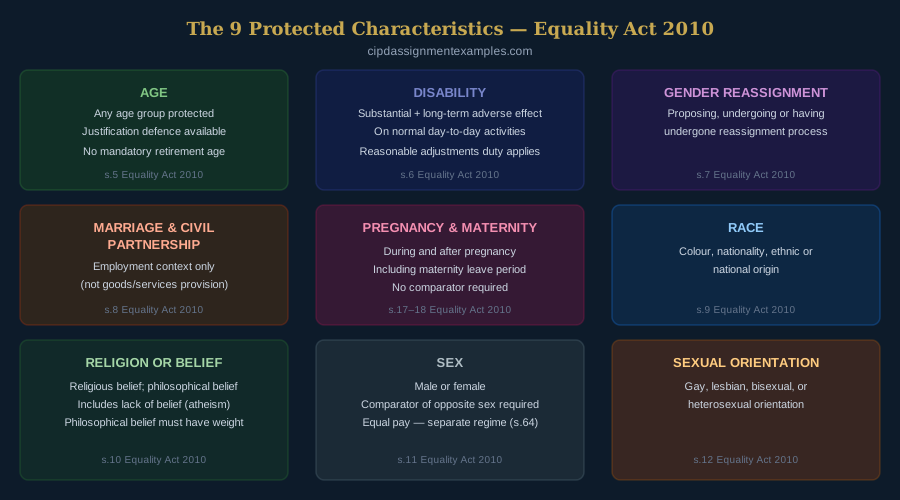
Section 4 of the Equality Act 2010 lists the nine protected characteristics. Each characteristic is defined by reference to specific provisions of the Act, and the precise legal definition matters for determining whether protection applies in a given situation. The following section provides the statutory definition and key practical notes for each characteristic.
Age
Age protection covers people of any age group — it is unlawful to discriminate against both younger and older workers. Unlike some characteristics, age discrimination can be objectively justified in certain circumstances: employers may be able to defend age-related practices by showing they are a proportionate means of achieving a legitimate aim (for example, structured pay progression that rewards experience). Compulsory retirement ages have been largely abolished in the UK — the Default Retirement Age of 65 was removed in 2011 — but employers can still potentially justify a compulsory retirement age if they can demonstrate objective justification in the specific operational context, which is a high threshold. Age-related recruitment criteria (for example, requiring "recent graduates" or candidates with "10 to 15 years' experience") may constitute indirect age discrimination and require objective justification.
Disability
Disability is defined in section 6 of the Equality Act 2010 as a physical or mental impairment that has a substantial and long-term adverse effect on the person's ability to carry out normal day-to-day activities. Each element of this definition has legal significance. "Substantial" means more than minor or trivial — the standard is relatively low, meaning many conditions that affect day-to-day functioning will qualify. "Long-term" means the effect has lasted or is likely to last for at least 12 months, or for the rest of the person's life. "Normal day-to-day activities" covers a wide range of activities including mobility, manual dexterity, physical coordination, continence, the ability to lift or carry everyday objects, speech, hearing or eyesight, memory or ability to concentrate, and the ability to understand and communicate.
Progressive conditions — including cancer, HIV, and multiple sclerosis — are protected from the point of diagnosis, even before the condition has a substantial effect on day-to-day activities, as long as it is likely to do so in the future. Past disability is also protected: someone who previously had a disability that has now resolved retains protection against discrimination based on their history of disability. Mental health conditions including depression, anxiety disorders, and PTSD are covered if they meet the substantiality and long-term duration thresholds — and research consistently shows that many employees with mental health conditions who would qualify for protection do not self-identify as disabled, creating both a diagnosis gap and a reasonable adjustments gap in many organisations.
Gender Reassignment
Protection for gender reassignment covers persons who are proposing to undergo, are undergoing, or have undergone a process (or part of a process) to reassign their sex by changing physiological or other attributes of sex. Crucially, the protection does not require the person to be under medical supervision or to have undergone any medical procedure — the process may be entirely social (change of name, presentation, and pronouns without surgical or hormonal intervention). Trans people are protected whether or not they hold a Gender Recognition Certificate. Harassment on the grounds of gender reassignment — including misuse of previous name or pronouns after a person has transitioned — may constitute prohibited harassment under the Act.
Marriage and Civil Partnership
Marriage and civil partnership is the only protected characteristic that applies exclusively in the employment context — it does not provide protection in the provision of goods, services, or other non-employment contexts. It covers persons who are married (including same-sex marriages following the Marriage (Same Sex Couples) Act 2013) and persons in a civil partnership. It does not protect cohabiting couples or those in other relationship types. In practice, claims based on this characteristic are relatively rare, but the protection is relevant in contexts where employers discriminate on the basis of marital status — for example, refusing to employ married women on the assumption that they will prioritise family responsibilities.
Pregnancy and Maternity
Pregnancy and maternity protection covers women during the protected period — from the beginning of pregnancy through to the end of maternity leave (or return to work if earlier). No comparator is required for direct pregnancy and maternity discrimination: the Act provides that treating a woman unfavourably because of her pregnancy or maternity is unlawful as an absolute rule, without the need to show a similarly placed man would have been treated more favourably. This reflects the recognition that pregnancy and maternity are exclusively female experiences and that a comparator analysis would be both artificial and unhelpful. Failure to consider pregnant women for promotion, failure to carry out individual risk assessments for pregnant workers, and dismissal that is materially connected to pregnancy all constitute unlawful treatment under this protected characteristic.
Race
Race protection covers colour, nationality, and ethnic or national origin. "Ethnic origin" has been interpreted broadly by the courts — Sikhs and Jews have been found to constitute ethnic groups with protected characteristics, reflecting a cultural and historical definition of ethnicity rather than a purely biological one. Gypsies and Travellers are also recognised as ethnic groups for the purposes of the Act. Nationality discrimination — treating a person less favourably because they are, for example, Polish, Nigerian, or Chinese — is prohibited, though immigration status (the legal right to work) is a separate matter governed by immigration law rather than equality law.
Religion or Belief
Religion or belief protection covers any religion and any religious or philosophical belief. "Religion" is interpreted broadly to cover mainstream and minority faiths. "Philosophical belief" has been given an expansive interpretation by employment tribunals: to qualify as a protected philosophical belief, the belief must satisfy the criteria established in Grainger plc v Nicholson [2010] — it must be genuinely held, not merely an opinion; it must be a belief rather than a viewpoint based on the present state of information available; it must concern a weighty and substantial aspect of human life and behaviour; it must attain a certain level of cogency, seriousness, cohesion, and importance; and it must be worthy of respect in a democratic society, not incompatible with human dignity, and not in conflict with the fundamental rights of others. Climate change beliefs, veganism (ethical rather than merely dietary), and belief in the constitutional importance of the rule of law have all been found to constitute protected philosophical beliefs. Crucially, the protection extends explicitly to lack of belief — atheists and agnostics are protected from discrimination on grounds of their non-religion.
Sex
Sex protection covers both men and women. The Equal Pay Act 1970 has been subsumed into the Equality Act 2010 (Part 5), meaning that claims for equal pay are now brought under the Act's framework rather than as separate statutory claims. Women remain significantly more likely to bring sex discrimination claims than men — the gender pay gap, occupational segregation, and the intersection of sex discrimination with pregnancy and maternity remain among the most significant equality challenges in the UK labour market. The Equality Act 2010 introduced gender pay gap reporting obligations (through secondary legislation applying to employers with 250 or more employees from 2017), which has made sex-based pay inequality more visible if not yet fully resolved.
Sexual Orientation
Sexual orientation protection covers gay, lesbian, bisexual, and heterosexual orientations. The protection covers both the actual sexual orientation and the perceived sexual orientation — harassing someone on the assumption that they are gay, even if they are not, is still prohibited conduct under the Act. This "perception" dimension is common to several protected characteristics and reflects the Act's focus on preventing discriminatory treatment rather than only protecting those who actually possess the characteristic.
The Four Types of Prohibited Conduct
The Equality Act 2010 prohibits four distinct types of conduct in relation to protected characteristics. Each has a different legal test and different defences available to employers. Understanding the distinctions is essential for accurate legal analysis in CIPD assignments.
Direct Discrimination (s.13)
Direct discrimination occurs when a person is treated less favourably than a real or hypothetical comparator in comparable circumstances, and the reason for the less favourable treatment is a protected characteristic. The test has three elements: (1) less favourable treatment; (2) compared to a real or hypothetical comparator in comparable circumstances; (3) the reason is the protected characteristic (causation). The causation test does not require the characteristic to be the only reason for the treatment — it is sufficient if it is "a significant influence" on the decision (following Nagarajan v London Regional Transport [1999]).
Direct discrimination is generally incapable of justification — unlike indirect discrimination, there is no legitimate aim defence available. The only exception is age discrimination, where direct age discrimination can be justified as a proportionate means of achieving a legitimate aim. For all other characteristics, if direct discrimination is established, the employer has no defence on the merits of the decision. An employer who refuses to promote a woman because she is about to take maternity leave, even if genuinely believing this is in the organisation's interests, commits direct sex discrimination — the business rationale is irrelevant.
Indirect Discrimination (s.19)
Indirect discrimination occurs when an employer applies a provision, criterion, or practice (PCP) to everyone, but the PCP puts persons who share a protected characteristic at a particular disadvantage compared to persons who do not share it, and the employer cannot justify the PCP as a proportionate means of achieving a legitimate aim. The four elements are: (1) a PCP; (2) applied to a group wider than the protected characteristic group; (3) placing the characteristic group at a particular disadvantage — statistical evidence of group disadvantage is admissible and probative, though not always required; (4) inability to justify through objective justification.
The objective justification defence requires the employer to establish both a legitimate aim (a real business need, not a mere preference) and proportionality (no less discriminatory means of achieving the aim was reasonably available). Common examples of PCPs that have been held to indirectly discriminate: requiring full-time working (can disadvantage women with childcare responsibilities — sex); requiring a minimum number of years of continuous UK experience (can disadvantage recent immigrants — race); scheduling mandatory meetings for Friday afternoon prayers (can disadvantage Muslims — religion or belief); requiring physical fitness standards above those genuinely required for the role (can disadvantage disabled people or older workers — disability or age).
Harassment (s.26)
Harassment is unwanted conduct related to a protected characteristic that has the purpose or effect of violating a person's dignity, or of creating an intimidating, hostile, degrading, humiliating, or offensive environment for that person. The Act recognises three types: (1) General harassment — unwanted conduct related to any of the protected characteristics (except marriage and civil partnership and pregnancy and maternity, which have separate harassment protections); (2) Sexual harassment — unwanted conduct of a sexual nature; (3) Less favourable treatment for rejection or submission — treating someone less favourably because they have rejected or submitted to sexual conduct or conduct related to gender reassignment or sex.
The "purpose or effect" formulation is important: harassment can be established even if the person engaging in the conduct did not intend to cause offence, as long as the effect on the recipient was objectively to create an offensive environment. Tribunals must consider whether it is reasonable for the conduct to have had that effect, applying an objective standard. Single incidents can constitute harassment — there is no requirement for a course of conduct. Employers can be vicariously liable for harassment by their employees unless they can show they took all reasonable steps to prevent it — the "statutory defence" requiring evidence of an effective anti-harassment policy, training, and complaint procedure.
Victimisation (s.27)
Victimisation occurs when a person is subjected to a detriment because they did, or the employer believes they did, a "protected act." Protected acts include: bringing proceedings under the Equality Act; giving evidence or information in connection with Equality Act proceedings; doing any act for the purposes of or in connection with the Act; making an allegation that another person has contravened the Act. There is no requirement to show less favourable treatment compared to a comparator — the protected act and the detriment are the core elements. Victimisation is particularly significant in the context of grievance management: an employer who takes disciplinary action against an employee who has raised an equality grievance, or who fails to promote an employee following their participation in a discrimination claim as a witness, risks a victimisation claim even if the action taken was otherwise justified.
Disability: The Reasonable Adjustments Duty
The duty to make reasonable adjustments for disabled persons is one of the most complex and practically important aspects of the Equality Act 2010. Unlike the other protected characteristics, disability does not simply require treating disabled people the same as others — it requires treating them differently to address the disadvantage created by their disability. The duty arises in three situations: (1) where a PCP applied by the employer places a disabled person at a substantial disadvantage compared to non-disabled persons; (2) where a physical feature of the employer's premises places a disabled person at a substantial disadvantage; (3) where the absence of an auxiliary aid or service places a disabled person at a substantial disadvantage.
The duty is to take such steps as it is reasonable to take to avoid the substantial disadvantage. Factors relevant to assessing reasonableness include: the effectiveness of the adjustment in preventing or reducing the disadvantage; the practicability of the step; the financial and other costs involved and the employer's ability to meet them; the nature of the employer's activities; the extent of the employer's financial and other resources; and the availability of financial or other assistance (such as Access to Work funding). A step that is reasonable for a large multinational employer may not be reasonable for a small business with three employees.
For service providers, the duty to make reasonable adjustments is anticipatory — organisations must think ahead and proactively put adjustments in place, rather than waiting for a disabled person to request them. For employers, the duty is reactive — it arises when the employer knows, or should reasonably know, that the employee is disabled and is likely to be at a substantial disadvantage. This means that employers cannot defeat a reasonable adjustments claim simply by showing they did not know about the disability if it was reasonably discoverable — for example, if a GP's note referencing depression had been provided or if the employee had disclosed relevant health information during occupational health referral.
Examples of reasonable adjustments in employment include: flexible working arrangements (adjusting hours or location to accommodate fatigue, medication schedules, or therapy appointments); providing assistive technology (screen readers, voice recognition software, ergonomic equipment); modifying performance management processes (adjusting targets or reviewing absence records with disability-related absences excluded); phased return to work after illness; allocating different car parking spaces; reassigning minor duties that the disabled person cannot perform; and relocation to a different department or work location. The duty is not a duty to employ or retain a disabled person who cannot perform the essential functions of the role even with adjustments — but the employer must first explore all reasonable adjustments before concluding that the person cannot perform the role.
The Public Sector Equality Duty (s.149)
The Public Sector Equality Duty (PSED), set out in section 149 of the Equality Act 2010, applies to public authorities — defined broadly to include local authorities, NHS bodies, schools, universities, government departments, the police, and any organisation exercising public functions. It imposes a proactive equality obligation that goes significantly beyond the reactive prohibition on discriminatory treatment that applies to all employers under the protected characteristics provisions.
The PSED has three limbs. First, public bodies must have due regard to the need to eliminate unlawful discrimination, harassment, victimisation, and other prohibited conduct under the Act. Second, they must have due regard to the need to advance equality of opportunity — this includes removing or minimising disadvantages suffered by persons sharing a protected characteristic, meeting the needs of persons sharing a protected characteristic differently from non-characteristic persons, and encouraging persons sharing a protected characteristic to participate in public life or in any activity in which their participation is disproportionately low. Third, they must have due regard to the need to foster good relations between persons who share a relevant protected characteristic and those who do not.
The specific duties, applicable in England (Scotland and Wales have different specific duty regimes), require: publication of relevant equality information (data about employees and persons affected by the public body's functions) at least annually; and preparation and publication of specific equality objectives at least every four years. The quality of specific duty compliance varies significantly between public bodies — EHRC reviews have consistently found that equality objectives are often vague, under-resourced, and inadequately monitored. CIPD Level 5 and Level 7 students working in or studying public sector organisations should assess whether their organisation's equality objectives meet the PSED's substantive requirements, not merely its procedural ones.
Positive Action: Section 158 and Section 159
Positive discrimination — treating a person more favourably because of a protected characteristic regardless of relative merit — remains unlawful under the Equality Act 2010, as it did under previous legislation. However, the Act expressly permits two forms of positive action that are frequently misunderstood or conflated with unlawful positive discrimination.
Section 158 permits general positive action. An employer who reasonably thinks that persons sharing a protected characteristic suffer a disadvantage connected to that characteristic, or that their participation in an activity is disproportionately low, may take proportionate action to enable or encourage those persons to overcome or minimise the disadvantage or to participate in the activity. In employment terms, this permits targeted training and development, outreach activities, mentoring programmes for underrepresented groups, and adjustments to recruitment outreach to reach underrepresented communities. All of these are lawful as long as they are proportionate to the scale of the disadvantage or underrepresentation.
Section 159 permits tie-break positive action in recruitment and promotion. Where an employer is choosing between candidates who are equally qualified for a vacancy or promotion, and one candidate shares a protected characteristic that is underrepresented in the workforce or that is associated with disadvantage in the workforce, the employer may choose that candidate over an equally qualified candidate who does not share the characteristic. This is not a quota system and it is not a licence to prefer protected characteristic candidates regardless of merit — it applies only where candidates are genuinely of equal merit, the group is underrepresented or disadvantaged, and the employer has not adopted a policy of always preferring the underrepresented candidate in such circumstances. The distinction between this and unlawful positive discrimination is important and should be clearly addressed in any CIPD assignment on diversity and inclusion.
Employment Tribunal Process for Equality Claims
For CIPD Level 5 students in particular, understanding the procedural framework for equality claims is important for advising on legal risk and managing complaints effectively. Before an employment tribunal (ET) claim can be submitted, ACAS early conciliation is mandatory — the claimant must contact ACAS, which attempts to facilitate settlement between the parties. Only after a certificate of conciliation has been issued (indicating that conciliation has been attempted) can the claimant lodge the ET claim.
The time limit for bringing an equality claim in the ET is three months from the date of the discriminatory act (or the last act in a continuing course of conduct). The tribunal has discretion to extend this if it is just and equitable to do so — a broader discretion than the "not reasonably practicable" test that applies to unfair dismissal claims. This means that late claims are more frequently accepted in discrimination cases than in unfair dismissal cases, but claimants should not rely on this discretion as a matter of course.
The burden of proof in discrimination claims follows a two-stage test established in EU law and now codified in section 136 of the Act. The claimant must first establish facts from which the tribunal could conclude, in the absence of an adequate explanation, that the respondent has committed a prohibited act — this is sometimes described as a "prima facie case." Once the claimant has established the prima facie case, the burden shifts to the employer to provide a non-discriminatory explanation for the treatment. If the employer cannot do so, the tribunal must find discrimination. This burden-shifting structure means that employers need to be able to produce contemporaneous evidence of the reasons for employment decisions — the absence of documented reasons for a rejection or dismissal decision in a case involving a protected characteristic is a significant evidential risk.
Compensation in successful discrimination claims is uncapped — unlike unfair dismissal, where the compensatory award is subject to a statutory cap, there is no upper limit on the damages an employment tribunal can award in a discrimination case. Awards include financial loss (both past loss of earnings and future loss of earnings where appropriate), injury to feelings (bands established in Vento v Chief Constable of West Yorkshire Police [2002], updated by Da'Bell v NSPCC [2009]), and aggravated damages where the employer's conduct was high-handed or oppressive.
Using the Equality Act 2010 in Your CIPD Assignment
The Equality Act 2010 is directly assessed in 5HR01 (Employment Relationship Management), particularly learning outcomes relating to employment law and managing equality and diversity. It also underpins 5OS05 (Equality, Diversity and Inclusion in Practice) and 7HR01 (Strategic Employment Relations). At Level 7, assessors expect not just accurate legal knowledge but strategic analysis: how should HR design policies, processes, and practices to meet not just the minimum legal standards but to achieve substantive equality outcomes?
The citation formula for legal references in CIPD assignments: reference the Act and the specific section — "Equality Act 2010, s.19 (indirect discrimination)" — not merely "the Equality Act." Where you cite EHRC codes of practice or guidance: EHRC (2011) Employment Statutory Code of Practice. London: EHRC. For case law, use neutral citation where available: Grainger plc v Nicholson [2010] IRLR 4 (EAT). Assessors at Level 7 expect students to engage with the difference between legal compliance (minimum standard) and best practice equality management, drawing on CIPD research on EDI effectiveness alongside the legal framework.
Related CIPD Resources
- Diversity and Inclusion — CIPD Framework and Assignment Application
- Employee Relations — CIPD Definition and Key Concepts
- 5HR01 Assignment Example — Employment Relationship Management
- 7HR01 Assignment Example — Strategic Employment Relations
- Maternity Leave UK — Employer Guide and CIPD Application
- EU Employment Law Post-Brexit — What Changed and What Remained