Psychological Contract — CIPD Definition, Breach and Assignment Application
The psychological contract sits at the heart of the employment relationship. It captures what employees believe has been implicitly promised to them — and what they in turn believe is expected of them — beyond what any written contract spells out. When those unwritten promises are kept, engagement and trust flourish. When they are broken, the consequences for motivation, performance, and retention can be severe and swift. For CIPD students at Level 5 and Level 7, understanding the psychological contract means mastering Rousseau's foundational theory, the breach-violation distinction, and the evidence base that connects perceived promise-breaking to measurable organisational outcomes.
CIPD Framework
What is the Psychological Contract?
The psychological contract is an individual's belief about the implicit, unwritten mutual obligations between themselves and their employer. It is not a document, not a negotiated agreement, and not legally enforceable — yet research consistently shows it exerts more day-to-day influence on employee behaviour than the formal employment contract that sits in the personnel file. The concept entered organisational literature through Chris Argyris (1960), who used it to describe the informal understanding between employees and their supervisors that governed discretionary effort and loyalty. Levinson, Price, Munden, Mandl, and Solley (1962) developed the idea further, emphasising its reciprocal nature. Denise Rousseau (1989, 1995) established the modern definition that CIPD teaching draws on today.
Rousseau's (1989) definition — "an individual's beliefs regarding the terms and conditions of a reciprocal exchange agreement between the focal person and another party" — highlights several features that distinguish the psychological contract from other HR frameworks. It is subjective: each employee constructs their own version based on their own perceptions and interpretations of what was promised. It is implicit: the obligations are unwritten and often unspoken, inferred from signals sent during recruitment, induction, performance conversations, and the visible treatment of colleagues. It is perceptual: the contract is based on what the employee believes was promised, not on what the employer intended to communicate. And it is mutually binding in the employee's experience: even without legal status, perceived violations trigger responses as powerful as formal contractual breach.
The CIPD recognises the psychological contract as a central framework for understanding engagement, motivation, and retention. Unlike job satisfaction surveys or engagement scores, which measure current states, the psychological contract framework illuminates the relational dynamics that drive those states — the sense of fairness, reciprocity, and trust that accumulates or erodes through everyday workplace interactions. For HR professionals, this means the psychological contract is not an abstract concept but a practical diagnostic lens: when turnover spikes, when discretionary effort withdraws, or when engagement scores collapse following a restructuring, psychological contract theory provides explanatory tools that surface solutions invisible to purely transactional HR analysis.
Types of Psychological Contract — Rousseau's Taxonomy
Rousseau's (1995) taxonomy in Psychological Contracts in Organizations distinguishes between transactional, relational, and balanced (hybrid) contract types, creating a framework that has become standard in both academic research and CIPD curriculum. Understanding which type of psychological contract predominates in a given employment context allows HR professionals to anticipate what employees will expect, what management actions risk breach, and what HR practices are most likely to build trust and commitment.
The transactional psychological contract is characterised by short-term, economically focused exchange. Both parties have specific, limited obligations to each other. The employee delivers defined outputs in return for defined rewards; the employer expects task performance but not loyalty or above-contractual effort; the employee similarly expects pay and clear task definition but not career investment or emotional engagement. This type of contract dominates in agency work, zero-hours arrangements, fixed-term project roles, and gig economy contexts. It is not inherently inferior — for many workers and employers, a transactional arrangement is precisely what is wanted — but it means the relationship is fragile: either party can exit without the sense of betrayal that characterises relational breach.
The relational psychological contract is long-term and socioemotional. Trust, loyalty, job security, genuine employer care for employee wellbeing, and investment in the employee's career are its defining features. In return, the employee offers commitment, discretionary effort, and above-contractual loyalty. This type of contract dominated public sector employment, large professional services firms, and traditional manufacturing organisations through much of the twentieth century. Its great strength is that it generates the deep engagement and discretionary effort that produce organisational performance. Its great vulnerability is that it is the type most severely damaged by layoffs, restructuring, and promises of security that are subsequently broken. When a relational contract is violated, the emotional response can be extreme — not merely disappointment but genuine betrayal — because the employee invested trust that goes far beyond what an economic transaction would justify.
The balanced or hybrid contract combines relational warmth with explicit performance expectations. The employer invests in development, offers career opportunity, and demonstrates genuine care for the employee — but also makes clear that continued employment and advancement depend on demonstrable performance results. This type is closely associated with high-performance work systems (HPWS) and high-commitment HR strategies. It represents a sophisticated evolution of the psychological contract that acknowledges contemporary employment realities: neither the pure job security of the traditional relational contract nor the purely transactional arrangement of gig work, but a dynamic partnership where development investment flows in exchange for performance commitment. Most employment relationships in practice contain elements of more than one type, varying by career stage, seniority, and line manager relationship quality.
What Employers and Employees Typically Expect
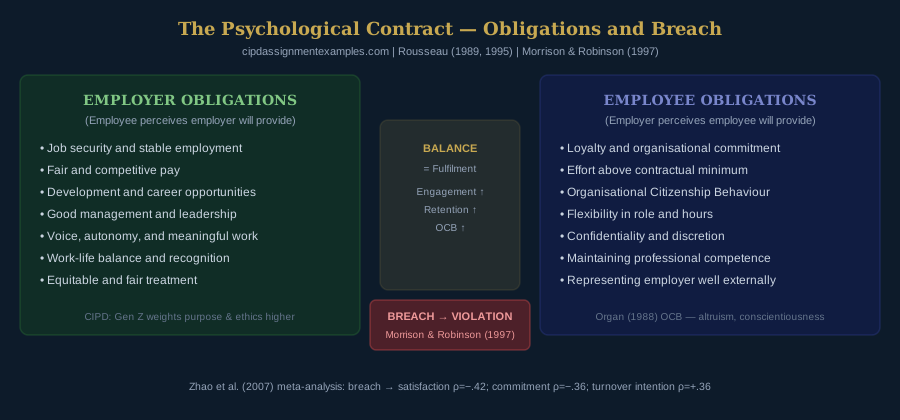
The psychological contract operates as a bilateral framework: it encompasses what employees believe employers owe them and what employees believe they owe in return. CIPD research has consistently documented the principal employee expectations that form the content of the contemporary psychological contract. These include: job security (particularly prominent for employees in relational contracts); fair and equitable pay; genuine development opportunities; good management — specifically, line managers who provide clear direction, recognition, and support; meaningful work with a clear sense of purpose; a degree of voice and autonomy; manageable workloads and work-life balance; and recognition that connects individual contribution to organisational outcomes.
CIPD research also documents significant generational variation in psychological contract content. Employees in younger cohorts — particularly those entering employment post-2010 — place substantially higher weight on employer ethical behaviour, environmental and social purpose, flexibility and hybrid working, and psychological safety than employees whose psychological contract norms were formed in earlier employment contexts. This matters for HR practice because it means psychological contract management is not a static process: as workforce demographics shift, the implicit promises that employees perceive as being made during recruitment and induction will change. An induction process designed to signal one set of relational commitments may be signalling something quite different to a new cohort of employees with different implicit expectations. CIPD employers who fail to audit and update their psychological contract communications risk generating breach from the first day of employment.
On the employee obligation side, employers typically expect: loyalty and commitment that goes beyond the strict terms of the employment contract; a level of effort above the contractual minimum — what Organ (1988) termed Organisational Citizenship Behaviour (OCB), comprising altruism (helping colleagues without being asked), conscientiousness (going beyond minimum role requirements), sportsmanship (tolerating inconveniences without complaint), courtesy (consulting others before taking actions that affect them), and civic virtue (participating in and caring about the organisation's life); flexibility in response to changing business needs; maintenance of competence; and representing the employer positively in external interactions. The gap between what employees believe they owe and what employers actually expect is itself a source of psychological contract tension — misaligned role expectations are a primary driver of early-career disengagement.
Psychological Contract Breach and Violation
The most consequential contribution of the psychological contract literature to HR practice is the systematic analysis of what happens when perceived promises are broken. Morrison and Robinson (1997) established a distinction that is now fundamental to the field: breach is the cognitive perception — the individual's belief that the organisation has failed to fulfil obligations it had promised to fulfil; violation is the emotional response to that perceived breach — feelings of anger, betrayal, and deep disengagement that are qualitatively different from and more severe than ordinary disappointment. This distinction matters because not all perceived breaches lead to violation. Whether a breach intensifies into violation depends on: the severity of the unmet obligation (a missed pay review is more serious than a postponed training event); the employee's attribution of intent (was it deliberate and avoidable, or inadvertent and attributable to genuine organisational constraint?); and the quality of the prior relationship (a long-standing relational contract provides more buffer before breach becomes violation than a short transactional arrangement).
The empirical evidence on breach consequences is substantial. Zhao, Wayne, Glibkowski, and Bravo (2007) published a meta-analysis synthesising the results of over 800 empirical studies on psychological contract breach. Their corrected correlation estimates reveal strong and consistent relationships: breach predicts reduced job satisfaction (Ï = −.42), lower affective organisational commitment (Ï = −.36), reduced organisational citizenship behaviour (Ï = −.30), higher turnover intention (Ï = .36), and lower in-role job performance (Ï = −.28). These effect sizes are substantial by social science standards, and they hold across industries, organisational types, and national contexts, establishing psychological contract breach as one of the most powerful predictors of employee behavioural outcomes in the HR literature.
Common triggers for psychological contract breach include: redundancy following explicit or implicit promises of job security; role reorganisation that expands responsibilities without commensurate compensation or acknowledgement; failure to deliver on promised development opportunities (a particularly common trigger in graduate development programmes); pay freezes following promises of review; and change of line manager disrupting a relational trust that was built with the previous manager. The last trigger is particularly revealing because it demonstrates that the psychological contract is partly personal — the implicit promises that employees perceive as being made include promises made by individual managers, not only by the organisation as an abstract entity. When HR policies transfer a high performer to a different team, the relational contract built with the previous manager does not automatically transfer.
The distinction between deliberate and inadvertent breach is critical for HR intervention design. Morrison and Robinson argue that when employees attribute breach to organisational reneging — deliberate failure to fulfil perceived obligations — the emotional intensity of violation is much greater than when the breach is attributed to perceived inability to fulfil obligations due to genuine external constraints (economic downturn, legal restriction, pandemic-forced change). This has a direct implication for change management: when organisations must break psychological contract expectations — for example, withdrawing bonus schemes under financial pressure — the manner and quality of explanation matters enormously. Transparent, honest communication about why expectations cannot be met, accompanied by genuine acknowledgement of the impact on employees, consistently produces lower violation responses than opaque or evasive communication about the same objective event.
Managing the Psychological Contract
HR practices for building and maintaining psychological contract health begin at recruitment. The realistic job preview (RJP) — providing candidates with an accurate, balanced picture of the role including its challenges and constraints, not only its attractions — has consistent research support as a tool for reducing early-tenure psychological contract breach. Inflated recruitment promises are a primary source of expectation-reality gaps that generate breach within the first year of employment. RJPs reduce this by aligning initial expectations with actual experience, trading some short-term attractiveness as an employer for substantially better long-term engagement and retention outcomes.
The line manager is the primary interface through which employees experience the psychological contract on a day-to-day basis. Consistent, fair, and transparent line manager behaviour — providing recognition, development support, clear feedback, and genuine interest in employee wellbeing — is the most powerful ongoing investment in psychological contract health available to an organisation. HR policies can be designed with perfect psychological contract management principles, but if line managers are inconsistent, unpredictable, or careless in communicating expectations and feedback, the psychological contract at team level will deteriorate regardless of organisational-level HR design. Building line manager capability in the behaviours that sustain the psychological contract — specifically through training in coaching, giving meaningful recognition, and conducting development conversations — is therefore one of the highest-return investments HR can make in workforce engagement and retention.
Transparent communication during organisational change is the intervention most critical to preventing breach at scale. Unexplained structural change — where reporting lines shift, roles are redesigned, or employment terms are modified without adequate explanation of why — triggers breach perception even when the formal contractual terms remain unchanged. Employees interpret the absence of explanation as evidence that the organisation does not value them sufficiently to keep them informed, which itself constitutes a breach of the relational expectation of respect and consideration. HR-designed change communication frameworks that mandate timely, honest, two-way communication during restructuring — combined with genuine opportunity for employee voice and question — consistently produce lower breach response and better post-change engagement scores than communication designed solely to manage information flow.
The remote and hybrid working renegotiation of the post-2020 employment landscape has created a significant new chapter in psychological contract management. For many employee groups, the implicit expectation of full-time office presence has been superseded by an equally implicit expectation of flexibility. Employers who unilaterally withdraw hybrid working arrangements post-pandemic — without adequate consultation, explanation, or recognition that flexibility has become a core element of the contemporary psychological contract for many workers — consistently report elevated turnover and engagement decline in the aftermath. CIPD research on this topic reinforces that the issue is not primarily about the physical location of work but about the perceived message that mandatory return policies send about trust, autonomy, and how much the employer values employees' circumstances and preferences.
Critical Evaluation of Psychological Contract Theory
The psychological contract framework has genuine explanatory power but also significant limitations that distinction-level CIPD students must engage with. The most fundamental methodological limitation is that the core construct — an individual's beliefs about implicit obligations — is subjective and difficult to measure operationally. You cannot observe an implicit belief directly; researchers must infer it from self-report surveys, which are subject to social desirability bias, retrospective rationalisation, and the fundamental problem that individuals may not be able to accurately articulate what they believed was promised before the breach occurred. This measurement challenge limits the precision of research findings and makes organisational diagnosis harder in practice: how does an HR function know what employees believe was implicitly promised if those beliefs are private, unspoken, and potentially even unconscious?
A second line of critique concerns the relationship between psychological contract theory and organisational justice frameworks. Distributive justice (fairness of outcomes), procedural justice (fairness of decision-making processes), and interactional justice (fairness of interpersonal treatment) collectively cover much of the same explanatory ground as psychological contract breach and violation. When an employee perceives that their pay increase was less than they expected, this can be described as psychological contract breach (the promise of fair pay was not kept) or as distributive injustice (the outcome was unfair). The two frameworks often make overlapping predictions, raising the question of whether the psychological contract adds genuinely unique explanatory value beyond what organisational justice theory already provides. At Level 7, students should be able to articulate this theoretical overlap and argue for the distinctive contribution of each framework.
A third critique concerns the psychological contract's individualism. Rousseau's framework treats the psychological contract as a purely individual cognitive construct — each employee has their own subjective version. This individual focus makes the framework less analytically useful for understanding collective employment relationship dynamics: collective bargaining, union-management trust, sectoral norms, and industry-wide implicit expectations are difficult to capture through an individual-level framework. Collins (2020) argues compellingly that the COVID-19 pandemic fundamentally renegotiated psychological contracts at a collective level — the shared experience of the pandemic created shared shifts in expectations about flexible working, employer care, and job security across entire workforces simultaneously — in ways that individual-focused frameworks struggle to fully capture. For HR professionals managing large, demographically diverse workforces, a framework that is entirely individualistic may miss the collective dimensions of psychological contract that HR policy must address.
Using the Psychological Contract in Your CIPD Assignment
The psychological contract appears explicitly or implicitly across multiple CIPD units at Level 5 and Level 7. 5HR01 (Employment Relationship Management) is the most direct application: the psychological contract underpins discussions of employee voice, psychological safety, engagement, and the relational foundations of effective employment relations practice. Assessment criteria asking students to evaluate approaches to building positive employment relationships and managing conflict are best answered using the breach-violation framework alongside organisational justice theory. 7CO02 (People Management and Development Strategies for Performance) at Level 7 connects the psychological contract to engagement, motivation, and the performance link — high-performing work systems that are built on high-commitment HR practices rest on a relational psychological contract as their foundation. 7CO01 (Strategic Employment Relations) places the psychological contract in macroeconomic and labour market context: how do structural changes (gig economy growth, zero-hours contract expansion, AI-driven job redesign) reshape the implicit expectations that employees bring to the employment relationship? 7HR01 (Strategic Employment Relations) addresses trust, voice, and the employment relationship at a strategic level where psychological contract theory provides the conceptual infrastructure.
At Level 5, the marking formula is: define the psychological contract accurately using Rousseau (1989, 1995) and CIPD; explain breach and violation using Morrison and Robinson (1997); apply the framework to your scenario with specific identification of which obligations may have been perceived and what triggered breach. At Level 7, examiners expect critical engagement: compare Rousseau's framework with organisational justice theory and evaluate what each adds that the other does not; use the Zhao et al. (2007) meta-analysis as quantitative evidence; identify the measurement limitations of the construct; and develop a theoretically grounded recommendation about how HR policy should manage the psychological contract in the specific strategic context you have been given. Examiners consistently reward students who demonstrate that they understand both the framework's explanatory power and its limitations, rather than treating it as settled truth.
Related CIPD Resources
- Employee Relations — CIPD Definition and Frameworks
- 7CO02 Assignment Example — People Management and Development
- 7CO01 Assignment Example — Strategic Employment Relations
- 7HR01 Assignment Example — Strategic Employment Relations
- Organisational Culture — CIPD Definition and Models
- 5HR01 Assignment Example — Employment Relationship Management