7CO04 Business Research in People Practice — CIPD Level 7 Assignment Example
Assignment Example
7CO04 Business Research in People Practice is the methodological core of the CIPD Level 7 Advanced Diploma. It provides the research literacy that underpins all other units: the ability to critically evaluate evidence, design studies that can answer organisational questions, and distinguish rigorous research from commercially motivated advocacy or management fads. Unlike the other Level 7 core units, 7CO04 has no direct Level 5 equivalent — the closest analogue is the evidence-based practice emphasis in 5CO01, but 7CO04 engages at a substantially deeper level with research philosophy, methodology, and the specific challenges of conducting research in organisational settings. The unit is particularly important because its analytical tools — critical appraisal of evidence quality, understanding of research design limitations, sensitivity to researcher positionality — are directly applicable to every claim about 'what works' in people management that students will encounter throughout their careers. This worked example provides a comprehensive demonstration of the Level 7 standard across all six assessment criteria, from the philosophy of social science to the practical craft of presenting findings to a non-technical board audience.
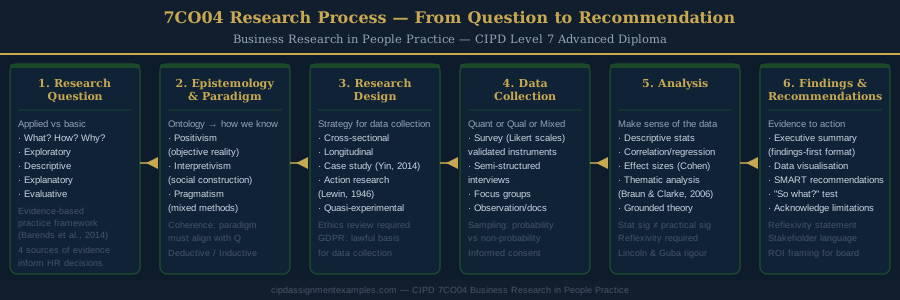
AC 1.1 — Nature and Purpose of Business Research in People Practice
The scientist-practitioner model, originating in clinical psychology and subsequently adopted in occupational and organisational psychology, provides a compelling framework for the role of research in HR practice. The model proposes that effective practitioners apply scientific reasoning to practical problems: they use systematic methods to generate evidence about what works, they interpret that evidence critically rather than selectively, and they update their practice when evidence contradicts established assumptions. Applied to HR, the scientist-practitioner model stands in contrast to two common alternatives: the experience-based practitioner (who relies primarily on personal and organisational history rather than systematically generated evidence) and the fad-follower (who adopts whatever methodology is currently fashionable in management consulting or leadership development, regardless of its evidential basis). The CIPD Profession Map's 'insights-focused' core behaviour — described as using 'evidence and data to generate actionable insights' — operationalises the scientist-practitioner orientation as a professional expectation rather than an optional aspiration.
The distinction between applied and basic research is fundamental to understanding the purpose of 7CO04. Basic research aims to generate knowledge for its own sake — to understand how organisations function, why people behave as they do at work, or what the theoretical mechanisms of performance management might be. Applied research aims to solve specific practical problems: why is our organisation experiencing elevated voluntary turnover among high-performing engineers? What is the relationship between our leadership development programme and subsequent promotion rates? Does the introduction of flexible working arrangements affect individual productivity and team cohesion in our context? 7CO04 focuses on applied research — but it teaches applied research through a rigorous methodological framework, because the quality of applied research determines whether its conclusions are trustworthy or misleading. The evidence-based practice framework articulated by Barends, Rousseau and Briner (2014) in their practitioner guide 'Evidence-Based Management' specifies four sources that should inform management decisions: scientific literature (systematic reviews and primary studies from peer-reviewed journals); organisational data (the facts, figures, and information from the specific organisation); stakeholder values and concerns (the preferences, experiences, and interests of those affected by the decision); and professional expertise (the practitioner's judgment, developed through experience and reflection). The critical contribution of 7CO04 is to develop the capability to evaluate each of these four sources rigorously rather than accepting them uncritically.
Business research is substantively distinct from management consultancy, though the boundary is often blurred in practice. Research uses systematic methods to generate generalisable evidence about a question — the researcher's prior views should not determine the findings. Consultancy applies expertise and experience to help a client solve a specific problem — the consultant is paid for recommendations, not for neutral evidence generation. The conflict of interest in commercially funded research is well-documented: research sponsored by organisations with a financial interest in particular findings consistently shows results more favourable to the sponsor than independently funded research on the same question (Ridker and Torres, 2006, provide a healthcare analogue widely cited in methodology literature). For HR practitioners commissioning or consuming research — whether from external consultancies, management training providers, or HR technology vendors — research literacy means being able to identify when a 'study' is marketing dressed as evidence, and distinguishing between correlation and causation, between statistical significance and practical significance, and between findings from a single context and generalisable conclusions.
AC 1.2 — Research Philosophy and Epistemology
The positivist paradigm in social science, associated with Auguste Comte and the nineteenth-century ambition to apply natural scientific methods to the study of society, holds that social reality is objective — it exists independently of those who observe or experience it — and that it is therefore amenable to the same empirical measurement and hypothesis-testing methods that produce reliable knowledge in the natural sciences. Positivist social researchers seek to describe and explain social phenomena through observation, measurement, and the testing of theoretically derived hypotheses against empirical data. In the HR context, a positivist research approach might ask: what is the relationship between supervisor support and employee psychological wellbeing, measured using validated instruments, in a sample of 500 UK employees drawn from a range of sectors? The research produces correlational or causal claims that aspire to generalise beyond the specific sample. The methods associated with positivism — structured questionnaires with Likert-scale items, validated psychometric instruments, statistical analysis — are designed to minimise the influence of researcher subjectivity on the findings, to enable replication, and to produce conclusions that can be accumulated across studies into systematic bodies of evidence.
The interpretivist paradigm, whose intellectual roots include Max Weber's concept of Verstehen (understanding), the phenomenology of Edmund Husserl and Alfred Schutz, and the sociology of knowledge developed by Berger and Luckmann (1966), starts from a fundamentally different ontological premise: that social reality is not pre-existing and objective but is continuously constructed through the meanings that social actors create and share. Because reality is constituted through meaning, the goal of social research is not prediction and generalisation but understanding: grasping the subjective significance of events, practices, and structures for those who live them. An interpretivist HR researcher studying organisational change might ask: how do employees in a newly merged organisation make sense of the integration process — what meanings do they assign to new management behaviours, cultural clashes, and communication failures? The methods suited to this question — semi-structured interviews that allow the researcher to follow the participant's own frames of reference, ethnographic observation of informal workplace behaviour, discourse analysis of organisational communication — are designed to preserve interpretive richness rather than to minimise researcher influence, and they produce findings that are context-specific and illuminating rather than generalisable in a statistical sense.
The distinction between ontology and epistemology is fundamental to research design coherence and is frequently conflated in introductory treatments. Ontology refers to the nature of reality — specifically, whether social reality exists independently of human consciousness (realist ontology, associated with positivism) or is constituted through social meaning and interaction (constructionist ontology, associated with interpretivism). Epistemology refers to the theory of knowledge — specifically, how we can acquire knowledge about reality. Positivist epistemology holds that reliable knowledge is produced through systematic empirical observation and measurement; interpretivist epistemology holds that reliable knowledge of social phenomena requires interpretive understanding of meaning. The importance of this distinction for research design is that choosing methods that are epistemologically inconsistent with the stated paradigm produces incoherent research: using quantitative survey methods to answer an interpretivist research question about meaning-making is not methodological triangulation but methodological confusion. Research design coherence — the alignment between research question, paradigm, methodology, and methods — is a central evaluative criterion at Level 7.
Pragmatism, associated with the philosophical tradition of William James, John Dewey, and Richard Rorty, and articulated in research methodology by John Creswell, takes a more instrumental approach to paradigm selection: the research paradigm should be chosen on the basis of what works best for answering the research question, rather than on the basis of prior philosophical commitment to realism or constructionism. Pragmatism provides the philosophical justification for mixed methods research — combining quantitative and qualitative approaches within a single study to generate both the statistical patterns that quantitative methods produce and the interpretive depth that qualitative methods provide. For HR practitioners conducting applied organisational research, pragmatism is often the most practically appropriate philosophical orientation: real organisational questions frequently have both measurable dimensions (how much turnover? how strong is the correlation between engagement and performance?) and interpretive dimensions (why do employees experience the performance management system as unfair? what meanings do they attach to the organisation's stated values?). The Level 7 requirement is not to choose a paradigm for its own sake but to demonstrate coherent reasoning about why the chosen approach is appropriate for the specific research question.
The question of why paradigmatic choice matters — beyond the philosophical interests of methodology scholars — has a practical answer: choosing the wrong paradigm leads to methods that cannot answer the research question, wasting resources and generating misleading conclusions. A researcher investigating the lived experience of employees during organisational restructuring who uses a structured questionnaire with forced-choice responses will produce numerical data that cannot capture the interpretive complexity of the experience — the sense of betrayal, the reinterpretation of organisational identity, the renegotiation of psychological contract terms — that are precisely the phenomena that the research question addresses. Conversely, a researcher investigating the statistical relationship between training investment per employee and subsequent sales performance who uses semi-structured interviews with 15 respondents will produce rich qualitative data that cannot establish the strength and direction of a relationship across a large population. Level 7 students must demonstrate not only awareness of paradigmatic options but the reasoning capability to select and justify an approach that is coherent with their research question.
AC 2.1 — Research Design
The fundamental distinction between inductive and deductive reasoning reflects different directions of intellectual travel in the research process. Deductive reasoning moves from theory to hypothesis to test: the researcher starts with an established theoretical framework (for example, the AMO model in HR), derives a specific, testable hypothesis from it (for example, 'organisations with higher employee voice opportunity scores, controlling for ability and motivation, will show higher individual work performance'), collects data appropriate to testing this hypothesis, and interprets the findings in terms of their implications for the theoretical framework. Deductive research is associated with the positivist paradigm and quantitative methods: it seeks to confirm or disconfirm theoretical propositions against empirical evidence. Inductive reasoning moves from observations to theory: the researcher starts with data (for example, transcripts from interviews with employees who have recently experienced a performance improvement plan) and builds theoretical concepts or propositions from the patterns observed in that data, without a prior theoretical commitment. Inductive research is associated with interpretivism and qualitative methods. In practice, research frequently combines elements of both: a primarily deductive study may generate unexpected findings that prompt inductive theorising, while a primarily inductive study may be informed by relevant prior literature without being constrained by a specific prior hypothesis.
Cross-sectional survey design — collecting data from a defined population or sample at a single point in time — is the most common research design in applied HR research, for pragmatic reasons: it is relatively low cost, can achieve large sample sizes, and is logistically feasible within the typical timeframe of a practitioner research project or dissertation. The critical limitation of cross-sectional design is that it cannot establish causation: because all variables are measured simultaneously, it is impossible to determine whether A causes B, B causes A, or both are caused by an unobserved third variable. A cross-sectional study finding that higher engagement scores are associated with lower voluntary turnover cannot determine whether engagement reduces turnover, whether low turnover intentions lead to higher engagement, or whether some third variable (for example, job quality or management quality) drives both. For many HR research questions, correlation is sufficient — knowing that engagement and turnover are associated, regardless of causal direction, has practical value for intervention design. But causal claims, including most claims about the effectiveness of HR interventions, require longitudinal or experimental designs.
Longitudinal research design follows the same individuals or organisations over time, enabling analysis of temporal precedence (does a change in one variable precede a change in another?) and change over time. Panel surveys, where the same respondents are surveyed at multiple time points, are the most common longitudinal design in HR research: the CIPD's annual 'Good Work Index' and the UK Household Longitudinal Study (Understanding Society) are examples. Longitudinal designs provide stronger evidence of causal direction than cross-sectional designs, but they are substantially more expensive, carry participant attrition risk (particularly for organisational studies where people leave employment), and require careful analysis to distinguish genuine change from measurement artefact. Case study methodology, as theorised by Robert Yin (2014), is specifically appropriate for research questions of the form 'how?' and 'why?' rather than 'how much?' or 'how often?'. A case study of how an organisation implemented a four-day working week would investigate the mechanisms, contextual factors, and outcomes of a specific instance rather than seeking to generalise across all organisations. The analytical value of a case study lies in its theoretical rather than statistical generalisability: it tests and potentially refines theoretical propositions rather than establishing population parameters.
Action research, first systematically described by Kurt Lewin (1946) in his foundational paper 'Action Research and Minority Problems', is a distinctive research design in which the researcher is not an external observer but an active participant in the situation under study, and in which research and intervention are iteratively intertwined. The basic cycle consists of four phases — planning (defining the problem and designing an intervention), acting (implementing the intervention), observing (collecting data on the effects of the intervention), and reflecting (interpreting the data and revising the intervention) — which are repeated through successive cycles until the problem is resolved or sufficiently understood. Action research is particularly appropriate in HR because HR practitioners are almost always insiders in their research contexts: they are both the researchers and the agents of change. The methodological challenge is managing the dual role — maintaining enough analytical distance to observe and interpret the situation critically while being sufficiently involved to facilitate effective change. Quasi-experimental designs in HR — for example, implementing a new onboarding programme in one division while leaving another as a control, and measuring 90-day productivity and retention in both — provide stronger causal evidence than observational studies but rarely achieve the random assignment that defines a true experiment. A/B testing, widely used in consumer technology, is increasingly applied in HR analytics for decisions such as the formatting of job postings or the timing of engagement interventions.
AC 2.2 — Quantitative Research Methods
Survey design is the most critical quantitative methods skill for HR practitioners conducting primary research. The quality of a survey depends first on the quality of the research question — a poorly specified question cannot be operationalised into valid and reliable survey items — and second on a series of technical choices about item format, response scale design, and questionnaire structure. Likert scale items (typically five or seven points from 'strongly disagree' to 'strongly agree') are the most widely used format for measuring attitudes, beliefs, and perceptions in HR surveys, but they are prone to several systematic biases: acquiescence bias (the tendency of some respondents to agree with items regardless of content), social desirability bias (the tendency to respond in ways that appear favourable rather than truthfully), and central tendency bias (the tendency to choose the middle option to avoid commitment to a position). Validated psychometric instruments — such as the Maslach Burnout Inventory, the Utrecht Work Engagement Scale, or the Job Demands-Resources scale — have been developed and tested to minimise these biases and to ensure that they measure what they claim to measure (construct validity) consistently across administrations (reliability). Where validated instruments are available for the constructs being measured, practitioners should use them in preference to constructing new items.
Sampling strategy determines whether the findings of a survey can be generalised to the target population and with what degree of confidence. Probability sampling methods — in which every member of the target population has a known, non-zero probability of being selected — include simple random sampling (every individual equally likely to be selected), stratified random sampling (the population is divided into homogeneous subgroups and individuals sampled within each stratum, ensuring representation), and cluster sampling (naturally occurring groups such as departments or sites are sampled, and all members of selected groups surveyed). Probability sampling enables statistical inference: the researcher can calculate confidence intervals and test hypotheses about population parameters. Non-probability sampling methods — including purposive sampling (participants selected on the basis of specific relevant characteristics), convenience sampling (participants available and willing), and snowball sampling (existing participants recruit further participants) — are appropriate for qualitative research and exploratory quantitative work but do not enable statistical generalisation. Determining sample size for a quantitative HR study requires balancing statistical power (the ability to detect a real effect if one exists) against cost and practical feasibility: as a general rule, 30+ responses are sufficient for descriptive statistics, 100+ for simple comparisons between groups, and 200+ for regression analysis with multiple predictor variables.
Statistical analysis in applied HR research spans a range of techniques that practitioners must be able to both conduct and interpret critically. Descriptive statistics — means, standard deviations, frequency distributions, and cross-tabulations — summarise the basic characteristics of a dataset and are the necessary starting point for any quantitative analysis. Correlation analysis (Pearson's r for interval data, Spearman's rho for ordinal data) assesses the strength and direction of the relationship between two variables: a Pearson r of 0.5 indicates a moderate positive correlation. Regression analysis extends correlation to ask: which variables, considered simultaneously, predict the outcome variable, and how much variance in the outcome does the model explain? Multiple regression is widely used in HR research: for example, predicting voluntary turnover probability from engagement score, manager quality rating, and pay satisfaction score simultaneously. The critical interpretive skill at Level 7 is distinguishing statistical significance (a finding unlikely to have occurred by chance given the sample size) from practical significance (a finding large enough to matter in practice): a correlation of r = 0.12 may be statistically significant in a sample of 2,000 but explains less than 2% of variance in the outcome and has limited practical value for HR decision-making. Effect size statistics — Cohen's d for mean differences, r for correlations — quantify the magnitude of a finding independently of sample size and should be reported alongside significance tests.
AC 2.3 — Qualitative Research Methods
The semi-structured interview is the qualitative method most widely used in applied HR research, and for good reason: it enables the researcher to explore participants' perspectives and experiences in depth, following the participant's own conceptual frame while maintaining sufficient structure to ensure that topics relevant to the research question are covered across all interviews. The interview guide — typically one to two pages of open questions and potential prompts — is not a rigid script; it is an orientation document that enables the researcher to enter the conversation with direction while remaining genuinely open to unexpected responses. The quality of a semi-structured interview depends heavily on the quality of the questions: effective questions are open (they cannot be answered with yes or no), non-leading (they do not hint at expected or preferred answers), and focused on specific experiences, events, or decisions rather than abstract generalities. Probing — the use of follow-up questions to deepen, clarify, or elaborate on initial responses — is the technique that distinguishes a skilled qualitative interviewer from a questionnaire administrator: 'Can you tell me more about that?' 'What did you mean when you said the process felt unfair?' 'How did that experience compare with previous performance reviews you've had?' are examples of probing that generate the interpretive depth qualitative research requires.
Focus groups offer a different kind of qualitative data: not the individual perspective of a single respondent, but the social construction of meaning through group discussion. When the research question concerns shared beliefs, norms, or collective sensemaking — 'how do line managers collectively understand their responsibilities for employee wellbeing?' or 'what stories do employees tell about why people leave this organisation?' — the group dynamics of a focus group are not noise to be controlled but data to be analysed. The facilitator's role is to enable productive discussion while managing the dynamics that can compromise data quality: the dominance of vocal participants, the suppression of dissenting views through social conformity, and the emergence of artificially consensual positions that mask genuine disagreement. Focus group data are appropriately analysed for evidence of normative positions (what the group agrees is right or normal), for moments of dissent and negotiation (where different views are exposed), and for the specific language through which participants frame issues — language that often reveals assumptions that individual interview responses take for granted.
Thematic analysis, as systematised by Virginia Braun and Victoria Clarke (2006) in their foundational British Journal of Health Psychology paper, provides the most widely applicable framework for analysing qualitative interview and focus group data in applied HR research. The six-phase process begins with familiarisation: reading and re-reading the transcripts, noting initial impressions, and developing a holistic understanding of the dataset before beginning systematic coding. Phase two — generating initial codes — involves marking every passage of data that is potentially relevant to the research question, at a fine-grained level without yet seeking to organise or interpret: individual lines, sentences, or short passages are assigned descriptive labels that capture their content or significance. Phase three searches for themes: the researcher reviews the complete set of codes and identifies clusters — groups of codes that share a conceptual coherence and together address a substantive aspect of the research question. Phase four involves reviewing the candidate themes against both the coded data (checking that each theme is coherently supported by the extracts assigned to it) and the full dataset (checking that the theme set adequately represents the range of the data). Phase five defines and names each theme with precision: a good theme name captures the essence of the theme in a phrase, and the theme definition articulates what is distinctive and substantive about this cluster of meaning. Phase six is the write-up: the analyst tells a compelling analytical story using selected data extracts as evidence, connecting the themes to the research question and relevant theoretical literature.
Grounded theory, developed by Barney Glaser and Anselm Strauss (1967) in their study of dying patients in hospital settings, is a qualitative methodology that aims to generate theory directly from data rather than testing prior theory. The defining methodological commitment of grounded theory is theoretical sampling: the researcher does not define the complete sample in advance but continues to collect data until theoretical saturation is reached — the point at which new data are not generating new conceptual categories or theoretical insights. In practice, saturation in grounded theory studies of HR phenomena typically occurs after 10 to 25 interviews, depending on the complexity of the phenomenon and the diversity of the sample. The rigour criteria applicable to qualitative research differ from those applied to quantitative research, as formulated by Lincoln and Guba (1985): credibility (the interpretivist equivalent of internal validity — do the findings accurately represent participants' perspectives?) is established through member checking (sharing findings with participants for verification) and prolonged engagement with the data; transferability (the equivalent of external validity — do the findings speak to contexts beyond the specific study?) is established not through statistical generalisability but through thick description that enables readers to assess applicability; dependability (the equivalent of reliability — would another researcher reach similar conclusions from the same data?) is established through an audit trail of analytical decisions; and confirmability (the equivalent of objectivity — do the findings reflect the data rather than the researcher's prior commitments?) is established through reflexivity — the explicit acknowledgement of how the researcher's own positionality, assumptions, and prior experiences may have shaped the research process and findings.
AC 3.1 — Ethics in Organisational Research
Informed consent is the foundational principle of research ethics: research participants have the right to decide whether or not to participate on the basis of accurate and complete information about what participation involves, what data will be collected, how it will be used, and what the potential benefits and risks of participation are. In academic research, formal consent is typically obtained through a written consent form; in applied HR research within an organisation, consent is often communicated through a clear introductory statement before a survey or at the start of an interview. The challenge in organisational research is that genuinely voluntary consent can be difficult to achieve when the researcher is in a position of authority over the potential participant. An HR Director conducting research with their own employees cannot credibly guarantee that non-participation will have no career consequences — even if they genuinely intend this to be so, employees may perceive implicit pressure to participate, particularly if the research concerns sensitive topics such as management quality, organisational culture, or wellbeing. Research design should include explicit measures to address this: clearly communicated anonymity or confidentiality guarantees, management assurance that non-participation will not be recorded, and ideally data collection mechanisms that physically or digitally prevent the researcher from identifying individual responses.
The distinction between anonymity and confidentiality is frequently misunderstood in practice but carries significant ethical weight. Anonymity means that the researcher does not and cannot know which individual provided which data — survey responses collected without demographic identifiers that could triangulate to a specific person are truly anonymous. Confidentiality means that the researcher knows who provided the data but will not disclose it to others without consent. In small organisations or in surveys of highly defined populations (for example, a survey of the 12 members of an organisation's senior leadership team), even genuinely anonymous data may be practically identifying: if the research question concerns an experience that only one or two people in the organisation are likely to have had, the response set may enable de-anonymisation regardless of the researcher's intent. Ethical research design in small-population contexts must confront this risk directly — either by aggregating responses across groups large enough to prevent identification, by using only qualitative methods in which the researcher makes explicit commitments about data security and non-disclosure, or by being honest with participants that complete anonymity cannot be guaranteed and obtaining informed consent for this qualified level of protection.
The ethics of researching one's own organisation — by far the most common situation for HR practitioners undertaking a 7CO04 research project — creates a set of challenges that are distinct from those facing external researchers. The insider researcher has access to context, relationships, and organisational history that an outsider lacks, enabling richer and more practically relevant research. But this insider position creates risks: the researcher may unconsciously select, interpret, or present findings in ways that confirm prior beliefs or serve political interests within the organisation; employees may respond to an HR manager researcher differently than to a neutral external researcher, potentially suppressing candid responses for political self-protection; and the HR manager's professional obligations to the organisation (including duties of confidentiality and loyalty) may conflict with the research obligation to represent findings accurately regardless of how inconvenient they are for the organisation. GDPR creates additional constraints: employee data collected under the employee's contract of employment (for payroll, performance management, absence management) cannot be repurposed for research without additional consent, even if the HR practitioner has administrative access to that data. Research using existing HR data must have an identified lawful basis under Article 6 GDPR (typically legitimate interests for internal research, with appropriate safeguards) and must comply with data minimisation and purpose limitation principles.
AC 3.2 — Presenting Research Findings and Making Recommendations
The executive summary is the most read section of any research report presented to a senior audience, and frequently the only section that is read in full. Its function is not to summarise the research process but to deliver the conclusions: a well-crafted executive summary states the research question in one sentence, summarises the most important findings in three to five numbered bullets, presents the key recommendations with clear action implications, and indicates the strength of the evidence base. The maximum length is two pages; one page is better. The common error of executive summaries written by researchers (rather than practitioners) is to lead with methodology and context, relegating findings to the final paragraph: this reverses the information priorities of executive audiences, who are time-constrained and primarily interested in what the findings mean for decision-making. The recommendations section should be structured to support action: each recommendation should specify what should be done, who is responsible, by when, and how success will be measured. Vague recommendations ('improve communication') are not actionable; specific recommendations ('implement quarterly town hall meetings by Q3 2026, with a post-meeting pulse survey to track perceived information quality, managed by the Head of Internal Communications') are.
Data visualisation for non-technical board audiences is a distinct skill from data analysis. The principles of effective data visualisation for communication purposes include: prefer charts to tables wherever possible, since visual patterns are processed more rapidly than numerical tables; use chart titles that state the finding rather than merely labelling the data (not 'Figure 1: Engagement by Department' but 'Engineering and Operations show engagement scores 12 points below the organisational average, driving predicted annual turnover of 22%'); avoid common misleading visualisation practices including truncated y-axes (which exaggerate differences), inconsistent time periods (cherry-picking a timeframe that supports a preferred conclusion), and dual-axis charts (which allow unrelated scales to be visually compared). The choice of chart type should follow the type of data and the analytical story being told: bar charts for comparing categories, line charts for showing change over time, scatter plots for showing relationships between variables, and heat maps for showing patterns across a matrix of variables. For most HR board reporting purposes, a small number of well-chosen and clearly explained charts communicates more effectively than comprehensive data coverage that overwhelms the audience's interpretive capacity.
The 'so what?' test — the discipline of connecting every finding to an actionable implication — is the critical translation step between research and practice. A finding that 37% of employees report feeling unable to raise concerns with their manager is descriptively interesting but analytically incomplete until it is connected to what the organisation should do about it. SMART recommendations — specific (exactly what action is proposed), measurable (how will we know whether the action has been taken and whether it has worked), achievable (is this action within the organisation's capability and resource constraints), relevant (does it address the identified problem), and time-bound (by when will it be done and by when will outcomes be measured) — provide the framework for translating research findings into actionable guidance. Acknowledging limitations is not a weakness of the research report but an enhancement of its credibility: all research is conducted under constraints that affect the confidence with which findings can be generalised or acted upon. Proactively stating that the research used a convenience sample, that response rates to the survey were below 50% (limiting representativeness), that the study was cross-sectional and cannot establish causation, and that the researcher's own role in the organisation may have influenced participant responses, demonstrates methodological honesty that strengthens rather than undermines the report's authority. Reflexivity in the final written report — an explicit section acknowledging how the researcher's positionality, prior assumptions, and organisational role may have shaped both the research process and the interpretations offered — is expected at Level 7 and is the dimension of reporting that most clearly distinguishes post-graduate research from competent undergraduate work.
Reading This Page in the Context of the Level 7 Programme
7CO04 is methodologically central to the Level 7 programme in a way that students often underestimate. The research literacy it develops — the ability to evaluate evidence quality, identify methodological weaknesses, and distinguish correlation from causation — is directly applicable to every theoretical claim made in every other Level 7 unit. When 7CO02 discusses the empirical evidence for High Performance Work Systems, a student with 7CO04 research literacy can evaluate whether the cited studies are cross-sectional or longitudinal, whether they rely on self-report data or objective performance measures, and whether the samples are generalisable to the student's organisational context. When 7HR01 reviews the evidence on the effectiveness of union recognition agreements, a student with research literacy can assess whether the research is primarily qualitative case study work (high interpretive richness, low generalisability) or quantitative panel data analysis (high generalisability, potential for causal inference). 7CO04 is not a standalone methods unit; it is the epistemological foundation on which all other Level 7 learning rests.
7CO04 vs Nearest Level 5 Equivalent — What Changes at Level 7
| Dimension | Level 5 (5CO01 — closest) | Level 7 — 7CO04 |
|---|---|---|
| Research philosophy | Some introduction to evidence-based practice; use of CIPD research and good-quality sources | Explicit engagement with ontology, epistemology, and paradigm (positivism, interpretivism, pragmatism); justified paradigm selection based on research question |
| Research design | Use secondary sources and existing data to inform analysis; basic primary research possible | Full primary research design: justified choice among cross-sectional, longitudinal, case study, action research, and experimental designs; coherence between paradigm, design, and methods |
| Methods sophistication | Basic quantitative (descriptive statistics, simple surveys) or qualitative (interviews, focus groups) | Systematic sampling strategy; validated instruments; statistical literacy; rigorous qualitative analysis (Braun and Clarke thematic analysis, grounded theory concepts); reflexivity |
| Ethics | Awareness of ethical research principles; consent and confidentiality | GDPR application to research data; power dynamics in organisational research; dual-role (HR manager/researcher) challenges; Lincoln and Guba rigour criteria |
| Reporting | Clear and structured presentation of findings with practical recommendations | Executive-summary format for senior audiences; data visualisation principles; SMART recommendations; explicit acknowledgement of limitations; reflexivity statement |