Diversity and Inclusion — CIPD Framework, Business Case and Assignment Application
Diversity and inclusion sits at the intersection of ethics, strategy, and HR practice. It encompasses the moral imperative to ensure that talent is recognised and developed regardless of protected characteristics, the legal requirements of the Equality Act 2010, the business case grounded in performance research, and the organisational culture work required to move from demographic representation to genuine belonging. For CIPD students, understanding D&I means mastering the definitional distinctions between diversity, inclusion, and equity; engaging with the evidence on business case and intervention effectiveness; and developing the critical perspective to evaluate what works, what is merely performative, and what the research actually demonstrates.
CIPD Framework
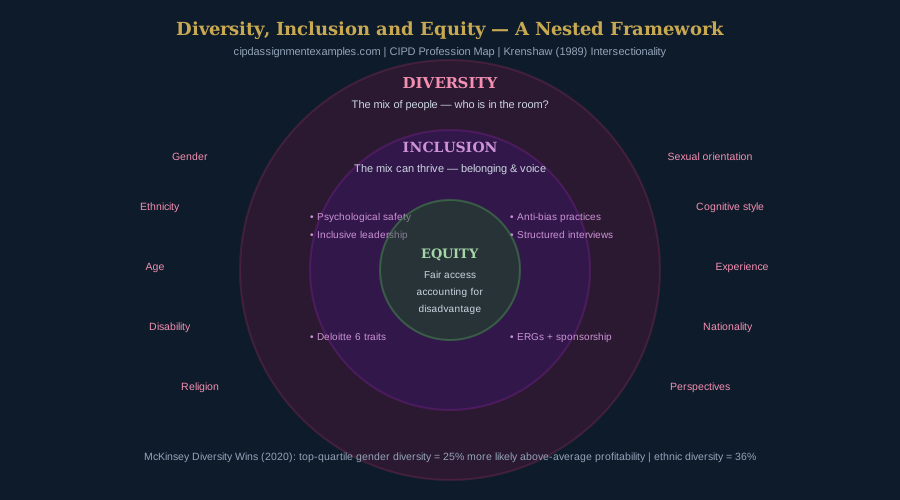
Definitions — Diversity, Inclusion, and Equity
Diversity describes the mix of people in an organisation. It encompasses two broad dimensions: demographic diversity — the protected and non-protected characteristics that differentiate people, including gender, ethnicity, age, disability, sexual orientation, religion or belief, and nationality — and cognitive diversity — the variation in thinking styles, mental models, problem-solving approaches, and perspectives that arise from different lived experiences, disciplinary backgrounds, and career histories. Demographic diversity is more easily measured and more directly addressed through representation targets; cognitive diversity is less visible but often the dimension that most directly drives the innovation and problem-solving benefits associated with diverse teams.
Inclusion is the organisational culture, leadership behaviour, and HR practice that enables the diverse mix to contribute fully, perform at their best, and genuinely feel they belong. This is the critical distinction that many organisations miss: a diverse organisation without an inclusive culture is one that has achieved representation without belonging. Diverse recruits arrive and leave rapidly when the culture rewards conformity to a dominant norm rather than welcoming the contribution of different perspectives. The Chartered Institute of Personnel and Development position is unambiguous: diversity without inclusion is neither good HR practice nor a sustainable business strategy. Inclusion is the work — diversity is an outcome measure of whether that work is succeeding.
Equity is the third concept in the D, E and I framework that has become increasingly standard in professional discourse. Equity is distinguished from equality: equality means treating everyone the same; equity means ensuring fair access to opportunity by accounting for the structural disadvantages that different groups face because of their starting position. An equality approach offers every employee the same development budget; an equity approach recognises that employees who face structural barriers to progression — lack of senior role models who share their identity, cultural capital mismatches in leadership selection processes, caring responsibilities that create attendance inflexibility — need different levels of support to achieve the same fair outcomes. Kimberlé Crenshaw's (1989) intersectionality concept adds a further layer: individuals hold multiple social identities simultaneously — a Black woman experiences the employment relationship differently from a white woman and from a Black man, because the interaction of race and gender creates a compound experience that single-axis analysis cannot capture. D&I strategy that addresses gender and ethnicity as separate programmes without examining their intersection will produce partial solutions that primarily benefit the most advantaged members of each targeted group.
The Business Case for Diversity and Inclusion
McKinsey's Diversity Wins: How Inclusion Matters (2020), the most comprehensive analysis of the diversity-performance relationship available, analysed data from over 1,000 large companies across 15 countries. Its headline findings are significant: companies in the top quartile for gender diversity on their executive teams are 25% more likely to achieve above-average profitability than companies in the bottom quartile; companies in the top quartile for ethnic and cultural diversity on executive teams are 36% more likely to achieve above-average profitability. These performance premiums have grown over successive McKinsey studies — the 2014 analysis found a 15% gender premium; by 2020 it had risen to 25% — suggesting that the performance advantage of diverse leadership teams is strengthening over time as competitive landscapes become more complex and cognitively demanding.
The theoretical mechanism that explains why diversity produces performance advantage was most rigorously articulated by economist Scott E. Page in The Difference: How the Power of Diversity Creates Better Groups, Firms, Schools, and Societies (2007). Page's argument — supported by formal mathematical modelling — is that in complex problem-solving contexts, groups of diverse problem-solvers outperform groups of individually high-ability but homogeneous problem-solvers. The mechanism is straightforward: diverse team members bring different cognitive tools — different heuristics, different mental models, different frameworks for decomposing and approaching problems. When stuck on a problem, a homogeneous group of high performers all hit the same wall because their approaches are similar; a diverse group is more likely to contain a member whose different framework provides a way through. This is sometimes captured in the phrase "diversity trumps ability" — under specific conditions, having the right mix of different problem-solving approaches outweighs having the highest average individual ability.
Harvard Business Review research on innovation and diversity consistently finds that diverse teams generate more creative solutions than homogeneous teams — but the diversity-creativity relationship is conditional. Diverse teams with low psychological safety, where the norms punish dissent or reward conformity to dominant perspectives, do not deliver their potential creative advantage. The performance premium from diversity requires inclusive leadership — specifically, the leader behaviours that create psychological safety, actively invite diverse contributions, and prevent dominant voices from suppressing minority perspectives. This conditionality is an important qualification of the straightforward business case: diversity without inclusion is not associated with performance improvement, and may be associated with performance reduction through the team conflict and communication friction that arise when different perspectives are not managed skillfully.
A further qualification that distinction-level students should engage with is the direction of causation in the McKinsey data. The research demonstrates correlation between diversity and performance, not causation. It is plausible that better-managed organisations are both more likely to be diverse (because better management includes better talent practices that reduce demographic bias) and more likely to be financially successful (because better management improves performance generally). If this interpretation is correct, diversity is a marker of good management rather than a cause of performance — reversing the causal story that the business case narrative assumes. This does not invalidate D&I as a strategic priority, but it means that organisations that pursue diversity as a performance lever without also improving overall management quality may not achieve the expected returns.
The Moral and Legal Case
The moral case for diversity and inclusion rests on three related principles. First, talent is distributed across the population regardless of gender, ethnicity, age, disability, or other protected characteristic — any selection process that systematically favours certain groups over others is wasting human potential that the organisation needs and that individuals deserve to have recognised. Second, the perpetuation of structural disadvantage through biased organisational processes is unjust — HR professionals who design and implement those processes carry professional responsibility for their fairness. Third, for CIPD professionals specifically, the CIPD Profession Map establishes "working inclusively" as one of the eight core behaviours that define professional practice across all CIPD roles and levels. Inclusion is not an optional add-on to HR practice — it is a constitutive element of what professional HR means.
The legal framework in the United Kingdom is anchored in the Equality Act 2010, which consolidated and extended previous discrimination legislation into a single statute covering nine protected characteristics: age, disability, gender reassignment, marriage and civil partnership, pregnancy and maternity, race, religion or belief, sex, and sexual orientation. The Act prohibits direct discrimination, indirect discrimination, harassment, and victimisation on the basis of these characteristics, and the Public Sector Equality Duty (section 149) requires public bodies to actively advance equality of opportunity, not merely avoid discrimination. The Gender Pay Gap Reporting Regulations 2017 require all employers with 250 or more employees to publish annually the mean and median gender pay gap, as well as bonus gap data — a significant accountability mechanism that has brought occupational segregation and its wage consequences into public visibility for the first time at scale.
The gap between legal compliance and genuine inclusion is significant and should feature in any high-quality CIPD discussion of the D&I landscape. Legal compliance means not breaking the law — no direct or indirect discrimination in employment practices, reasonable adjustments for disabled employees, no harassment or victimisation. This is a floor, not a ceiling. An organisation that does not discriminate but also does not create conditions where diverse employees can contribute fully, advance equitably, and genuinely feel they belong is legally compliant but not inclusive. The ethnicity pay gap — not yet mandatory to report in the UK at the time of writing, though government consultation has been ongoing — and disability employment gap data consistently demonstrate that legal compliance across the protected characteristics has not produced equitable employment outcomes, pointing to the gap between the legal standard and the inclusion standard that the CIPD champions.
Barriers to Inclusion
Unconscious bias is the most frequently cited barrier to inclusion in both academic and practitioner literature, and for good reason: the Implicit Association Test (IAT), developed by Greenwald, McGhee, and Schwartz at Project Implicit and made widely accessible online, has provided compelling evidence that most people hold some level of implicit preference for particular social groups even when they consciously hold egalitarian values and consciously reject prejudice. In HR contexts, the most consequential manifestations include affinity bias — the systematic tendency to prefer candidates, employees, and collaborators who are similar to oneself in background, education, communication style, and social experience — which means that in the absence of structured processes, hiring and promotion decisions are predictably shaped by homosocial reproduction: leaders recruiting and promoting people who remind them of themselves.
Structural barriers are distinct from bias and require different interventions. The glass ceiling — the invisible barrier that prevents women from advancing to the most senior organisational roles — has been extensively documented and has shifted but not disappeared: women hold approximately 40% of management roles in the UK but only around 25% of CEO positions in FTSE 100 companies. The glass cliff (Ryan and Haslam, 2005) adds a revealing qualification: women are more likely than men to be appointed to senior leadership roles when the organisation is already in difficulty — a pattern suggesting that leadership positions are made available to women when the risk of failure is highest and the conditions for success are worst. The bamboo ceiling (Sy et al., 2010) describes the barriers that prevent Asian employees from advancing to senior leadership roles despite strong educational and technical credentials, operating through cultural stereotypes that dissociate Asian identity from Western leadership norms. Career path architecture that assumes a linear, uninterrupted career trajectory disadvantages caregivers, those with health-related career gaps, and employees from backgrounds where early career investment was constrained — systematically excluding experience profiles that may offer significant value.
Micro-aggressions, a concept developed by Derald Wing Sue (2007) drawing on Chester Pierce's earlier work, describe the everyday, often subtle verbal and non-verbal communications that signal disrespect or marginalisation to members of underrepresented groups. Individual micro-aggressions may appear minor — an assumption that a senior Black professional is a junior member of staff, a pattern of interrupting women in meetings while allowing men to complete their contributions, a question about where someone is "really from" — but the cumulative effect of experiencing many such signals daily is significant: research links chronic exposure to micro-aggressions with elevated psychological distress, reduced engagement, and accelerated departure from organisations. Organisational culture that values conformity and punishes difference is the systemic context within which individual bias and micro-aggressions operate: cultures that explicitly value difference and actively model inclusive behaviour reduce the incidence and intensity of micro-aggressive interactions.
The structural interaction between these barriers creates a compounding effect that is larger than the sum of its parts. An employee who faces unconscious bias in performance evaluation, is excluded from informal sponsorship networks because they do not fit the social profile of those networks, experiences micro-aggressions that signal they do not fully belong, and encounters a career path architecture that does not accommodate the caring responsibilities they carry is experiencing a system of barriers that simultaneously erodes their performance, their development, and their retention. D&I interventions that address each barrier individually — a training course on unconscious bias here, a mentoring programme there — will produce limited results without a systemic approach that redesigns processes and culture simultaneously.
Inclusive Leadership
Deloitte's (2012) research on inclusive leadership — subsequently updated and refined through multiple global studies — identified six signature traits of leaders who create conditions where diverse teams perform at their best. Commitment: inclusive leaders demonstrate visible, sustained commitment to inclusion through their actions, not merely their stated values — they sponsor underrepresented employees, call out exclusionary behaviour, and devote attention and resource to inclusion work even when commercial pressure creates competing priorities. Courage: inclusive leaders speak up on inclusion issues even when it is uncomfortable and challenge organisational norms and individual behaviour that create exclusion — they do not stay silent when a colleague's comment is dismissive or when a process produces systematically skewed outcomes. Cognisance of bias: inclusive leaders have done the reflective work to understand both their own personal biases and the systemic biases embedded in organisational processes, and they actively take steps to mitigate both. Curiosity: inclusive leaders are genuinely interested in the perspectives of people different from themselves, actively seek out those perspectives rather than waiting for them to be offered, and create conversation conditions where different views are welcomed.
Amy Edmondson's (1999) concept of psychological safety — the shared belief that the team is safe for interpersonal risk-taking, where speaking up, sharing ideas, raising concerns, and admitting mistakes will not result in punishment or humiliation — is the most powerful single enabling condition for the performance benefits of diverse teams to be realised. Edmondson's original research with healthcare teams demonstrated that psychological safety predicted learning behaviour, error reporting, and team performance. Google's Project Aristotle (2016), an extensive internal study of what made Google's teams effective, identified psychological safety as the single most important factor differentiating high-performing from lower-performing teams — more predictive than the technical skills of team members, the clarity of goals, or the reliability of team members. Diverse teams with low psychological safety are less innovative than homogeneous teams, because the social risks of contributing a minority perspective outweigh the potential rewards in a low-safety environment.
Inclusive leaders create psychological safety through specific, learnable behaviours: modelling vulnerability by sharing their own uncertainty and mistakes; actively inviting dissenting views and demonstrating genuine consideration of them; treating mistakes as learning opportunities rather than occasions for blame; distributing speaking time equitably in meetings rather than allowing dominant voices to crowd out quieter contributors; and explicitly naming and valuing the different perspectives that team members bring. The inclusive leadership literature consistently finds that these behaviours can be developed — they are not fixed personality traits — which makes inclusive leadership a legitimate L&D objective rather than merely a selection criterion.
The distinction between representation and inclusion at the leadership level deserves specific emphasis: leaders can be demographically diverse in profile — reflecting the full range of protected characteristics — without being inclusive in their behaviour. Inclusion is a practice and a set of daily leader behaviours, not an identity. An organisation that appoints diverse leaders on the basis that their identity will automatically create inclusion for people who share that identity is making a category error — it is conflating representation (having diverse people in leadership) with inclusion (leader behaviours that create psychological safety and belonging for all). Both matter, but they are achieved through different means.
D&I Interventions — What the Evidence Shows
Structured interviews represent one of the most robustly evidenced HR interventions for reducing demographic bias in recruitment and selection. Schmidt and Hunter's (1998) meta-analysis of selection methods — the most comprehensive quantitative review of selection validity available — found that structured interviews have approximately twice the predictive validity of unstructured interviews for job performance. The mechanism through which structured interviews reduce bias is straightforward: by using the same standardised questions for all candidates and scoring each response against pre-defined behavioural criteria, structured interviews reduce the reliance on interviewer judgment that is most susceptible to affinity bias and stereotyping. When all candidates are asked identical questions and evaluated on identical criteria, the scope for biased interpretation of ambiguous signals is significantly constrained. The evidence strongly supports structured interviews as a standard practice in any organisation seriously committed to fair selection.
Blind CV and application screening — removing name, gender, address, educational institution, and other identifying information from applications before they are reviewed — has a more mixed evidence base. The theoretical mechanism is sound: research showing that CVs with typically white names receive more callback invitations than identically qualified CVs with typically Black or Asian names (Bertrand and Mullainathan, 2004, in the US context; similar studies in the UK context) establishes that reviewer bias operates at the application screening stage. Goldin and Rouse's (2000) landmark study of orchestral auditions — showing that blind auditions behind a screen increased the probability of a woman advancing to the later rounds — provides direct experimental evidence of the effect of removing identity cues on selection outcomes. However, UK trials of blind CV screening in government departments and private sector organisations have produced mixed results, and some studies have found null or even counterproductive effects, suggesting that the intervention's effectiveness depends significantly on implementation quality and the specific bias mechanisms operative in the organisation.
Diverse shortlisting requirements — mandating that recruitment processes produce shortlists including minimum representation of underrepresented candidates before interview decisions are made — address the pipeline problem that produces homogeneous interview panels even where individual selectors hold no conscious bias. The Rooney Rule (originated in the US National Football League, requiring that at least one ethnic minority candidate be interviewed for every head coaching vacancy) is the most well-known application. Evidence from its application in the NFL and subsequently in corporate hiring contexts suggests positive effects on the hiring of underrepresented candidates over time, though the effect size is moderate and dependent on the quality of the candidate pool development that precedes shortlisting. Diverse interview panels reduce the risk of homogeneous evaluation by ensuring that the scoring process draws on perspectives from different backgrounds — research suggests that assessors are more likely to recognise and value competence in candidates from groups they themselves represent.
The distinction between mentoring and sponsorship is one of the most important evidence-based findings in D&I intervention research. Mentoring — advisory relationships where a more experienced practitioner provides guidance, support, and career wisdom to a less experienced individual — is widespread and positively regarded. Sponsorship — active advocacy, where a senior and influential leader uses their social and political capital to create advancement opportunities for a more junior employee — is less common but significantly more impactful for career progression. Catalyst research has consistently found that sponsorship rather than mentoring is the critical missing link in the advancement of underrepresented employees: the difference between having someone who gives advice and having someone who publicly champions your advancement and actively creates opportunities is the difference between being mentored and being sponsored. Employee Resource Groups (ERGs) — affinity networks for underrepresented employee groups that provide community, voice to leadership, and belonging — are widespread in large organisations. Their risk is ghettoisation: placing the burden of D&I work on the voluntary labour of the very employees the organisation is trying to include, rather than embedding it in mainstream management accountability.
Measuring D&I
Effective D&I measurement requires a combination of representation data, process data, and experience data — none of which is sufficient on its own. Representation data — headcount by protected characteristic across grades, functions, and tenure — provides the fundamental picture of whether the organisation's workforce reflects the available talent pool, and where disparities are concentrated in the hierarchy and the lifecycle. Promotion rate analysis by demographic group reveals where the pipeline narrows and where the specific structural barriers to advancement operate. High-potential programme composition data — what percentage of employees identified as high potential come from underrepresented groups relative to their representation in the workforce? — shows whether the talent pipeline for future leadership is being built inclusively or is replicating current homogeneity at the top.
The Gender Pay Gap — measured as the mean and median difference between average hourly earnings of men and women across the whole organisation — is the most visible and legally mandated D&I metric in the UK for employers of 250 or more. It is important for CIPD students to understand clearly what the GPG measures and what it does not: it is a measure of occupational segregation (women concentrated in lower-paid roles, men concentrated in higher-paid roles) and its interaction with working pattern differences (part-time work, which women undertake more frequently, is associated with lower hourly pay in most organisations). It is not a direct measure of equal pay (the same pay for the same work) — equal pay claims arise from direct pay comparison between individuals in the same or equivalent roles; the GPG can be large even in an organisation with complete equal pay if the occupational distribution by gender is strongly asymmetric. An organisation with a large GPG may comply fully with equal pay law and still have a significant D&I problem visible in its representation data.
Inclusion metrics in employee engagement and pulse surveys — specifically questions about belonging, psychological safety, perceived fairness, and voice — disaggregated by protected characteristic reveal the experience dimension of D&I that representation data cannot capture. An organisation with 50:50 gender representation at all levels but where women report significantly lower psychological safety, belonging, and fairness perception than men has a serious inclusion problem that is invisible in its demographic data. Exit interview analysis — are certain demographic groups leaving disproportionately, at what tenure, and for what stated and unstated reasons? — is a particularly powerful diagnostic that most organisations are under-utilising. Disaggregated exit data that shows women or ethnic minority employees leaving significantly more frequently within the first two years of employment than white male colleagues is pointing to an inclusion failure that cannot be fixed by hiring more diverse recruits into a culture that does not retain them.
Critical Evaluation
The business case for D&I has important limitations as a foundation for strategic commitment. If D&I is pursued solely for commercial returns, it is inherently conditional: it will be maintained when diverse and inclusive workplaces are commercially advantageous, and abandoned or deprioritised when they are not — or when the causal link is ambiguous, as it frequently is at the level of the individual organisation. The moral case — that every person deserves fair access to employment opportunity regardless of characteristics irrelevant to their capacity to contribute — provides a more robust and durable foundation because it is not contingent on demonstrated performance premium. CIPD professional standards reflect this: inclusion is a core professional value, not a commercially contingent strategy. Organisations that anchor their D&I commitment solely in the business case risk the credibility of the entire programme when commercial headwinds emerge, precisely when diversity and inclusion investment is most likely to be needed.
Diversity without inclusion is a term that appears frequently in CIPD literature precisely because it describes a real phenomenon in many organisations: representation data that looks positive — the demographics of new hires improving, diverse cohorts entering the organisation — while the culture remains exclusive. The evidence of diversity without inclusion is in the retention data: when diverse recruits leave significantly faster than the average workforce, when representation improves at junior levels but does not translate into senior leadership representation, when diverse employees report lower belonging and psychological safety in engagement surveys — these are the signatures of diversity theatre. Hiring diverse talent into a homogeneous culture is an expensive and demoralising exercise: for the individuals who are recruited and then systematically excluded, the experience is damaging; for the organisation, the investment in diverse recruitment is wasted when the retention rate is poor.
Crenshaw's (1989) intersectionality analysis is a fundamental critique of single-axis D&I frameworks. When an organisation runs a gender equality programme and a race equality programme as separate initiatives with separate governance, separate metrics, and separate budgets, it creates a systematic blind spot: the experience of employees who are simultaneously women and from ethnic minority backgrounds — who face the compound and interacting effects of both gender and racial disadvantage — is addressed by neither programme adequately. The gender programme is implicitly designed around the experience of white women; the race programme is implicitly designed around the experience of Black men. The intersectional experience remains unaddressed, and the employees who face it are made invisible by the single-axis design. Truly inclusive D&I strategy requires intersectional analysis — measuring and acting on the compound effects of multiple identities rather than treating each dimension in isolation.
The global D&I challenge requires specific attention for organisations operating across multiple legal and cultural jurisdictions. What constitutes a protected characteristic and what forms of discrimination are legally prohibited vary significantly across national contexts. Same-sex relationships are criminalised in over 60 countries; gender identity protections that are established in UK law do not exist in many jurisdictions; disability rights frameworks vary enormously in scope and enforceability. An organisation that develops a global D&I strategy based on UK or US legal and cultural frameworks and then applies it uniformly across its global operations will encounter both legal compliance problems and cultural resistance in jurisdictions where the local context is substantially different. Global D&I strategy must navigate this variation with cultural intelligence and legal rigour — establishing clear non-negotiable minimum standards (no discrimination, no harassment, legal compliance in all jurisdictions) while recognising that the pace and form of inclusion work will legitimately vary by context — without using cultural variation as an excuse for abandoning core values or accepting practices that cause harm.
Using Diversity and Inclusion in Your CIPD Assignment
Diversity and inclusion is assessed directly in 5HR02 (Talent Management and Workforce Planning) — assessment criteria addressing fair and inclusive recruitment and selection practices draw on D&I frameworks, the Equality Act 2010, and evidence-based intervention research. 7HR02 (Resourcing and Talent Management) at Level 7 requires evaluation of how organisations attract, develop, and retain diverse talent and where bias operates in each stage of the talent lifecycle. D&I is a cross-cutting theme in 7CO02 (People Management and Development Strategy) — inclusive working environments, psychological safety, and equitable access to development are all connected to the performance and engagement outcomes that 7CO02 addresses. 7CO04 (Business Research in People Practice) may involve designing research that evaluates D&I outcomes and requires awareness of measurement challenges and ethical considerations in collecting data on protected characteristics.
At Level 5, the marking formula is: define diversity, inclusion, and equity with precision (not treating them as interchangeable); describe the business, moral, and legal cases with accurate evidence (McKinsey 2020, Equality Act 2010, CIPD Profession Map); evaluate at least two D&I interventions against the evidence base rather than simply listing them as positive practices. At Level 7, examiners expect: critical evaluation of the business case (including its limitations and the superiority of the moral case as a foundation); engagement with intersectionality theory and its implications for D&I programme design; evaluation of specific interventions against the evidence (structured interviews — strong evidence; unconscious bias training alone — limited evidence of sustained impact); and critical assessment of the gap between diversity as representation and inclusion as genuine belonging. Students who engage with Crenshaw's intersectionality concept at Level 7 consistently achieve higher marks because it demonstrates the theoretical depth that distinction-level work requires.
Related CIPD Resources
- Equality Act 2010 — CIPD Guide for HR Students
- Organisational Culture — CIPD Definition and Models
- 7CO02 Assignment Example — People Management and Development
- 7HR02 Assignment Example — Resourcing and Talent Management
- Psychological Contract — CIPD Definition, Breach and Application
- 5HR02 Assignment Example — Talent Management and Workforce Planning