Handy's Model of Organisational Culture — Four Culture Types Explained
Charles Handy's typology of organisational culture, first published in Gods of Management (1978, revised 1991), remains one of the most widely taught frameworks in CIPD HR study. By naming each culture type after a Greek god, Handy captured not just a structural arrangement but a character — a way of thinking, deciding, and relating that permeates the entire organisation. Understanding the four culture types, their HR implications, and their limitations is essential for CIPD 5CO02, 7CO02, and any assignment that requires cultural diagnosis or change management analysis.
Organisational Culture
What is Handy's Model of Organisational Culture?
Charles Handy published Gods of Management: The Changing Work of Organisations in 1978, with a substantially revised edition in 1991. The book was a landmark in management thinking not just for its typology of culture types, but for its broader argument that organisations are communities of people, not simply commercial enterprises optimised for production. Handy challenged the then-dominant rational-bureaucratic model of organisations by arguing that the character of an organisation — the way it thinks and feels — is as important as its formal structure in determining its effectiveness and the wellbeing of its members.
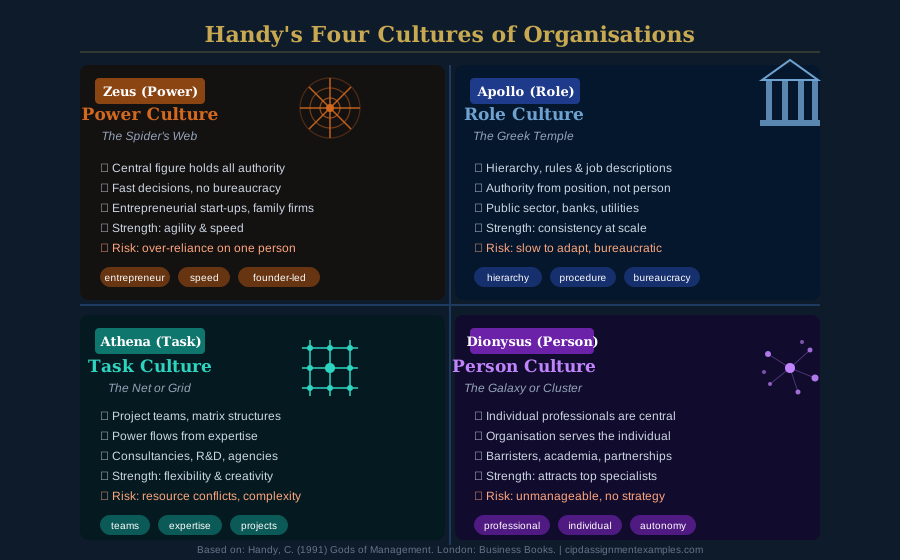
The four culture types — Power, Role, Task, and Person — were named after the Greek gods Zeus, Apollo, Athena, and Dionysus respectively. Each deity's mythological character illuminates the culture it represents: Zeus as the patriarch who rules by personal authority and charisma; Apollo as the god of reason and order; Athena as the goddess of wisdom and problem-solving; Dionysus as the individual spirit of creativity and autonomy. The use of mythological figures was not merely decorative — it communicated that organisations, like mythological characters, have personalities that are deeply ingrained, not easily changed, and resistant to purely rational redesign.
Handy argued that no single culture type is universally superior — each is well adapted to certain tasks, markets, and stages of organisational development. The problems arise when the culture type is mismatched to the organisation's situation — when a power culture tries to manage a thousand employees, when a role culture tries to operate in a rapidly changing market, or when a task culture tries to achieve the consistent operational delivery that requires role-culture discipline. Recognising the mismatch between culture type and organisational requirements is one of the most valuable diagnostic applications of the model in HR practice.
Power Culture (Zeus — The Spider's Web)
The Power Culture is represented by the spider's web: a central figure (or small group) from whom authority, decisions, and resources radiate outward. All significant power is concentrated at the centre, and influence decreases as you move toward the periphery. The defining characteristic of a power culture is speed: without committees, approval processes, or formal procedures, the organisation can identify a direction and move immediately. This agility is a genuine competitive advantage in fast-moving, uncertain environments where the ability to pivot faster than competitors matters more than procedural correctness.
Power cultures are most commonly found in entrepreneurial start-ups, founder-led businesses, political offices, and small family businesses where the founding figure remains dominant. In these contexts, the culture is not simply a management choice — it is an expression of the organisation's origins, where a single person's vision, energy, and judgment created the enterprise in the first place. The founder often cannot imagine — or refuses to contemplate — any other way of operating, because the power culture is inseparable from their personal identity and their account of why the organisation exists.
The HR implications of power culture are profound. Recruitment is primarily about personal loyalty and cultural fit with the central figure rather than technical competence or role specification — people who are hired must be trusted by the centre, and the centre's trust is personal, not positional. Performance management is informal, personality-based, and inconsistent — what matters is the central figure's judgment of your contribution, not a balanced scorecard process. Formal HR systems — job evaluation schemes, competency frameworks, structured appraisal — are resisted as threatening because they create a competing basis of authority to the central figure's personal judgment. The people who thrive in power cultures are comfortable with ambiguity, highly politically aware, and willing to subordinate their professional judgment to the centre.
The weaknesses of power culture become acute as the organisation grows. Over-dependence on a single individual creates catastrophic succession risk — when Steve Jobs was removed from Apple in 1985, the company lost direction almost immediately, and Handy would have diagnosed this as a predictable consequence of power culture at scale. Autocratic decision-making inhibits talent: high-quality professionals who value autonomy, recognised expertise, and consistent management will leave power cultures for environments that value their contribution more formally. The spider's web structure that enables speed in a ten-person company becomes a bottleneck in a three-hundred-person organisation, as every significant decision requires central approval and the central figure's bandwidth becomes the organisation's most critical constraint.
Role Culture (Apollo — The Greek Temple)
The Role Culture is represented by the Greek temple: each column (individual or department) has a defined function supporting the structure as a whole; the roof (senior management) rests on the columns but does not penetrate them. The defining feature is structure: formal job descriptions, reporting lines, procedures, rules, and hierarchy are the primary mechanisms of coordination. Authority derives from position — the role holder has authority commensurate with their position in the hierarchy, regardless of personal characteristics. In a pure role culture, the individual is almost interchangeable: when someone leaves their post, a successor fills the role and operates within the same parameters.
Role cultures are the natural home of large, stable organisations processing high volumes of routine work: government departments, large banks, utilities companies, manufacturing operations with standard operating procedures, and traditional professional services firms. The NHS, HMRC, and large local authorities are archetypal role cultures. These organisations' primary requirement is consistency and reliability at scale — thousands of transactions processed correctly, millions of pounds of tax collected accurately, healthcare delivered to minimum standards across every postcode. The role culture's procedural machinery is precisely designed to deliver this kind of consistent, scalable output.
The HR implications of role culture are equally distinctive. Job evaluation and formal grading structures are central to the HR architecture — pay and status are determined by the weight of the role, not the individual's contribution or market rate. Performance management is based on compliance with role requirements and process standards rather than on outcomes or innovation. Learning and development follows formal qualification pathways that align with the grading structure. Industrial relations tend to be formalised: large role-culture organisations are typically unionised, with national or collective agreements governing pay and conditions, and HR negotiating with union representatives according to established procedures.
The weaknesses of role culture are the mirror image of its strengths. The same procedural machinery that delivers consistency becomes an obstacle to change: role culture organisations are notoriously slow to adapt to shifting environments, because every change requires amendment to multiple procedures, job descriptions, and approval processes. Talented employees with high autonomy needs — particularly those with specialist expertise who could contribute more than their role specification allows — frequently become frustrated and leave role culture environments for more fluid task-culture settings. The process-obsession that characterises dysfunctional role cultures leads organisations to optimise for procedural compliance rather than outcomes — a phenomenon familiar to anyone who has engaged with large public sector bureaucracies.
Task Culture (Athena — The Net or Grid)
The Task Culture is represented by the net or grid: a matrix structure where power flows from nodes of expertise rather than from fixed hierarchical positions. The defining feature is team orientation and expert collaboration: project teams are assembled from specialists across different functions, given the resources and authority to complete a defined task, and then disbanded or reconfigured when the project concludes. Power belongs to the person with the most relevant expertise for the problem at hand, not to the person with the highest title. A junior consultant who understands a client's industry better than the partner has genuine power in a well-functioning task culture.
Task cultures are found wherever complex, non-routine problems require expert collaboration: management consultancy firms, advertising and creative agencies, technology product teams, R&D departments, and clinical teams in healthcare settings. McKinsey, Google's product teams, and NHS clinical MDTs (multi-disciplinary teams) all exhibit task culture characteristics. The common thread is that the problem cannot be solved by one person, requires the combination of different types of expertise, and benefits from a structure that allows expertise rather than hierarchy to determine who leads.
The HR implications of task culture reflect its expertise orientation. Role profiles are broader and less prescriptive than in role cultures — what matters is what you can contribute to team performance, not what your job description specifies. Reward structures recognise contribution and expertise rather than grade and seniority alone: many task culture organisations use project bonuses, expertise premiums, or broad salary bands that reflect market rates for skills rather than internal grading equity. Learning and development is continuous and self-directed — in a task culture, professional obsolescence is an existential threat, and organisations invest heavily in technical and professional skill development to keep expertise current.
The weaknesses of task culture emerge under resource pressure. When the same scarce experts are claimed simultaneously by multiple competing projects, coordination breaks down and performance suffers. Performance measurement is genuinely complex in matrix structures where an individual contributes to multiple projects simultaneously under different project leaders — which project should carry the performance review, and who has the complete picture of the individual's contribution? Without adequate structural coordination mechanisms, task cultures can become internally competitive and chaotic, with project leaders hoarding resources and information to protect their project's delivery at the expense of the wider organisation.
Person Culture (Dionysus — The Galaxy or Cluster)
The Person Culture inverts the normal assumption about the relationship between individual and organisation: here, the organisation exists to serve the individual's needs, not the other way around. Power is individual expertise, and the organisation is a loose federation of professionals who have come together for mutual convenience — shared administrative infrastructure, brand, premises — while retaining their professional independence. Coordination is achieved through mutual adjustment among peers rather than through hierarchy, rules, or team structure.
Person cultures are found in barristers' chambers, academic departments in universities, medical practices with multiple GP partners, and professional services partnerships where the partners are genuinely equal principals. The common thread is that the individual professional's reputation, client relationships, and expertise are the primary productive asset — the organisation cannot operate without them, and they know it. This fundamentally reverses the normal power relationship: in a person culture, the organisation has very limited leverage over its members, because the threat of dismissal carries little credibility when the member's departure would damage the organisation more than the member.
The HR implications of person culture are the most challenging of all four types. Management is facilitation rather than direction: the person culture leader coordinates rather than commands, persuades rather than instructs, and serves the professionals' needs rather than directing their activities. Reward is individually negotiated: standardised pay structures are almost impossible to impose, because each professional's market value and contribution are unique and they will not accept comparison with peers they consider less valuable. Retention depends entirely on maintaining the conditions — autonomy, professional status, peer recognition, and adequate resources — that attracted the individual in the first place.
The strategic weakness of person culture is its almost complete resistance to collective direction. If the organisation needs to change direction — to adopt a new technology platform, to enter a new market, to standardise processes — it cannot simply instruct its members to comply. Each professional must be individually persuaded that the change serves their interests, and a single powerful dissenter can block collective action indefinitely. Academic departments that have resisted digital transformation, partnerships that have failed to succession-plan because senior partners resisted reduced autonomy, and chambers that have maintained archaic practices despite clear evidence of their inefficiency — all illustrate the strategic cost of the person culture's resistance to collective governance.
Critical Evaluation of Handy's Model
Handy's four-culture typology has enduring strengths as a diagnostic tool. It is highly accessible — the Greek god metaphors make the abstract concept of organisational culture vivid and memorable — and it generates rich conversations among practitioners about what kind of organisation they actually work in versus what kind they aspire to be. The model is useful for identifying dominant culture types, for training managers to recognise cultural mismatches, and for structuring conversations about culture change that might otherwise lack a shared vocabulary.
The model's limitations, however, are significant and must be acknowledged in any serious CIPD-level analysis. First, most real organisations are cultural hybrids — the dominant culture type varies by function, level, and history within a single organisation. A large financial services firm might exhibit role culture in its compliance and finance functions, task culture in its change management and product development teams, and residual power culture around its founding family shareholders. Using Handy's typology to describe an organisation as simply "a role culture" is an oversimplification that can mislead analysis.
Second, Handy's model describes culture types but provides no mechanism for explaining how cultures form, why they persist, or how they can be changed. For this, practitioners must turn to Edgar Schein's three-level model (1985, revised 2010), which distinguishes between observable artefacts (the surface), espoused values (the stated level), and underlying basic assumptions (the deepest, most unconscious level). Schein's framework explains why culture change is so difficult — surface-level interventions that target artefacts (rebranding, restructuring, new values statements) without addressing underlying basic assumptions invariably fail, because the deep assumptions reassert themselves through informal behaviour even when formal structures change.
Third, Deal and Kennedy (1982) offer an alternative typology based on risk and feedback speed — their four types (Tough-Guy/Macho, Work Hard/Play Hard, Bet Your Company, and Process) cut the cultural landscape differently and provide different diagnostic insights, particularly for commercially oriented organisations. CIPD assignments at Level 7 will expect students not only to apply Handy's model but to evaluate it against these alternatives, demonstrating the critical analytical stance that distinguishes distinction-level work from descriptive pass-level responses.
Using Handy's Model in Your CIPD Assignment
Handy's four culture types appear most prominently in 5CO02 (Organisational Culture and Behaviour), where AC 1.1 requires students to explain what is meant by culture in the context of organisations, and AC 1.2 requires analysis of how culture affects people management practices. At Level 7, the model is relevant to 7CO02 (People Management and Development Strategies for Performance) — specifically the relationship between culture type and organisational performance — and to 7CO01, where students analyse how technological change and globalisation reshape organisational culture over time.
The formula for a high-scoring application is: (1) Accurately describe the relevant culture type using Handy's framework, citing Gods of Management (1991) in Harvard format; (2) Apply the type to your organisational scenario with specific evidence — structural features, HR practices, decision-making patterns; (3) Evaluate the implications for people management — what does this culture type mean for recruitment, performance, L&D, and engagement?; (4) Recommend — if the culture is mismatched to the organisation's strategic requirements, what change strategy is needed and how long will it realistically take? Remember that culture change is rarely achievable in less than three to five years. The citation format for academic submission: Handy, C. (1991) Gods of Management: The Changing Work of Organisations. London: Business Books.
Related CIPD Resources
- Organisational Culture in HR Practice — Full Guide
- 7CO02 Assignment Example — People Management Strategies
- 7CO01 Assignment Example — Strategic Employment Relations
- CIPD Level 5 Assignment Examples — All Units
- CIPD Level 7 Assignment Examples — All Units
- Hierarchical vs Flat Organisational Structure Compared