Organisational Culture — CIPD Definition, Models and Assignment Application
Organisational culture is one of the most examined — and most contested — concepts in CIPD study. It shapes how work gets done, how people are managed, what behaviours are rewarded, and how change is experienced. Understanding culture is not an abstract academic exercise: poor culture is consistently identified by CIPD research as a root cause of employee disengagement, talent loss, change programme failure, and organisational underperformance. This guide covers the CIPD definition, Schein's foundational three-level model, Deal and Kennedy's typology, culture-performance evidence, and the critical perspectives that distinguish distinction-level CIPD work.
CIPD Framework
The CIPD Definition of Organisational Culture
The CIPD defines organisational culture as "the values and behaviours that contribute to the unique social and psychological environment of an organisation" (CIPD Factsheet: Organisational Culture). This deceptively simple definition encompasses something genuinely complex: culture is not a document, a set of values painted on a wall, or a HR initiative. It is the accumulated product of an organisation's history — the decisions that were made, the leaders who shaped the group, the crises that were survived, and the assumptions about work, people, and the world that crystallised over time into taken-for-granted ways of operating.
Edgar Schein — the MIT scholar whose work on culture is the most cited in both academic and practitioner literature — offers a complementary definition: "a pattern of shared basic assumptions that was learned by a group as it solved its problems of external adaptation and internal integration" (Schein, 2010, p.18). This definition adds three critical elements the CIPD factsheet definition implies but does not state explicitly. First, culture is shared — it cannot exist in one person alone; it is a collective phenomenon. Second, it is learned — culture is not designed top-down, it is the product of what the group has discovered works over time. Third, it addresses two distinct sets of problems: external adaptation (how the organisation positions itself relative to its environment, competitors, and mission) and internal integration (how members develop common language, social norms, and shared understanding of status and power).
For HR practitioners, culture matters because it is the medium through which all people management activity operates. The same HR policy — a competency framework, a performance management system, a flexible working policy — will produce radically different outcomes depending on the cultural context in which it is implemented. In a power culture, a formal performance management system will be subverted by the central authority figure's personal judgments. In a role culture, a flexible working policy will struggle against procedural norms. Understanding culture is therefore not optional for effective HR practice — it is a prerequisite for understanding why well-designed interventions sometimes fail to produce the intended effect.
The CIPD's own research makes the practical stakes clear. Their 2020 organisational culture report found that only 15% of employees say their organisation's purpose and values are always lived in practice. This gap between stated culture (what the organisation says it values) and enacted culture (what is actually rewarded and modelled by leaders) is one of the most significant drivers of employee disengagement. Schein's framework, examined in detail below, provides the analytical tools to diagnose exactly where this gap lies and why it is so persistent.
Schein's Three Levels of Culture
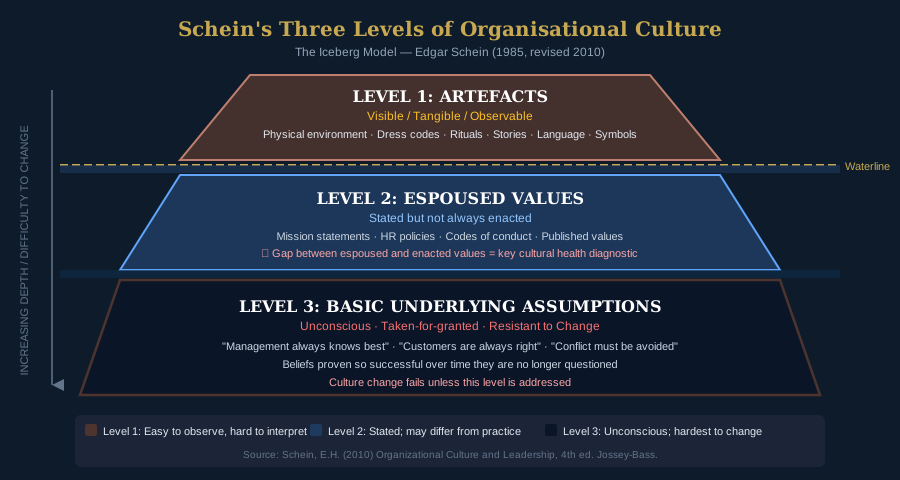
Schein's iceberg model remains the most analytically powerful framework for understanding organisational culture available to HR practitioners and CIPD students. The iceberg metaphor is instructive: what is visible above the waterline is real and important, but it is a small fraction of the total structure, and the part beneath the surface is what determines the iceberg's direction and momentum. Culture works the same way.
Level 1: Artefacts
Artefacts are the visible, tangible surface of culture — everything that a new employee or an outside observer would encounter on their first day. Physical artefacts include the organisation's built environment: open-plan offices signal collaboration and equality; separate executive floors with closed doors signal hierarchy and status differentiation. Dress codes are cultural signals: formal dress codes communicate professionalism and conformity; casual dress communicates egalitarianism and individual expression. Rituals and ceremonies — how promotions are announced, how milestones are celebrated, how departing employees are treated — reveal what the organisation values by showing what it chooses to mark and commemorate.
Artefacts also include the stories told and retold in the organisation — the founding myths, the heroes and villains of the organisation's history, the cautionary tales of careers that ended badly. Language is an artefact: organisations develop their own jargon, acronyms, and vocabulary that signals membership and encodes the values of the culture. The presence or absence of formal titles on email signatures, the speed and informality of responses, the use of humour in professional communication — all of these are cultural artefacts that encode deeper values about hierarchy, relationship, and identity.
The critical limitation of artefacts as a window into culture is that they are easy to observe but difficult to interpret correctly. An open-plan office might signal genuine egalitarianism, or it might signal cost-cutting dressed up in the language of collaboration. A values poster in the reception area might reflect deeply held and consistently modelled beliefs, or it might be a superficial PR exercise that is contradicted daily by actual management behaviour. Without understanding the espoused values and underlying assumptions, artefacts are easily misread.
Level 2: Espoused Values
Espoused values are the stated level of culture — what the organisation says it believes in and aspires to. Mission and vision statements, codes of conduct, HR policies, diversity and inclusion statements, published leadership principles — all of these are espoused values. They represent the organisation's conscious, intentional account of its own culture: what it tells new employees during induction, what it publishes on its careers website, what leaders communicate in all-staff briefings.
Espoused values are important, but they are not the same as the culture itself. The critical diagnostic question is the gap between espoused values and enacted values — the behaviours that are actually rewarded, modelled by leaders, and replicated by employees because they are understood to be what the organisation really values. When an organisation espouses "we value work-life balance" but consistently promotes people who work sixty-hour weeks and never takes action when managers demand presenteeism, the espoused value is contradicted by the enacted value. This gap is not invisible to employees — CIPD research consistently shows that employees are highly attuned to the difference between what their organisation says and what it rewards, and that inauthenticity at this level is a significant driver of disengagement and trust erosion.
HR policies are among the most visible espoused values in any organisation. A flexible working policy that is technically available but culturally stigmatised is an espoused value that has not penetrated to the enacted level. A bullying and harassment policy that is never used, or where complainants experience retaliation, communicates a deeply damaging message about the actual culture. For CIPD students, the analytical move is to distinguish between what an organisation's policies say (espoused) and what actually happens in practice (enacted), using this distinction as a basis for diagnosing cultural health.
Level 3: Basic Underlying Assumptions
Basic underlying assumptions are the deepest and most powerful level of culture — the unconscious, taken-for-granted beliefs about people, work, organisations, and the world that are so deeply embedded in group behaviour that they are no longer questioned or even consciously held. They were once conscious decisions or values — responses to real problems that proved successful and were reinforced over time — but they have since become automatic, invisible to the organisation's own members. They are the water in which the organisational fish swims: ever-present but rarely noticed.
Examples of basic underlying assumptions include: "management always knows best" (a unitarist assumption about the appropriate distribution of organisational authority); "people are fundamentally motivated by money" (a Theory X assumption that shapes reward system design); "customers are always right" (a service orientation assumption that determines how complaints and quality are handled); "conflict is destructive and should be avoided" (an assumption that shapes how performance issues and disagreements are managed). None of these would typically appear in any formal document — they are transmitted through informal socialisation, through observing how successful leaders behave, and through the stories that are told about how problems were solved in the past.
The HR significance of basic underlying assumptions is profound. Culture change programmes that target only artefacts and espoused values — new values statements, rebranding exercises, new HR policies — consistently fail to produce lasting behavioural change because the underlying assumptions reassert themselves through informal behaviour even when formal structures change. A restructuring exercise that creates new organisational charts but leaves the underlying assumptions about hierarchy and power untouched will produce an organisation that looks different but behaves identically. Schein's model explains why genuine culture change is so difficult and why it requires sustained, consistent leadership behaviour over years rather than one-off interventions.
Deal and Kennedy's Cultural Typology
Terrence Deal and Allan Kennedy (1982) developed an alternative typology to complement rather than replace Schein's model. Where Schein provides an analytical framework for understanding how culture operates at different levels of depth, Deal and Kennedy provide a diagnostic tool for classifying culture types based on two dimensions: risk tolerance (how much risk the organisation takes in its core activities) and feedback speed (how quickly the organisation receives feedback on whether its actions have been successful).
Tough-Guy/Macho Culture
High risk, fast feedback. Found in financial trading, entertainment, construction, emergency services, and some technology firms. Individual stars rather than team players are valued; high-pressure environments that reward boldness and penalise hesitation; short-term orientation because feedback is rapid; significant risk of burnout and high turnover. HR implications: reward systems favour individual performance-related pay; performance management is high-stakes and visible; wellbeing risks are significant and require active monitoring; leadership development must address the tendency toward toxic masculinity and the normalisation of psychological harm.
Work Hard/Play Hard Culture
Low risk, fast feedback. Found in sales-oriented organisations, retail, technology services, and customer-facing industries. High activity and energy levels; team orientation and collaborative selling; customer focus as the defining value; celebration of effort and volume of activity. HR implications: recognition and reward programmes are central; team-based bonuses and social incentives matter as much as financial reward; pace of work creates retention challenges — employees who cannot sustain the activity level leave quickly; the culture can mask poor quality work with high activity volume.
Bet Your Company Culture
High risk, slow feedback. Found in oil exploration, aerospace, defence, pharmaceuticals, and long-cycle manufacturing. Long-term orientation; high technical precision and analytical rigour; significant investment in expertise and professional development; patient cultures that tolerate long periods of uncertainty. HR implications: retention of specialist expertise is the critical HR challenge; reward structures must reflect long-term contribution rather than short-term output; organisational commitment and loyalty tend to be high but difficult to sustain across industry downturns.
Process Culture
Low risk, slow feedback. Found in traditional banking, insurance, government, and regulatory bodies. Procedure-oriented; systematic and careful; focused on how work is done rather than what outcomes are achieved; title and hierarchy matter significantly. HR implications: job evaluation and grading structures are central; compliance and consistency are the primary management values; change is resisted systematically and requires significant political management; employees tend to be risk-averse and respond better to incremental improvement than transformational change.
In CIPD assignments, Deal and Kennedy's typology is most useful when used alongside Handy's model (see Handy's Model of Organisational Culture) to provide a more rounded cultural diagnosis — the two frameworks cut the cultural landscape differently and illuminate different aspects of the same organisational reality.
Culture and Organisational Performance
The relationship between culture and performance is the most practically important dimension of organisational culture for CIPD students and HR practitioners. The evidence base is substantial and consistent in direction, even if the mechanisms are complex. Peter Drucker's much-quoted assertion that "culture eats strategy for breakfast" — while not sourced to a specific publication, it captures a widely evidenced empirical finding — reflects the research finding that strategic plans consistently fail when organisational culture is misaligned with the strategic direction. Employees enact their cultural assumptions, not their leaders' strategic intentions, when the two are in conflict.
The CIPD's 2020 report on organisational culture found widespread gaps between stated and enacted values. Only 15% of employees said their organisation's purpose and values were always lived in practice. This is not merely a question of organisational authenticity: CIPD research links this gap directly to engagement, which in turn drives productivity, absence rates, retention, customer satisfaction, and innovation outcomes. Gallup's extensive meta-analyses — synthesising data from millions of employees across dozens of countries — consistently find that business units in the top quartile for employee engagement show 21% higher productivity, 41% lower absenteeism, and 59% lower turnover than those in the bottom quartile. While engagement is not identical to culture, cultural health is among the strongest predictors of engagement.
The culture-performance relationship is particularly acute in the context of mergers and acquisitions. Approximately 70% of M&A transactions fail to deliver their projected value, and cultural incompatibility is consistently identified as one of the primary causes. McKinsey research on post-merger integration highlights that acquirers routinely underestimate the difficulty of integrating two different organisational cultures — not because the cultural differences are hidden, but because leaders systematically underestimate how deeply embedded cultural assumptions are and how long it takes to genuinely integrate them. Due diligence processes that treat culture as a soft afterthought, rather than as a fundamental driver of integration success, predictably fail.
Sub-cultures present a further performance challenge. In large, complex organisations, functional silos (finance, operations, HR, commercial), regional variations, professional communities (clinical staff versus administrators in healthcare), and acquired company cultures create a patchwork of sub-cultures that may be in tension with the stated organisational culture. HR practitioners need analytical frameworks — Schein's three levels, Martin's three perspectives (discussed below) — to map this sub-cultural complexity rather than assuming a unitary culture exists when it does not.
Leaders and Culture Change
Schein identifies six primary mechanisms through which leaders embed and reinforce culture — what he calls "primary embedding mechanisms" because they operate primarily at the level of basic assumptions rather than merely at the level of artefacts or espoused values. Understanding these mechanisms is essential for any CIPD student attempting to analyse how culture can be changed or strengthened.
The first mechanism is what leaders pay attention to and measure. If senior leaders consistently focus on short-term financial metrics in every management conversation and never discuss customer outcomes or employee wellbeing, this communicates — more powerfully than any values statement — what the organisation actually values. Employees are highly attuned observers of what their leaders attend to; their behavioural priorities follow attention, not stated values.
The second mechanism is how leaders react to critical incidents and crises. When an organisation faces a crisis — a major safety incident, a significant customer complaint, a financial shortfall — how leaders respond reveals the actual cultural priorities. A leader who responds to a safety incident by assigning blame rather than investigating systemic causes communicates an underlying assumption about individual accountability versus systemic thinking. How crises are handled becomes organisational story material that shapes culture for years.
The third mechanism is deliberate role modelling. Leaders who consistently model the behaviours they espouse — genuinely prioritising wellbeing, visibly admitting mistakes, demonstrating psychological safety by asking for feedback — reinforce cultural values at the enacted level. Leaders who say one thing and do another create the espoused-enacted gap that is the primary source of employee cynicism about culture change programmes.
The remaining mechanisms — how leaders allocate resources, the signals sent by recruitment and socialisation decisions, and how leaders design structure and control systems — all operate by continuously and consistently communicating what the organisation values. Lou Gerstner's turnaround of IBM in the 1990s is the most frequently cited evidence that deep culture change is possible: his own reflection that "I came to see in my time at IBM that culture is not just one aspect of the game — it is the game" (Gerstner, 2002, p.182) captures his realisation that the technical and strategic dimensions of the turnaround were less significant than the cultural transformation he led. Research evidence suggests that changing basic underlying assumptions takes three to seven years of sustained, consistent leadership behaviour.
Culture, HR Practices, and Inclusion
Culture is not transmitted through documents or communications alone — it is transmitted primarily through everyday HR practices that signal what the organisation values. The onboarding process is one of the most powerful moments of cultural transmission. Van Maanen and Schein's (1979) socialisation theory identifies how different onboarding approaches produce different cultural outcomes: collective, formal, sequential socialisation processes produce custodians of existing culture; individual, informal, disjunctive approaches produce innovation and role departure. The decision about how to onboard new employees is therefore a decision about what kind of cultural socialisation the organisation intends.
Performance management systems are among the most powerful cultural artefacts in any organisation. What gets measured and rewarded shapes culture far more powerfully than any values statement. A performance management system that measures only financial metrics teaches employees that financial outcomes are what the organisation values, regardless of the sustainability of how those outcomes are achieved. A system that includes behavioural expectations alongside outcome measures communicates a more balanced set of cultural values. The design of performance calibration processes — who participates, whose voice counts, how disagreements are resolved — encodes assumptions about power, fairness, and voice.
Reward systems are cultural artefacts in the most direct sense. Differential pay levels, recognition programmes, bonus structures, and the criteria for promotion all communicate organisational values at the enacted level. When organisations reward presenteeism — being visible and available — rather than outcome quality, they transmit a cultural assumption about work that is independent of any wellbeing policy they may have published.
One of the most significant cultural risks in talent management is the "cultural fit" hiring criterion. Hiring for cultural fit — selecting candidates who share the existing culture's values, norms, and behavioural styles — perpetuates the existing culture and systematically excludes diversity, because cultural fit assessments are invariably shaped by the biases of the assessors. The concept of cultural "add" — what different perspective, value, or capability does this candidate bring that is not already present? — is an evidence-based alternative that supports both diversity and organisational learning. Amy Edmondson's (1999) research on psychological safety — the belief that the team environment is safe for interpersonal risk-taking — is directly relevant here: cultures that exclude difference systematically suppress the psychological safety that enables learning and innovation.
Critical Evaluation of Culture Theory
Joanne Martin's (1992) three perspectives on culture provide CIPD Level 7 students with the critical analytical framework needed to move beyond the mainstream consensus view of culture as a manageable, unitary force. The Integration perspective — the dominant mainstream view in most management textbooks — treats culture as organisation-wide consensus: shared values, common understandings, and aligned behaviour. This is the view that underpins most corporate culture management initiatives, and it is the view that most senior leaders hold when they commission culture surveys. It is also, Martin argues, a partial and ideologically loaded view that serves the interests of management by presenting cultural alignment as both possible and desirable.
The Differentiation perspective treats culture as a collection of multiple sub-cultures with genuine disagreement and conflict between them. In large, complex organisations — multinational corporations, NHS trusts, large government departments — this is the more realistic description. Different functional groups, professional communities, and geographic locations develop distinct sub-cultures that may share the official corporate values at the espoused level while enacting quite different assumptions at the behavioural level. The practical implication of the Differentiation perspective is that culture management must engage with sub-cultural diversity rather than attempting to impose a false uniformity.
The Fragmentation perspective is the most radical: culture is neither unified nor divided into stable sub-cultures, but is constantly in flux, ambiguous, and shifting. Different individuals construct different meanings from the same cultural artefacts, and these meanings change over time. The Fragmentation perspective challenges the fundamental manageability assumption that underlies most culture management initiatives — if culture is inherently ambiguous and unstable, the premise of a managed culture change programme is questionable. This perspective resonates with critical management scholars who argue that organisations do not simply "have" cultures that can be designed and changed — they "are" cultures, and attempting to "manage" culture is inherently a political act that serves particular interests.
Gideon Kunda's (1992) ethnographic study Engineering Culture at a technology company provides the most disturbing empirical evidence of this critical perspective. Kunda documented how senior management's attempt to create a strong, distinctive corporate culture produced not genuine shared values but sophisticated performances of cultural compliance by employees who privately maintained their own distinct identities. The culture management programme was experienced not as authentic value-sharing but as social control — employees learned to perform the expected cultural identity while privately resisting it. This finding should give HR practitioners pause: strong culture programmes are not neutral HR interventions. They carry real ethical risks of manipulation and inauthenticity that must be weighed against their stated benefits.
Using This in Your CIPD Assignment
Organisational culture is assessed most directly in 5CO02 (Organisational Culture and Behaviour) — AC 1.1 requires you to explain what culture means in an organisational context, and AC 1.2 requires analysis of how culture affects people management practices. At Level 7, culture frameworks apply to 7CO02 (culture-performance strategy), 7CO01 (how external change reshapes culture), and implicitly to virtually every other unit because culture shapes the context in which HR interventions operate.
The marking criteria distinguish descriptive from analytical responses. A descriptive response defines Schein's three levels and moves on. An analytical response applies each level to your organisational scenario with specific evidence, evaluates the gap between espoused and enacted values, and assesses the HR implications of the cultural diagnosis. A distinction-level response goes further: it evaluates the framework itself using Martin's three perspectives, acknowledges the limitations of the manageability assumption, and considers the ethical dimensions of culture management. Academic citations: Schein, E.H. (2010) Organizational Culture and Leadership, 4th ed. San Francisco: Jossey-Bass. CIPD (2020) Organisational Culture and the Role of HR. London: CIPD.
Related CIPD Resources
- Handy's Model of Organisational Culture — Four Culture Types Explained
- Psychological Contract — CIPD Definition, Breach and Assignment Application
- 7CO02 Assignment Example — People Management and Development Strategies
- 7CO01 Assignment Example — Strategic Employment Relations
- Diversity and Inclusion — CIPD Framework and Practice
- CIPD Level 5 Assignment Examples — All Units