Learning Needs Analysis — CIPD Framework, Methods and Assignment Application
Learning needs analysis (LNA) is the foundation on which effective L&D strategy is built. Without it, training budgets are allocated on the basis of manager preference, supplier relationships, or the mistaken assumption that what worked last year will address this year's capability gaps. With it, organisations can direct development investment toward the specific knowledge, skill, and behaviour gaps that stand between current performance and strategic objectives. For CIPD students studying 5HR03 at Level 5 or 7CO02 at Level 7, understanding LNA means mastering the three-level framework, the range of diagnostic methods, the principles of prioritisation, and the Kirkpatrick evaluation model that closes the L&D cycle.
Analysis Framework
What is a Learning Needs Analysis?
Learning needs analysis (LNA), also called training needs analysis (TNA), is the systematic process of identifying the gap between current and required knowledge, skills, and behaviours to achieve strategic objectives. The process begins with the question: what do people in this organisation need to be able to do in order to deliver the strategy? It then works backward from that strategic requirement to identify where current capability falls short, who is affected, and what interventions would close the gap most effectively. Boydell (1976) formalised the three-level approach that remains the dominant framework in CIPD curriculum and L&D professional practice. The CIPD definition — "a systematic approach to identifying what learning interventions are needed to support organisational objectives and employee development" — captures both the strategic purpose (organisational objectives) and the individual dimension (employee development) that a complete LNA must address.
The business case for rigorous LNA is straightforward, and yet CIPD research consistently finds that it is more often endorsed in principle than enacted in practice. CIPD (2021) L&D survey data showed that only 48% of UK L&D teams conduct a structured LNA before designing or commissioning learning interventions. The remaining majority allocate budget based on historical patterns, line manager requests, supplier proposals, or generic benchmarking against what comparable organisations provide — none of which reliably identify the specific capability gaps that are preventing the organisation from achieving its objectives. Organisations that do conduct structured LNA report significantly better self-assessed L&D return on investment, higher rates of learning transfer, and stronger alignment between L&D activity and business performance improvement.
The ethical dimension of LNA is less often discussed but genuinely important for HR professionals. Learning interventions require significant investment — of money, of employee time, and of the psychological effort that genuine skill development demands. Directing those interventions at people who do not have the identified need wastes all of those resources and can generate resentment rather than development. Directing interventions at genuine need identified through rigorous analysis is the professional standard that the CIPD Code of Conduct implicitly requires. The LNA process is therefore not merely a technical step in the L&D cycle: it is the ethical foundation that justifies the allocation of development resources and the commitment of employee time.
The Three-Level Analysis Framework
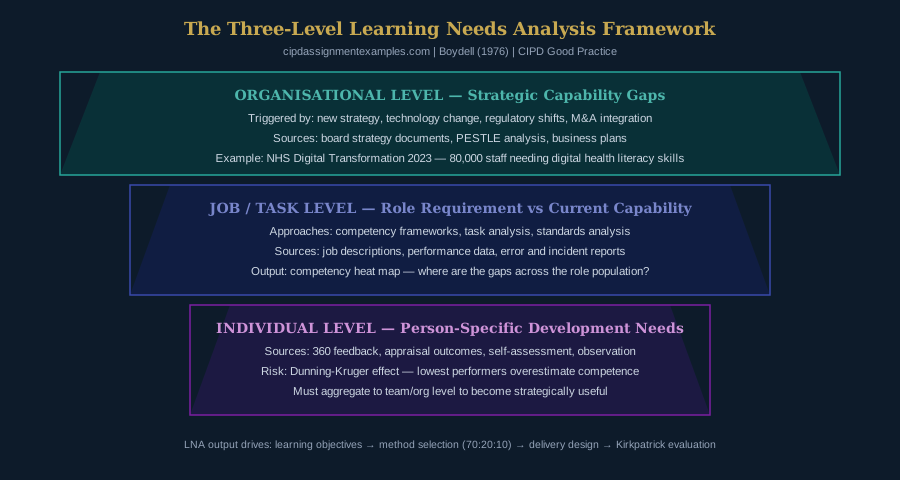
The three-level framework distinguishes between analysis at the organisational, job/task, and individual level. These three levels are not sequential alternatives — a complete LNA addresses all three simultaneously, because the needs identified at each level have different implications for intervention design, priority, and delivery. An organisational-level need (the entire sales function requires new digital selling skills following a CRM platform change) will call for a different response than a job-level need (the call centre team leader role now includes workforce scheduling responsibilities that the current population lacks) or an individual-level need (a specific high-potential manager has a development gap in strategic communication).
At the organisational level, the analysis asks: what capabilities does the organisation need to execute its current and emerging strategy? Triggers include new business strategy requiring new skills (digital transformation, market entry, product innovation); technology change creating skill obsolescence or new technical requirements; regulatory change mandating new compliance knowledge (GDPR, health and safety legislation changes); and M&A integration requiring harmonisation of capability standards across previously separate organisations. Sources of data at this level include board strategy documents, business plans, PESTLE analysis, competitor capability intelligence, and industry workforce intelligence reports. A real-world example: NHS England's digital transformation strategy identified that approximately 80,000 clinical and non-clinical staff needed digital health literacy capabilities that could not wait for organic development — an organisational-level LNA triggered a nationally coordinated programme of intervention across the NHS estate.
At the job or task level, the analysis asks: for each job family or role, what knowledge, skills, and behaviours are required at the standard the role demands? This is then compared against what the current population in that role actually holds, generating a gap profile for the job type rather than the individual. Approaches include competency framework analysis (comparing the specified competency standard against assessed current levels for each competency); task analysis (decomposing the job into its component tasks and identifying the knowledge and skill each requires); occupational standards analysis (using national occupational standards or sector-specific frameworks as the reference point for job-level requirements); and job analysis interviews with high performers (what do the people doing this job at the highest level actually do, and what enables them to do it?). Job-level analysis is particularly powerful for identifying training needs that line managers are blind to because they are embedded in their own team's way of working.
At the individual level, the analysis asks: for each specific employee, what is the gap between their current assessed capability and the requirement of their role? Sources include 360-degree feedback instruments; performance appraisal outcomes and development plan conversations; self-assessment questionnaires; line manager observation and informal assessment; formal assessment centre exercises designed to evaluate capability against the job-level standard; and development centre data. The individual level is the most granular and the most directly actionable for the line manager and HR business partner, but it is also the most resource-intensive to conduct at scale. Individual-level analysis must be aggregated systematically across teams, functions, and the whole organisation to identify patterns that reveal systemic needs — a single individual's development gap in project management may be an individual issue; the same gap appearing in 60% of middle managers is a systemic capability issue requiring an organisational-level response.
LNA Methods
Surveys and questionnaires are the most scalable LNA method for large organisations. They can reach hundreds or thousands of employees at low marginal cost and, when well designed with clear behavioural anchors for each response option, generate quantifiable gap profiles that support prioritisation. Their primary limitation is self-assessment bias: employees' ratings of their own capability are subject to the Dunning-Kruger effect — the well-replicated finding that individuals with the lowest actual capability tend to overestimate their performance most significantly, precisely because competence in a domain includes the meta-cognitive ability to recognise what competence looks like. The practical implication is that survey data should never be the sole source of LNA evidence, particularly for identifying the highest-priority development needs.
Interviews — structured or semi-structured — generate rich qualitative data about development needs that surveys cannot capture. A structured interview with a team leader about the capability gaps they observe in their team will typically surface nuanced situational insight: "they can follow the compliance process but they struggle when a customer case doesn't fit the standard categories" is the kind of contextually specific gap description that a survey scale cannot generate. The limitation is time: a thorough interview programme across a large organisation is expensive, and interview quality depends heavily on the skill of the interviewer and the honesty of the interviewee — interviewees may be reluctant to identify their own gaps if they fear the information will be used in performance management rather than to support development.
Performance appraisal data — when analysed systematically across teams, roles, and the organisation — is one of the most objective and already-available LNA sources. Patterns of underperformance against specific objectives or competency ratings, when aggregated by role or department, point directly to systemic capability gaps. The limitation is that performance appraisal data reflects the quality of the appraisal process: if ratings are inflated by leniency bias or compressed into the middle of the scale by managers avoiding difficult conversations, the data will understate genuine development needs. Observation and work shadowing provides LNA data that avoids self-assessment bias entirely, making it especially valuable for manual, technical, or customer-facing roles where performance is directly observable. Its limitation is obvious: it is time-intensive and may itself alter behaviour (the observer effect), potentially generating an inflated picture of current capability during the observation period.
Competency gap analysis — comparing each individual's or team's assessed performance on each competency against the required level defined in the competency framework — generates a heat map of development need that is both quantifiable and visually accessible to senior stakeholders. A well-constructed heat map shows at a glance where capability is below standard across the workforce, ranked by severity and breadth. Error and incident analysis deserves particular mention as an often-underused LNA source: when the same type of customer complaint, operational error, or near-miss recurs across different teams, the pattern frequently points to a specific, addressable learning need. Before designing a training response, however, it is critical to check whether the underlying cause is actually a capability gap (a learning intervention is appropriate) or a process design problem or resource constraint (training will not solve it). LNA that fails to make this distinction risks directing development resources at symptomatic behaviour rather than root cause.
Prioritisation — From Needs to Action
A rigorous LNA typically identifies more learning needs than can be addressed simultaneously with available resources. Systematic prioritisation is therefore not optional — it is a core L&D competence. The professional standard is a four-category prioritisation framework: mandatory/compliance needs represent legal or regulatory requirements where non-compliance creates legal liability or safety risk — fire safety awareness, manual handling, GDPR, safeguarding — these must be addressed regardless of cost-benefit calculation; strategic needs are directly aligned to the current business strategy and planned future capability requirements — they should be addressed proactively with planned intervention programmes; performance-critical needs are gaps that are currently preventing the organisation from operating its core business functions at the required standard — these are addressed urgently regardless of whether they appear in the strategic plan; development needs enhance individual or team capability beyond the current baseline in ways that are valuable but not immediately critical.
Within each priority category, cost-benefit analysis provides the quantitative discipline to allocate resources effectively. The estimated cost of each intervention — facilitator fees, materials, technology platform, learner time away from productive work — is weighed against the estimated value of the performance improvement the intervention is expected to produce. For compliance training, the calculation is dominated by the cost of non-compliance (legal penalty, enforcement action, reputational damage) rather than performance improvement. For strategic capability development, the calculation is more complex and more uncertain — but the professional L&D practitioner is expected to make an evidence-based estimate, not simply declare the calculation impossible.
The LNA heat map is the practical tool that makes prioritisation transparent and shareable with senior stakeholders. Plotting identified needs on a matrix of urgency (how soon does this gap need to be closed?) against impact (how significantly does this gap affect organisational performance?) produces four quadrants: high urgency/high impact (immediate action — typically includes performance-critical and strategic needs); high urgency/low impact (quick fix — address efficiently but do not over-invest); low urgency/high impact (plan and invest — typically the strategic development priorities that will build future capability); low urgency/low impact (defer, decentralise to self-directed learning, or deprioritise). Presenting this matrix to a senior leadership team during the L&D planning cycle provides the visible strategic alignment that elevates the L&D function from a training provider to a strategic capability partner.
From LNA to Learning Solution Design
The transition from identified need to learning solution design requires a disciplined focus on learning objectives. Effective learning objectives are written in terms of observable learner behaviours — what the learner will be able to do following the intervention, not what the trainer will deliver during it — and meet SMART criteria (specific, measurable, achievable, relevant, and time-bound). "Understand compliance procedures" is not a learning objective — it is a content description. "Apply the organisation's GDPR data subject access request procedure to at least three different customer scenarios, meeting all regulatory timelines, without supervisor guidance" is a learning objective: it specifies observable behaviour, a performance standard, and a context.
Method selection should follow from the learning objective and the LNA evidence, not from the default preferences of the L&D function or the availability of existing materials. The 70:20:10 model — which proposes that approximately 70% of effective capability development comes from on-the-job experience, 20% from social learning through coaching, mentoring, and peer interaction, and 10% from formal instruction — provides a useful strategic orientation toward experiential and social learning modalities. See the 70:20:10 model for a full explanation and critical evaluation of its evidence base. The practical implication for LNA-to-design linkage is that formal training courses should be the last resort, not the default response — the majority of capability development is best supported through structured work assignments, action learning, coaching relationships, and communities of practice.
Transfer of learning — the application of learning back to the role — is the most critical and most commonly neglected phase of the L&D cycle. Research by Broad and Newstrom (1992) established that line manager support — specifically the manager's active reinforcement of new behaviours and explicit connection of training content to work challenges — is the single strongest predictor of transfer from training to performance improvement. Their research showed that this support is most powerful when provided before training (setting expectations), during training (discussing application plans), and after training (reviewing application progress and removing barriers). Action learning sets — small groups of managers working on real, live organisational challenges through cycles of action and reflection — are one of the most effective transfer mechanisms because learning and application are integrated rather than sequential. The LNA process should therefore include an analysis of transfer conditions as well as learning gaps: what environmental and managerial conditions will support application of the learning back to the role?
Kirkpatrick's Four-Level Evaluation Model
Donald Kirkpatrick's four-level evaluation model, first published in 1959 and developed through subsequent editions including the posthumous Kirkpatrick's Four Levels of Training Evaluation (2016, co-authored with James Kirkpatrick), provides the dominant framework for evaluating learning effectiveness in CIPD curriculum and professional practice. The model is organised around four progressively demanding questions: did participants react positively? Did they learn? Did they change their behaviour? Did the organisation benefit? Each level requires different measurement methods and has different strategic implications.
Level 1 Reaction asks whether participants found the learning intervention relevant, engaging, and useful. Measured through post-event participant surveys — often called "happiness sheets" — this level is the easiest to collect and the most commonly reported in L&D metrics. Its primary limitation is low predictive validity for the outcomes that actually matter: participants can rate a training event highly because it was enjoyable, well-facilitated, and socially engaging without it having produced any measurable knowledge acquisition or behaviour change. Level 2 Learning asks whether participants actually acquired the intended knowledge, skill, or changed their attitude. Measured through pre/post knowledge tests, skills demonstrations, assessed practice exercises, or attitude surveys before and after the intervention, Level 2 measurement directly assesses whether the learning objective was met. It is more informative than Level 1 but still does not reveal whether acquired knowledge will be applied in the workplace.
Level 3 Behaviour asks whether participants changed their on-the-job behaviour as a result of the learning. This is the level that most directly addresses the purpose of the intervention — capability development — and yet it is consistently the most neglected in practice. Measurement requires line manager observation, 360-degree follow-up assessments, or performance data collection at 3-6 months post-intervention, when new behaviours have had the opportunity to be established. The resource requirements are significant, and the results can be uncomfortable when they reveal that expensive training programmes produced little measurable behaviour change. The evidence base for low transfer rates — studies consistently suggesting that only 10-30% of training is effectively applied in the workplace — makes Level 3 measurement both critical and professionally challenging. Level 4 Results asks whether the organisation achieved the business outcomes that motivated the learning intervention. Measurement uses business KPIs: productivity rates, error rates, customer satisfaction scores, safety incident frequency, revenue per employee, or whatever metric the LNA identified as the performance gap to be closed. Level 4 is the ultimate measure of L&D value but the hardest to attribute specifically to training, because multiple confounding variables affect organisational performance simultaneously.
Jack Phillips (1997) extended the Kirkpatrick model by adding a fifth level — Return on Investment — which monetises the Level 4 results (converting performance improvement into financial value) and compares that figure to the total cost of the training programme. This ROI calculation gives the L&D function a financial language to use with CFOs and boards who evaluate investment proposals in cost-benefit terms. A well-constructed Level 5 analysis demonstrating, for example, that a leadership development programme costing £200,000 generated £800,000 in measurable performance improvement (ROI = 300%) makes a compelling case for continued investment. The critical evaluation of Kirkpatrick and Phillips that Level 7 students should provide is this: the model assumes a linear causal chain (training produces learning, learning produces behaviour change, behaviour change produces results) that rarely holds in complex organisations. Multiple non-learning interventions affect performance outcomes simultaneously; measurement cost is highest at the levels (3 and 4) that matter most; and the attribution problem for Level 4 results is rarely fully solvable with the research designs available to internal L&D functions.
Critical Evaluation of LNA
The limitations of LNA deserve the same rigorous treatment that distinction-level CIPD students apply to any theoretical framework. The self-assessment bias problem — that the individuals who most need development are often least able to recognise it — fundamentally undermines individual-level LNA that relies on self-report without triangulation against objective performance data or third-party assessment. The Dunning-Kruger effect is not a marginal phenomenon: it is a robust, replicated finding that poor performers systematically overestimate their competence because they lack the meta-cognitive capability to recognise the gap. LNA that is built primarily on self-assessment surveys will systematically understate the development needs of the employees who most need intervention.
The Hawthorne effect — the finding that performance may improve simply because people know they are being assessed, not because of any specific intervention — creates an evaluation problem at Level 3 of Kirkpatrick's model. If behaviour changes following training because the assessment process has increased awareness and attention, rather than because the training content produced new capability, then the training's measured effectiveness is inflated by the observation process itself. More fundamentally, LNA can become what organisational scholars call a performative exercise: conducted to demonstrate that due diligence was done, but the results then set aside when commercial pressures, budget constraints, or the preferences of powerful stakeholders push the L&D function toward pre-determined solutions. The gap between espoused L&D practice (systematic needs analysis followed by evidence-based design) and enacted practice (rolling out last year's programme with minor modifications) is well-documented in CIPD research and represents a significant credibility risk for the profession.
Transfer is the problem that LNA typically does not solve. The research evidence — estimates vary but suggest that 60-80% of training content is not applied in the workplace — points to a systemic failure not in learning design or delivery but in the environmental conditions that support or suppress application. LNA rarely includes a systematic analysis of transfer conditions: the degree of managerial support, the presence or absence of opportunities to practise new skills, the psychological safety to try new approaches without fear of criticism, and the removal of procedural barriers that prevent new behaviours from being implemented. An LNA process that identifies what to teach without analysing whether the organisational conditions for application are present will reliably produce well-designed training that fails to change performance. A complete LNA framework should treat transfer conditions as a needs analysis question in its own right.
Using Learning Needs Analysis in Your CIPD Assignment
5HR03 (Supporting Individual Development) is the primary Level 5 unit where LNA is directly assessed. Assessment criteria ask students to describe the LNA process, evaluate different LNA methods, and recommend an appropriate approach for a given scenario. The formula for high-scoring work: define LNA with reference to the CIPD definition and Boydell's three-level model; evaluate at least three LNA methods comparing their strengths and limitations (survey vs interview vs performance data); apply the framework to the scenario by identifying which level of analysis is most appropriate and which method is most suitable given the organisational context. 7CO02 (People Management and Development Strategies for Performance) at Level 7 requires students to critically evaluate the L&D cycle — from strategic alignment through needs analysis, solution design, delivery, and Kirkpatrick evaluation — and develop a theoretically grounded recommendation for an L&D strategy in a specific strategic context.
At Level 7, examiners expect critical engagement with LNA limitations: acknowledge self-assessment bias and explain how it affects the reliability of individual-level analysis; evaluate Kirkpatrick's model critically — its linear assumptions, attribution problems, and measurement costs; and address the transfer problem directly by arguing for the inclusion of transfer conditions analysis within the LNA process. Students who demonstrate understanding of what LNA does not do — as well as what it does — consistently achieve higher marks than those who describe the three-level model without evaluation. The strongest Level 7 answers connect LNA to business strategy through a theoretically coherent argument: the purpose of LNA is not to generate a training plan but to close the gap between current organisational capability and the capability required to achieve strategic objectives.