CIPD Assessment Criteria Explained — How Assignments Are Marked
CIPD qualifications use criterion-referenced assessment — your grade depends on whether your work meets defined criteria, not on how you compare to other students. Understanding precisely what assessors are looking for at each level is the single most powerful lever for improving your CIPD assignment grades. This guide explains the four marking dimensions, the differences between Level 3, 5 and 7 expectations, what distinction-level work looks like, referencing standards, and the most common reasons assignments are referred back for resubmission.
Criteria Explained
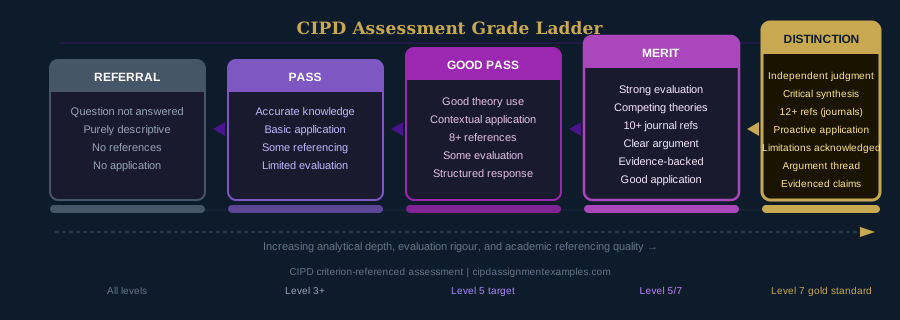
Criterion-Referenced Assessment — The Foundation
Unlike university degrees that use bell-curve norm-referenced marking (where your grade depends partly on how you compare to your cohort), CIPD qualifications are criterion-referenced: your grade is determined entirely by whether your work meets the published assessment criteria, independent of what other students submit. This is important for two reasons. First, it means that every student in a cohort can in principle achieve distinction — there is no fixed quota. Second, it means that understanding the criteria precisely is genuinely lever-able: the student who knows what assessors are looking for has a structural advantage over the student who simply works hard without understanding the evaluation framework.
Each CIPD unit is divided into Assessment Criteria (ACs) — specific questions or tasks that correspond to numbered learning outcomes. For example, 5CO02 AC 1.1 might ask: "Explain what is meant by organisational culture and its significance to people practice." Your response to that AC is marked against the unit's assessment criteria on a grade scale that typically runs: Referral — Pass — Good Pass — Merit — Distinction. The overall unit grade is derived from your performance across all ACs. To achieve a distinction overall, you typically need distinction or merit grades on the majority of ACs.
CIPD assessors — whether internal markers at your study centre or CIPD external moderators — use a marking guide that identifies the specific knowledge, analysis, and application expected at each grade level for each AC. They are not impressed by length, confident tone, or general HR knowledge — they are checking whether your response demonstrates the specific competencies the AC is designed to assess. Writing a beautifully structured five-paragraph answer to the wrong question will earn you a referral regardless of its quality.
The Four Assessment Dimensions
Across all CIPD levels, four core dimensions underpin the assessment of most assignment tasks. Understanding each one — and recognising where your current responses are strong or weak — is the key to targeted improvement.
| Dimension | What it means | Common weakness |
|---|---|---|
| Knowledge & Understanding | Accurate recall and clear explanation of theory, models, legislation, and concepts. At Level 3, description is sufficient. At Level 5+, knowledge must be precise enough to apply and evaluate. | Vague or inaccurate definitions; confusing similar concepts (e.g. unfair vs wrongful dismissal); relying on incomplete recall rather than checking sources. |
| Analysis & Evaluation | Comparing theories, critiquing models, weighing evidence, reaching supported conclusions. This dimension separates pass from distinction at Level 5+. | Purely descriptive writing — summarising what theories say without asking whether they are well-evidenced, what their limitations are, or how they compare to alternatives. |
| Application | Using theory and legislation to analyse a real or realistic organisational scenario. Theory that floats free of context scores lower than theory grounded in specific organisational evidence. | Generic statements that could apply to any organisation; failure to engage with the specific scenario provided; applying models mechanically without considering contextual fit. |
| Structure & Presentation | Logical flow, clear headings, precise word count management, accurate Harvard referencing, and professional register. | Going significantly over the word count; inconsistent or missing Harvard referencing; report structure that makes it hard to follow the argument; informal tone. |
The relative weight of these dimensions shifts as you move up the qualification levels. At Level 3, Knowledge and Application carry the most weight. At Level 5, Analysis and Evaluation becomes critically important — descriptive responses, however accurate, will not achieve merit or distinction. At Level 7, all four dimensions are assessed at post-graduate standard, and the Integration dimension (drawing intelligently on multiple theoretical frameworks simultaneously) becomes an additional marker of distinction.
Level 3 — Foundation Certificate Standard
The CIPD Level 3 Foundation Certificate in People Practice is assessed at RQF Level 3 — broadly equivalent to A-level standard. The primary expectation is accurate description and basic application: can you correctly explain what the relevant concepts mean, and can you give examples of how they appear in practice? Critical evaluation of competing theoretical frameworks is not expected at this level; assessors are checking whether you have understood and absorbed the core content.
Typical task lengths at Level 3 are 1,000–2,000 words per task, though individual ACs may be shorter. CIPD factsheets, the core textbook for your study centre, and the CIPD's own knowledge hub provide sufficient source material. Academic referencing is not required at Level 3 — but including references (even informal citations) demonstrates engagement with the material and is good practice for the habits you will need at Level 5 and 7. The most common Level 3 failure mode is vagueness: responses that correctly identify the topic area but do not provide enough specific detail. For example, an AC asking "Describe three forms of employee voice" requires you to accurately name and distinguish direct voice (team meetings, one-to-ones), representative voice (trade union recognition, collective bargaining, works councils), and delegation voice (suggestion schemes, employee forums) — not simply note that "organisations use voice mechanisms such as meetings."
At Level 3, the practical scenarios used in assignments are usually simple and accessible — a small retail business, a hospitality organisation, or a fictional case study provided by the study centre. Your application does not need to be sophisticated, but it does need to connect the theory to the scenario: name the specific organisation and explain how the concept manifests in that context, not just in organisations generally.
Level 5 — Associate Diploma Standard
The CIPD Level 5 Associate Diploma in People Management is assessed at RQF Level 5 — equivalent to the second year of a UK degree. The shift from Level 3 to Level 5 is qualitative, not just quantitative: Level 5 requires analysis and evaluation, not just description. You are expected to demonstrate that you understand not just what theories and models say, but how well-evidenced they are, how they compare to alternatives, and what their limitations are. This is the level at which most students who struggle with CIPD assessment encounter the core challenge — moving from "here is what the theory says" to "here is an evaluation of whether the theory is convincingly supported, what its alternatives are, and what the implications are for the organisation."
Typical task lengths are 2,500–4,000 words. Academic referencing is expected — assessors expect 8–12 references per task, drawn from a range of academic journals, textbooks, CIPD research, and legislation. Peer-reviewed journal articles score highest; textbooks are valued; CIPD factsheets are appropriate for factual content but should not be the primary basis of academic argument. Real-world organisational context is required: generic, decontextualised responses that discuss theory in the abstract without anchoring it in a specific organisational setting will not achieve merit or distinction.
A Level 5 example: an AC asking "Assess the impact of different types of employment contracts on employers and employees." A pass response correctly identifies zero-hours contracts, fixed-term contracts, and permanent employment, and makes accurate statements about each. A distinction response: identifies the contract types with precision; applies the psychological contract framework (Rousseau, 1989) and the employment relationship literature (Blyton and Turnbull, 2004) to analyse the differential impact on employee commitment and wellbeing; evaluates the empirical evidence on the relationship between zero-hours contracts and insecurity outcomes (Office for National Statistics data, CIPD Good Work Index); applies Equality Act 2010 and Employment Rights Act 1996 provisions where relevant; and draws a supported conclusion about the strategic trade-offs for employers between labour flexibility and employment relations quality.
Level 7 — Advanced Diploma Standard
The CIPD Level 7 Advanced Diploma in Strategic People Management is assessed at RQF Level 7 — post-graduate Masters level. The expectation is critical evaluation, theoretical synthesis, and demonstrated independent academic judgment. At Level 7, it is not sufficient to evaluate individual theories; assessors expect you to synthesise across multiple theoretical frameworks simultaneously and to identify the meta-theoretical assumptions that different frameworks share or contest. This is genuinely difficult and requires consistent engagement with academic literature throughout the programme, not a pre-assessment cramming strategy.
Typical task lengths are 3,000–5,000 words per AC in some units, with overall assessments running to 8,000–15,000 words. Reference expectations are 12–20 per task, with a strong weighting toward peer-reviewed journal articles. CIPD factsheets are appropriate for policy and regulatory facts but should not anchor theoretical arguments. People analytics and data literacy are explicitly assessed in several Level 7 units — students are expected to evaluate quantitative evidence, interpret organisational data, and situate data within a broader analytical argument rather than simply citing statistics as facts.
A Level 7 example: an AC asking "Evaluate the theoretical frameworks that explain organisational approaches to reward." A pass response accurately describes expectancy theory (Vroom, 1964), equity theory (Adams, 1965), and self-determination theory (Deci and Ryan, 2000). A distinction response: not only describes these frameworks but systematically evaluates their empirical evidence base (what does the meta-analytic literature on pay-for-performance say about whether expectancy theory predictions hold in practice?); identifies their theoretical limitations (expectancy theory assumes rational information processing — what happens when employees cannot accurately assess the P→O linkage?); compares their prescriptions and identifies where they conflict (intrinsic motivation crowding out from contingent reward, as per Deci, Koestner and Ryan, 1999); applies total reward theory (WorldatWork, CIPD) as an integrating framework; and develops a theoretically grounded strategic recommendation that explicitly acknowledges the constraints of the specific organisational context. The distinction response demonstrates that you can simultaneously hold multiple theoretical lenses, evaluate their relative strengths, and synthesise a position that is informed by evidence rather than simply reporting what theories say.
What 'Critical Evaluation' Actually Means
Critical evaluation is probably the most misunderstood concept in CIPD assessment. Many students interpret it as finding fault — noting that a theory or approach has "limitations." This interpretation is correct but insufficient. Genuine critical evaluation has four components that work together to demonstrate academic judgment.
First, acknowledging limitations: every theory has boundary conditions, empirical weaknesses, and contexts in which it performs poorly. Stating these limitations with specificity — not just "Maslow's hierarchy has been criticised" but "Maslow's hierarchy lacks empirical validation; Wahba and Bridwell's (1976) meta-analysis found no consistent support for the progression hypothesis" — demonstrates academic depth. Second, comparing competing frameworks: evaluation requires comparison. If you are evaluating motivation theories, you cannot evaluate Maslow without considering how Herzberg's two-factor theory, Adams' equity theory, or Deci and Ryan's SDT address the same phenomena. The comparison — which framework explains more of the observed variance in motivation outcomes? — is the heart of evaluation. Third, supporting positions with evidence: evaluative claims are only as strong as the evidence that supports them. "Organisations that invest in L&D achieve higher performance" is an assertion; "A systematic review by Tharenou, Saks and Moore (2007) found a positive but modest relationship between training investment and organisational performance, with significant moderation effects of training design and transfer climate" is an evidenced claim. Fourth, the 'so what' test: every theoretical claim should connect to a practical implication. If expectancy theory predicts that reward contingency drives motivation, the so what is: what does this mean for your pay structure design, and what are the risks if the P→O linkage is unclear to employees?
The distinguishing feature of distinction-level critical evaluation is not just that all four components are present — it is that they are integrated into a coherent argument thread. The student does not tack a criticism paragraph onto the end of a description; they weave evaluation into the analytical fabric of the entire response, so that the argument develops through the process of evaluation rather than presenting evaluation as a separate activity.
Academic Referencing Standards for CIPD
CIPD qualifications use Harvard referencing — the author-date in-text citation system (Smith, 2022) with a full reference list at the end. The hierarchy of source types, from most to least academically valued, is: peer-reviewed journal articles; textbooks; CIPD and government research reports; CIPD factsheets; reputable organisational research (ONS, ACAS, CBI); and websites. At Level 5 and above, assessors expect your primary theoretical arguments to be grounded in journal articles rather than textbooks or websites.
Key journals for CIPD study include: the International Journal of Human Resource Management (IJHRM); the British Journal of Management; the Human Resource Management Review; the Journal of Applied Psychology; the British Journal of Industrial Relations; and Work, Employment and Society. Google Scholar provides free access to many articles, and your study centre's library resources will provide access to databases such as Business Source Complete or ProQuest.
Paraphrasing is strongly preferred over direct quotation at Level 5 and above. A response that consists of a sequence of quotations from different sources demonstrates the ability to find sources but not the ability to synthesise and apply them. Paraphrase with in-text citation shows that you have understood the source well enough to express it in your own words. Direct quotation should be reserved for definitional precision — when the exact phrasing of a statutory provision or a specific definition matters — or when the original formulation is so precisely expressed that paraphrase would lose meaning.
Reference list formatting in Harvard: journal article — Author(s), Year. Title of article. Journal Name, Volume(Issue), pp. Page–Page. Book — Author(s), Year. Title of Book. Edition. Place: Publisher. CIPD factsheet — CIPD, Year. Title of Factsheet [online]. London: CIPD. Available at: URL [Accessed date]. Get the format precisely right — careless referencing signals to assessors that your engagement with academic literature is superficial.
Common Reasons for Referral
Understanding why CIPD assignments are referred is as valuable as understanding what distinction looks like. The most frequent referral reasons, in approximate order of prevalence, are as follows. First, the task question has not been answered: the student has written a competent general response to the topic area but has not addressed the specific AC wording. This is the single most dangerous trap — reading the AC question carefully and structuring every paragraph as a direct response to that specific question is non-negotiable. Second, purely descriptive writing: the student has accurately summarised theories but has not analysed, evaluated, or compared them. If every sentence in your response reads "Author X says Y," you are describing, not evaluating. Third, insufficient referencing: relying primarily on CIPD factsheets and websites rather than academic journals at Level 5+, or submitting with fewer than 5 references at Level 5 (where 8–12 is expected).
Fourth, over-word-count: CIPD assessors have the discretion to stop reading at the word limit plus a reasonable tolerance (typically 10%). Responses significantly over the limit will have content ignored; responses moderately over may be penalised on the Presentation dimension. Word count discipline is a skill that assessors specifically value. Fifth, no real-world application: theoretical discussion with no connection to an organisational scenario or context scores lower than theory grounded in specific evidence. Sixth, citing theory without evidence: stating that "equity theory suggests employees who perceive unfairness will reduce effort" without providing any empirical support for this claim is a mid-range response. Adding "a meta-analysis by Cohen-Charash and Spector (2001) confirmed a significant negative correlation between distributive injustice perceptions and task performance across 179 studies" is the evidenced version that earns higher marks.
What Distinction-Level Work Looks Like
The hallmarks of a distinction response across all CIPD levels are: a clear argument thread that runs through the entire response, so that reading from beginning to end feels like following a developing analytical case rather than a series of separate points; independent academic judgment — the student's own evaluative voice is clearly present, not just a parade of sources; proactive application — the student applies theory to contexts beyond those specified in the task question, demonstrating genuine understanding rather than mechanical recall; impeccable referencing with a well-chosen range of sources that includes recent academic research; explicit acknowledgment of the limitations of the theories and frameworks used; and synthesis across multiple sources that produces insights that no single source contains alone.
Distinction work does not need to be longer than merit work — indeed, some of the best CIPD responses are shorter than average because every sentence is contributing something specific to the argument. The ability to be precise, selective, and concise — to say exactly what needs to be said and no more — is itself a marker of high-level academic competence. Students who write at great length in the hope that more words will compensate for unclear analysis typically achieve pass or good pass, not distinction.
Using This in Your CIPD Assignment
The assessment criteria guidance on this page applies across all CIPD units. For worked examples of what distinction-level responses look like in specific units, see our full assignment example pages: Level 7 examples at CIPD Level 7 Assignment Examples and Level 5 examples at CIPD Level 5 Assignment Examples. If your programme includes 7CO04 (Business Research in People Practice), understanding the criterion-referenced assessment philosophy is directly relevant — see our full example at 7CO04 Assignment Example. The qualification levels page at CIPD Qualification Levels Explained provides the broader context for how these standards relate to each other.
Related CIPD Resources
- CIPD Qualification Levels Explained — Level 3, 5 and 7
- CIPD Level 7 Assignment Examples — All Units
- CIPD Level 5 Assignment Examples — All Units
- CIPD Level 3 Assignment Examples — All Units
- 7CO04 Business Research in People Practice Assignment Example
- How to Write a CIPD Assignment — Step-by-Step Guide
- What is CIPD? — Qualifications, Membership and Careers